
You’ve invested in social media, run ads, maybe even hired a marketing team. Yet leads remain inconsistent, sales conversations feel random, and revenue stays unpredictable. The problem isn’t your effort or budget. It’s the lack of a systematic approach connecting marketing attention to qualified sales conversations. A Growth Engine solves this by automating lead capture, qualification, and conversion into a single predictable system. This guide explains what a Growth Engine is, how AI and automation power it, the essential components you need, and proven results small businesses achieve when they stop improvising and start systematizing their growth.
Table of Contents
- Understanding The Growth Engine: What It Is And Why It Matters
- How AI And Automation Fuel Modern Growth Engines
- Key Components: Building A Complete Growth Engine System
- Applying Growth Engines: Benefits And Proven Results For Small Businesses
- Explore Marketing Solutions To Build Your Growth Engine
- Frequently Asked Questions
Key takeaways
| Point | Details |
|---|---|
| Growth Engine definition | A fully built acquisition and sales system that converts attention into qualified conversations and revenue through structured automation. |
| AI-powered efficiency | Automation reduces prospecting time by up to 80% while personalizing outreach to increase email response rates significantly. |
| Qualification funnels | Pre-qualify leads through structured steps before sales engagement, ensuring your team focuses only on high-intent prospects. |
| Predictable revenue | Replaces inconsistent lead flow with systematic processes that deliver measurable, repeatable sales growth month over month. |
Understanding the growth engine: What it is and why it matters
Most small businesses approach marketing like throwing darts in the dark. You create content, run campaigns, and hope something sticks. When a lead appears, you scramble to respond. When the phone goes quiet, you panic and start over. This reactive cycle drains resources and limits growth because it lacks intentional structure.
A Growth Engine is a fully built acquisition and sales system designed specifically for a business. Unlike scattered marketing tactics, it connects every touchpoint with clear intent. Content attracts attention. Outbound campaigns engage prospects. Conversations qualify interest. Follow-up systems nurture relationships. Each piece works together to move people from awareness to purchase systematically.
The core purpose is simple but powerful: convert attention into qualified conversations, then conversations into revenue. Traditional marketing stops at generating awareness or clicks. A Growth Engine goes further by automating the qualification process, ensuring only serious prospects reach your sales team. This shift from volume to quality transforms how businesses grow.
Without this system, business owners face constant strain. You’re manually chasing every inquiry, guessing which leads matter, and losing deals because follow-up falls through cracks. Your team wastes time on unqualified prospects while real opportunities go cold. Revenue becomes a gamble instead of a forecast.
Intent-connected systems change this dynamic entirely. By mapping content and outreach to specific buyer stages, you guide prospects through qualification automatically. Someone downloads a guide, receives targeted emails, books a consultation, and arrives pre-educated about your solution. Your sales team enters conversations knowing the prospect’s challenges, budget readiness, and decision timeline. This is how inbound marketing advantages compound over time.
“A Growth Engine eliminates the guesswork by creating predictable pathways from first contact to closed deal, allowing business owners to focus on delivery instead of constant prospecting.”
Key elements that distinguish Growth Engines from traditional marketing include:
- Automation that runs 24/7 without manual intervention
- Multi-channel coordination across email, ads, content, and outbound
- Built-in qualification criteria that filter leads before human contact
- Data tracking that reveals what’s working and what needs adjustment
- Scalability that grows revenue without proportionally growing your team
When you replace improvisation with infrastructure, growth becomes predictable. You know how many leads enter the system, what percentage qualify, and how many convert. This visibility lets you forecast revenue, allocate resources intelligently, and scale confidently.
How AI and automation fuel modern growth engines
Human sales teams have limits. They can only contact so many prospects, personalize so many messages, and follow up so many times before burnout sets in. AI-powered automation removes these constraints by handling repetitive tasks at scale while maintaining personalization that drives engagement.
Artificial intelligence analyzes prospect data to craft outreach that feels custom-written. Instead of generic blast emails, AI identifies specific pain points based on industry, company size, or recent activity, then tailors messaging accordingly. This personalization increases email open rates by 26% and response rates even higher because recipients feel understood rather than spammed.
Multi-channel lead generation expands beyond what internal teams can manage alone. A Growth Engine simultaneously runs LinkedIn outreach, email sequences, retargeting ads, and content campaigns. Each channel reinforces the others, creating multiple touchpoints that build familiarity and trust. Prospects might see your ad, visit your site, receive a helpful email, and then engage on social media, all orchestrated automatically.
Consider AI-driven prospecting in practice. Traditional methods require sales reps to manually research companies, find decision-makers, and guess at pain points. AI tools scan thousands of businesses instantly, identifying those matching your ideal customer profile based on industry signals, growth indicators, or technology usage. What took a rep hours now happens in seconds with greater accuracy.

Automation slashes prospecting time dramatically. Businesses using AI prospecting tools report reducing time spent by 80% while increasing qualified lead volume. Your team stops wasting hours on research and cold calling, instead focusing energy on high-value conversations with pre-qualified prospects ready to buy.
Implementing AI effectively requires clear strategy:
- Define your ideal customer profile with specific, measurable criteria like revenue size, employee count, or technology stack.
- Select AI tools that integrate with your existing CRM and communication platforms to avoid data silos.
- Create messaging frameworks AI can personalize rather than fully automated generic templates.
- Monitor performance metrics weekly to identify what resonates and adjust targeting accordingly.
- Train your sales team to handle AI-qualified leads differently than cold prospects, focusing on solution fit rather than discovery.
Pro Tip: Start with one channel and perfect the AI-driven process before expanding. Mastering automated email sequences delivers better results than poorly executing across five channels simultaneously.
The email marketing engagement gains from AI personalization compound over time. As the system learns which messages generate responses, it optimizes future outreach automatically. Your campaigns get smarter with each interaction, continually improving conversion rates without additional manual effort.
AI doesn’t replace human salespeople. It amplifies their effectiveness by handling grunt work and delivering qualified opportunities. Your team spends time building relationships and closing deals instead of chasing dead ends. This shift transforms sales from a numbers game into a strategic function focused on value creation.
Key components: Building a complete growth engine system
A Growth Engine isn’t a single tool or tactic. It’s an integrated infrastructure with specific components working together. Understanding these elements helps you evaluate what you need and where to invest resources for maximum impact.
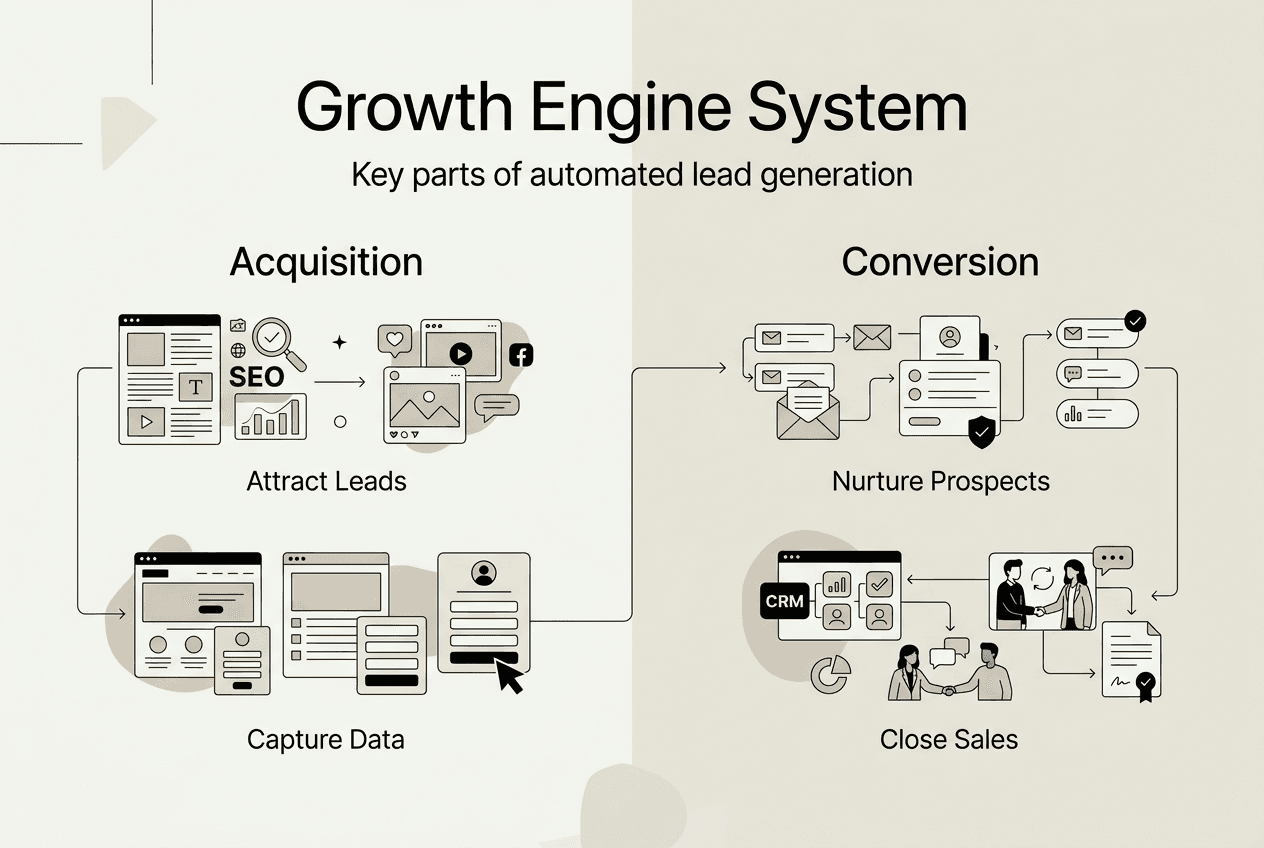
Custom CRM infrastructure forms the foundation. Unlike generic CRMs configured for broad use cases, Growth Engine CRMs are tailored to your sales process, industry terminology, and qualification criteria. This customization ensures data flows logically, reports reveal actionable insights, and your team actually uses the system instead of fighting it.
The qualification funnel represents the heart of the system. Most businesses treat every inquiry equally, wasting time on tire kickers while missing serious buyers. A structured four-step funnel pre-qualifies leads before sales engagement:
- Awareness capture: Prospect enters system through content download, ad click, or outbound response.
- Interest validation: Automated sequence delivers value while gauging engagement through email opens, link clicks, and replies.
- Fit assessment: Survey or chatbot asks qualifying questions about budget, timeline, and decision authority.
- Sales handoff: Only prospects meeting all criteria reach human salespeople, arriving with context and demonstrated intent.
This approach contrasts sharply with manual lead handling:
| Manual Lead Handling | Growth Engine Automation |
|---|---|
| Sales team contacts every inquiry | System filters leads before human contact |
| Reps spend time qualifying basics | Prospects self-qualify through engagement |
| Inconsistent follow-up causes lost deals | Automated sequences ensure no lead falls through |
| No visibility into pipeline health | Real-time dashboards show conversion at each stage |
| Revenue depends on rep activity levels | System generates qualified opportunities continuously |
Conversation tracking and performance monitoring close the loop. Growth Engines record sales calls, track email exchanges, and measure conversion rates at every funnel stage. This data reveals bottlenecks immediately. If prospects drop off after the fit assessment, your qualifying questions might be too aggressive. If sales calls aren’t converting, the handoff might lack sufficient context.
Integrated components of a complete system include:
- Lead capture tools like landing pages, forms, and chatbots
- Email automation platform for nurture sequences and follow-up
- Outbound prospecting tools for LinkedIn and cold email campaigns
- Scheduling software that lets qualified leads book consultations instantly
- Analytics dashboard showing funnel performance and ROI metrics
- Sales enablement resources like case studies and proposal templates
Pro Tip: Review funnel performance monthly, not quarterly. Waiting three months to identify a broken qualification step costs dozens of lost opportunities. Weekly monitoring lets you spot trends early and adjust before significant revenue impact.
The digital marketing workflow integration ensures marketing and sales operate as one system rather than separate departments. Marketing doesn’t just generate leads and throw them over the wall. The Growth Engine tracks which marketing sources produce the best customers, feeding this intelligence back to optimize targeting and messaging continuously.
Building this infrastructure requires upfront investment but pays dividends through efficiency gains. One sales rep supported by a Growth Engine can handle the volume of three reps using manual processes. The system works 24/7, qualifying leads while you sleep and ensuring your team starts each day with a pipeline of ready-to-close opportunities.
Applying growth engines: Benefits and proven results for small businesses
Theory matters less than results. Small businesses adopting Growth Engines report measurable improvements in lead quality, sales efficiency, and revenue predictability that justify the investment many times over.
Client results demonstrate dramatic growth in qualified opportunities. Businesses that previously struggled to generate 20 monthly inquiries now receive 40+ qualified consultations. The difference isn’t just volume but quality. These aren’t random website visitors or curious browsers. They’re pre-qualified prospects who understand the solution, have budget allocated, and are ready to make decisions.
Predictable revenue replaces the feast-or-famine cycle that plagues most small businesses. When you know your funnel converts 30% of qualified leads and your system generates 50 qualified leads monthly, you can forecast 15 new customers with confidence. This predictability enables smarter hiring, inventory planning, and growth investments because revenue becomes reliable rather than random.
Kalista Digital provides a concrete example. Before implementing a Growth Engine, their team spent 20+ hours weekly on manual prospecting with inconsistent results. After deployment, prospecting time dropped to 4 hours while response rates increased 35%. The system identified better-fit prospects faster, personalized outreach at scale, and automated follow-up that previously fell through cracks. Their sales team shifted from hunting for opportunities to managing inbound qualified interest.
Small businesses can start adopting Growth Engine principles without massive budgets. Begin by mapping your current customer journey from first contact to purchase. Identify manual bottlenecks where leads get stuck or lost. Implement automation for the biggest pain point first, whether that’s lead capture, qualification, or follow-up. Measure results, refine the process, then expand to the next bottleneck.
Documented benefits include:
- Lead quality improves as qualification filters remove poor-fit prospects early
- Sales team focuses on closing rather than prospecting and chasing unqualified leads
- Time savings from automation redeploy to strategic activities like partnership development
- Revenue growth accelerates without proportional increases in marketing or sales headcount
- Customer acquisition cost decreases as conversion rates improve throughout the funnel
“The shift from reactive lead chasing to systematic qualification transformed our business. We closed more deals with less stress because every conversation started with a qualified, educated prospect.”
Measuring Growth Engine performance requires tracking specific metrics:
| Metric | Before Growth Engine | After Growth Engine |
|---|---|---|
| Monthly qualified leads | 15-25 (inconsistent) | 40-50 (predictable) |
| Sales team prospecting hours | 80 hours/month | 15 hours/month |
| Lead-to-customer conversion | 12% | 28% |
| Average sales cycle length | 45 days | 30 days |
| Customer acquisition cost | $850 | $420 |
The performance marketing explained approach aligns perfectly with Growth Engines because both emphasize measurable outcomes over vanity metrics. You’re not celebrating website traffic or email open rates. You’re tracking qualified conversations and closed revenue, the metrics that actually matter for business growth.
Implementing funnel marketing strategies within a Growth Engine framework maximizes conversion at every stage. Each funnel step has clear success criteria and automated nurture designed to move prospects forward. Drop-offs trigger alternative sequences or re-engagement campaigns rather than letting opportunities disappear.
The compounding effect makes Growth Engines increasingly valuable over time. As the system gathers data about what works, it optimizes automatically. Your cost per qualified lead decreases while conversion rates increase. Marketing and sales alignment improves because both teams work from shared data and common goals. The infrastructure you build today generates returns for years as it scales with your business.
Explore marketing solutions to build your growth engine
Building a Growth Engine requires expertise in automation, funnel design, and conversion optimization. Lind Creative specializes in creating digital marketing workflows that turn attention into revenue systematically. Whether you need help designing qualification funnels, building high-converting landing pages, or integrating automation tools, professional guidance accelerates results and avoids costly mistakes.
Our approach combines strategic planning with technical execution. We help you define your ideal customer profile, map the buyer journey, and implement automation that nurtures prospects from awareness to purchase. From creating service landing pages that convert visitors into qualified leads to investing in website design that supports your entire Growth Engine, we build infrastructure that performs. Explore our resources to discover how systematic marketing automation can transform your business growth from unpredictable to inevitable.
Frequently asked questions
What common challenges does a growth engine solve?
Growth Engines address inconsistent lead flow by automating capture and qualification so opportunities arrive predictably rather than sporadically. They eliminate wasted time on manual prospecting by using AI to identify and engage ideal prospects at scale. Poor lead qualification disappears because structured funnels filter prospects before sales contact, ensuring your team focuses only on high-intent buyers ready for conversations.
How does AI improve the efficiency of a growth engine?
AI personalizes outreach by analyzing prospect data and tailoring messages to specific pain points, increasing email open rates by 26% and response rates even higher. It speeds prospecting by scanning thousands of potential customers instantly and identifying those matching your ideal profile based on industry signals, growth indicators, and technology usage. This automation reduces manual research time by up to 80% while improving lead quality simultaneously.
What are the key steps to implement a growth engine in my business?
Start by defining your target audience with specific criteria like industry, company size, budget range, and decision-maker roles. Next, integrate or build a CRM customized to your sales process with automation tools for email sequences, lead scoring, and follow-up. Then set up qualification funnels with clear stages that pre-filter leads through engagement tracking, survey questions, and behavioral signals before sales handoff. Monitor performance weekly and refine based on conversion data at each funnel stage.
Can growth engines guarantee sales growth?
Growth Engines increase predictability and improve conversion rates significantly, but they don’t guarantee overnight success or eliminate the need for good products and sales skills. Success depends on clear strategy, proper implementation, and consistent management of the system. Businesses that define their ideal customers accurately, create valuable content, and optimize based on data typically see qualified lead increases of 50% to 100% within six months, translating to measurable revenue growth when sales processes are sound.
How long does it take to see results from a growth engine?
Initial lead flow improvements often appear within 30 to 45 days as automation begins capturing and qualifying prospects systematically. Meaningful revenue impact typically becomes visible at the 90-day mark once enough leads have moved through the full funnel and conversion data validates the system. Full optimization and maximum efficiency usually require six months as you refine targeting, messaging, and qualification criteria based on real performance data. The timeline accelerates when you start with clear ideal customer profiles and strong foundational marketing assets.
Recommended
- Growth Marketing for eCommerce – Driving Scalable ROI – Lind Creative
- Build a High-Converting Digital Marketing Workflow – Lind Creative
- Build a Results-Driven Digital Marketing Strategy 2025 – Lind Creative
- What is funnel marketing: boost lead conversion in 2026 – Lind Creative
- Client Génie – Trouve et contacte tes clients facilement