
Many marketers mistakenly believe performance marketing is just affiliate programs. In reality, affiliate marketing is only one subset within a much broader strategy. Performance marketing encompasses any digital campaign where you pay only for measurable results like clicks, leads, or sales. This guide clarifies what performance marketing truly is, explores its payment models and channels, addresses common misconceptions, and shows how luxury hospitality and eCommerce businesses can drive measurable ROI through data-driven campaigns.
Table of Contents
- Introduction To Performance Marketing
- How Performance Marketing Differs From Traditional Brand Marketing
- Channels And Types Of Performance Marketing
- Common Misconceptions About Performance Marketing
- Leveraging Data, Analytics, And Automation For Roi Optimization
- Implementing Performance Marketing In Luxury Hospitality And Ecommerce
- Future Trends And Challenges In Performance Marketing
- Summary And Next Steps For Marketing Managers
- Ready To Elevate Your Performance Marketing Strategy?
Key Takeaways
| Point | Details |
|---|---|
| Pay-for-results model | Costs tied directly to measurable actions like clicks, leads, or sales. |
| Distinct from brand marketing | Focuses on short-term measurable outcomes rather than long-term brand equity. |
| Multi-channel approach | Combines PPC, social ads, affiliate programs, and native advertising for maximum ROI. |
| Data-driven optimization | Real-time tracking and automation enable continuous campaign improvement. |
| Privacy-first future | First-party data collection and explicit consent models replace third-party cookies. |
Introduction to Performance Marketing
Performance marketing is a results-driven strategy with pay-for-results models that ensures your ad spend aligns directly with business outcomes. You pay only when a specific action occurs.
This approach evolved alongside digital advertising’s growth. As tracking technology improved, marketers demanded more accountability. Traditional advertising charged for exposure. Performance marketing charges for actual user engagement.
Four core payment models dominate the landscape:
- Cost-per-click (CPC): Pay when users click your ad, ideal for driving website traffic
- Cost-per-acquisition (CPA): Pay when users complete a purchase or sign a contract
- Cost-per-lead (CPL): Pay when users submit contact information or request a quote
- Pay-per-action (PPA): Pay for any predefined action like app downloads or form submissions
Payment models include CPC, CPA, CPL, and PPA, linking costs directly to user actions. This transparency makes budget allocation more predictable.
The efficiency of this approach explains why 70% of marketers are increasing their performance marketing budgets in 2024. Every dollar spent connects to a measurable outcome. No guesswork about whether your ads are working.
“Performance marketing transforms advertising from a cost center into a profit engine by tying every expense to tangible business results.”
For marketing managers in luxury hospitality and eCommerce, this model offers unprecedented control. You can test small budgets, measure results precisely, and scale only what works. The performance marketing foundational guide provides deeper technical insights into implementation strategies.
How Performance Marketing Differs from Traditional Brand Marketing
Performance marketing targets immediate, measurable actions. Brand marketing builds long-term recognition and emotional connections. Both serve important roles, but their objectives, metrics, and spending patterns differ significantly.
Performance campaigns prioritize conversions right now. Brand campaigns invest in awareness that pays off over months or years. Your performance marketing might drive this quarter’s revenue. Your brand marketing makes next year’s sales easier.
The metrics tell the story clearly:
| Aspect | Performance Marketing | Brand Marketing |
|---|---|---|
| Primary Goal | Drive immediate conversions | Build long-term brand equity |
| Key Metrics | CPA, ROAS, conversion rate | Brand awareness, impressions, sentiment |
| Payment Model | Pay per result | Pay per exposure |
| Time Horizon | Short-term campaigns | Long-term investment |
| Budget Trend | Growing 11.3% CAGR | Stable or declining |
Spend on performance marketing is expected to reach $8.25B in the US by 2024 with 11.3% compound annual growth. This reflects a clear shift toward measurable ROI.
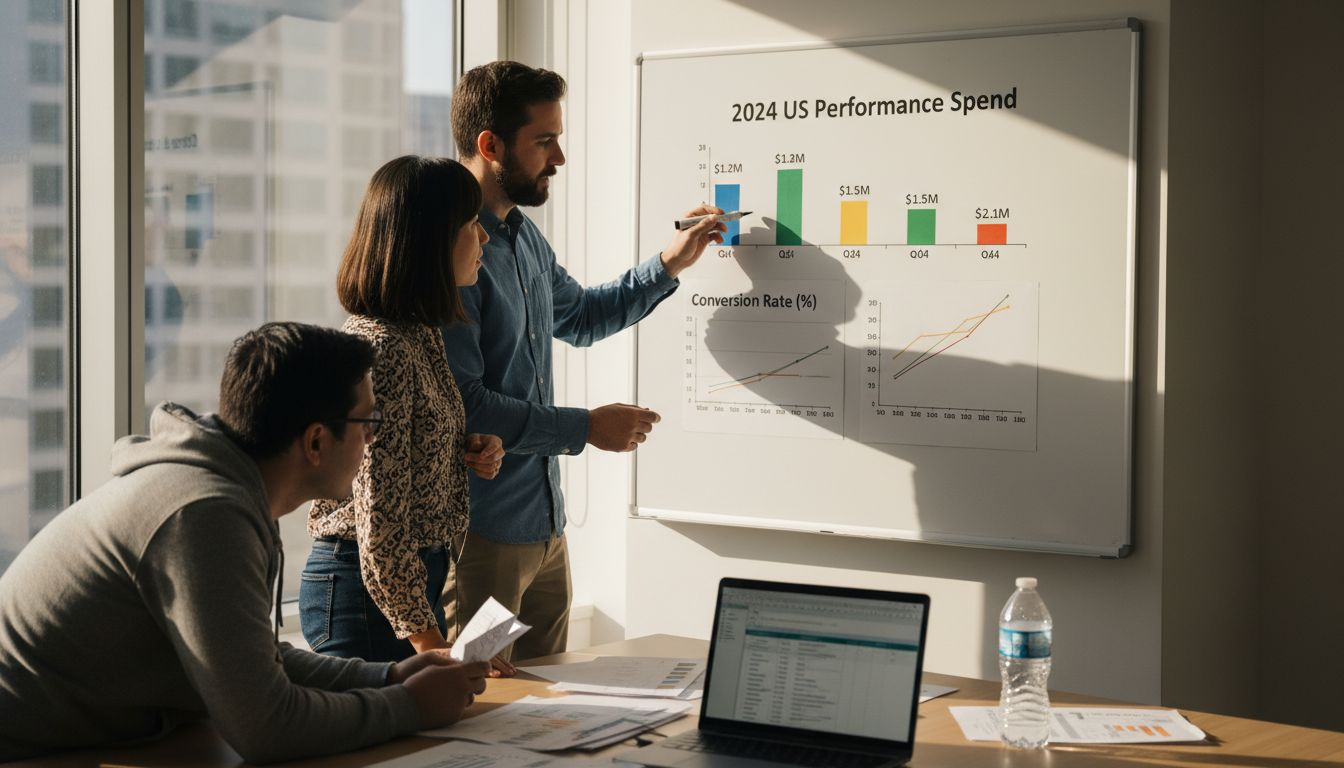
Consider how these strategies work together in luxury hospitality. Your brand marketing establishes your property as elegant and exclusive. Your performance marketing captures guests actively searching for luxury accommodations tonight.
Smart marketers use both approaches strategically. Brand marketing creates the conditions for performance marketing to succeed. Without brand trust, even perfectly optimized ads struggle to convert. The distinction matters for budget allocation and campaign design, not for choosing one over the other. Understanding performance vs brand marketing helps you balance both effectively.
Channels and Types of Performance Marketing
Performance marketing works across multiple digital channels. Each offers unique targeting capabilities and payment structures aligned with measurable outcomes.
Pay-per-click search ads capture users actively searching for your products or services. You bid on keywords and pay only when someone clicks. Google Ads dominates this space. High intent users mean strong conversion rates.
Social media advertising on platforms like Facebook, Instagram, and LinkedIn lets you target by demographics, interests, and behaviors. You can optimize for clicks, conversions, or lead generation. Visual formats work especially well for luxury hospitality and eCommerce products.
Affiliate marketing partners with publishers who promote your offerings. You pay commissions only when they drive sales or qualified leads. This subset of performance marketing leverages other people’s audiences.
Native advertising places your content within editorial feeds. Ads match the look and feel of surrounding content. Users engage more naturally. Programmatic buying automates placement and optimization.
Performance marketing channels include PPC, social media ads, affiliate marketing, and native ads, all paying only for completed actions. This transparency lets you compare channel effectiveness directly.
Channel choice impacts your campaign success dramatically. Search ads work for high-intent keywords. Social ads excel at discovery and remarketing. Affiliates provide credibility through third-party endorsements.
Pro tip: Diversify across at least three channels to avoid over-reliance on any single traffic source. Algorithm changes or policy updates can disrupt single-channel strategies overnight.
Luxury hospitality brands might combine Google search ads for “five-star resort Maldives” with Instagram ads showcasing property visuals and affiliate partnerships with travel bloggers. eCommerce brands layer in shopping ads, Facebook dynamic product ads, and influencer collaborations.
Blending channels creates resilience and reach. Different audiences prefer different platforms. Omnichannel marketing in luxury eCommerce demonstrates how integrated strategies outperform single-channel approaches. The performance marketing channels overview explores technical setup for each platform.
Common Misconceptions About Performance Marketing
Several persistent myths prevent marketers from using performance marketing effectively. Clarifying these misunderstandings improves strategic decisions and campaign outcomes.
-
All digital advertising is performance marketing. Not true. Display ads charged per thousand impressions (CPM) focus on brand awareness, not direct response. Only campaigns where you pay for specific actions like clicks or conversions qualify as performance marketing.
-
Performance marketing excludes brand building. Wrong. Performance campaigns can build brand recognition while driving conversions. Retargeting ads remind users of your brand repeatedly. Creative messaging in performance ads shapes brand perception. These approaches complement rather than conflict.
-
ROI is guaranteed and immediate. Unrealistic. Performance marketing provides measurable results, but success requires ongoing optimization. Poor targeting, weak creative, or misaligned offers waste budget even with pay-per-result models. Testing and iteration determine ultimate ROI.
-
Performance marketing equals affiliate marketing. This is the most common confusion. Affiliate marketing is just one subset of performance marketing, often mistakenly viewed as the whole. PPC search ads, social media campaigns, and programmatic display all count as performance marketing without involving affiliates.
These misconceptions lead to unrealistic expectations or missed opportunities. Some marketers avoid performance marketing thinking it ignores brand equity. Others dive in expecting instant profits without proper campaign management.
Understanding what performance marketing actually is helps you set appropriate goals, allocate budgets wisely, and integrate it properly with other marketing efforts. The common misconceptions about performance marketing resource addresses additional myths in detail.
Leveraging Data, Analytics, and Automation for ROI Optimization
Real-time tracking and data analysis separate good performance marketing from great performance marketing. Every click, conversion, and dollar spent generates data you can use to improve results.
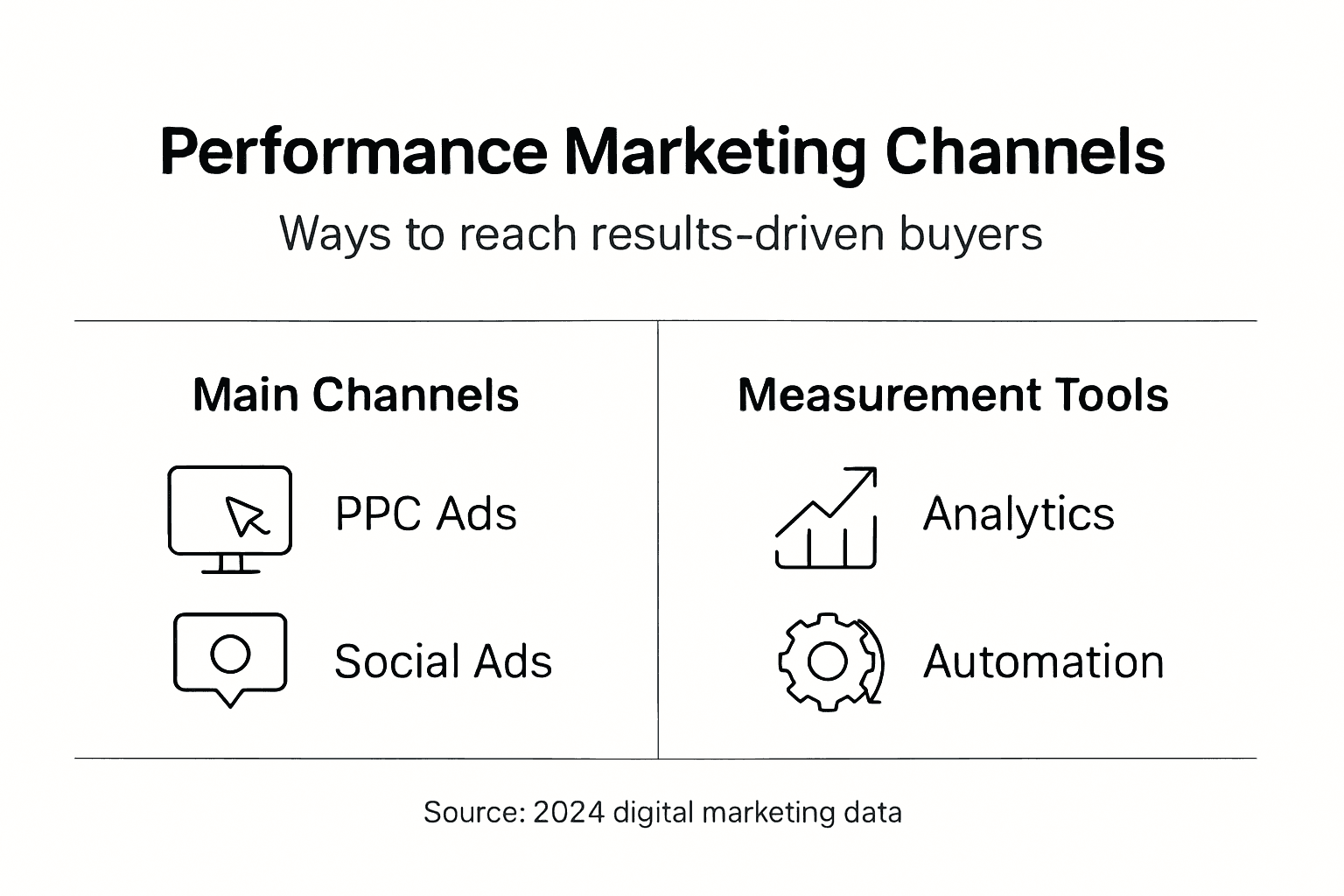
Modern analytics platforms track the entire customer journey. You see which keywords drive traffic, which ad creative converts best, and which audience segments provide the highest lifetime value. This visibility enables precise budget allocation.
Key performance indicators guide optimization decisions:
- Cost per acquisition (CPA): How much you pay to acquire one customer
- Return on ad spend (ROAS): Revenue generated per dollar spent on ads
- Conversion rate: Percentage of visitors who complete desired actions
- Customer lifetime value (CLV): Total revenue a customer generates over time
AI and machine learning now automate many optimization tasks. Platforms dynamically adjust bids, pause underperforming ads, and shift budgets toward high-performing campaigns. Real-time data and automation enable quick adjustments, increasing lead quality and reducing wasted ad spend in luxury hospitality and eCommerce.
This automation explains why 65% of marketers are optimistic about performance marketing due to data and automation advances in 2024. Technology handles routine optimizations while you focus on strategy and creative.
Privacy regulations are reshaping data collection. Third-party cookies are disappearing. Smart marketers now prioritize first-party data collected directly from their audiences through email signups, account registrations, and customer surveys. This owned data provides better targeting while respecting privacy.
Pro tip: Build an omnichannel data lake that combines insights from all marketing channels, website analytics, CRM systems, and sales data. Unified data reveals cross-channel attribution and customer journey patterns that single-platform analytics miss.
For luxury hospitality, this might mean connecting booking engine data with ad platform performance to understand which campaigns drive the most valuable guests. eCommerce brands link product catalog data with ad performance to identify which items generate the best ROAS. Understanding marketing attribution in luxury hospitality helps implement these tracking systems correctly. The performance marketing data analytics and automation guide explores technical implementation details.
Implementing Performance Marketing in Luxury Hospitality and eCommerce
Applying performance marketing successfully requires methodical execution tailored to your sector’s unique customer journey and business model.
Follow this step-by-step approach:
- Define specific goals. Set measurable targets like “reduce CPA by 20%” or “achieve 400% ROAS” rather than vague objectives like “increase sales.”
- Choose channels strategically. Match channels to your audience behavior and campaign goals. Luxury hospitality might prioritize Google search and Instagram. eCommerce might add Facebook shopping ads and affiliate programs.
- Craft compelling creative. Even performance campaigns need engaging visuals and persuasive copy. Test multiple variations to find what resonates.
- Implement comprehensive tracking. Install conversion pixels, configure event tracking, and set up attribution models before launching campaigns.
- Iterate based on data. Review performance daily at first, then weekly. Pause what fails. Scale what succeeds. Test new angles continuously.
Working with 30+ sources increases the likelihood of meeting ROI goals by 90% in these sectors. Diversification protects against platform changes and expands total reach.
Creative excellence combined with precise targeting drives campaign success including offline halo effects. Strong visuals and messaging multiply the impact of good targeting.
Consider sector-specific performance benchmarks:
| Metric | Luxury Hospitality | Luxury eCommerce |
|---|---|---|
| Average CPA | $80 to $150 | $45 to $95 |
| Conversion Rate | 2% to 4% | 2.5% to 5% |
| Target ROAS | 300% to 600% | 400% to 800% |
These benchmarks provide starting points. Your actual performance depends on offer quality, brand strength, and campaign execution.
Luxury hospitality brands should emphasize experience and exclusivity in ad creative. Show property amenities, highlight unique experiences, and target travelers researching luxury destinations. Implement digital marketing for luxury hospitality strategies that align performance campaigns with the guest journey.
eCommerce brands benefit from dynamic product ads that show users exactly what they browsed. Retarget cart abandoners. Test influencer partnerships as a performance channel. Apply omnichannel marketing in luxury eCommerce principles to coordinate messaging across touchpoints.
Both sectors should invest in landing page optimization. Traffic is expensive. Converting more visitors improves every campaign metric. Create personalized user experiences in luxury hospitality that match ad messaging and visitor intent. The performance marketing ROI data report provides additional sector-specific insights.
Future Trends and Challenges in Performance Marketing
The performance marketing landscape continues evolving rapidly. Understanding emerging trends and challenges helps you stay ahead.
AI and machine learning will automate increasingly sophisticated tasks. Platforms already optimize bids and budgets. Soon they’ll generate ad creative variations, predict customer lifetime value, and orchestrate entire campaigns with minimal human intervention. Marketers who embrace these tools gain efficiency advantages.
Privacy regulations fundamentally change data strategies. Growth of AI-driven automation and shift to first-party data models are driven by privacy laws phasing out third-party cookies. Browsers limit tracking. Users demand transparency.
This creates both challenges and opportunities:
- Challenge: Less granular targeting without third-party data
- Opportunity: Stronger customer relationships through direct data collection
- Challenge: More complex compliance requirements across regions
- Opportunity: Competitive advantage for brands that earn customer trust
Contextual targeting is resurging as behavioral tracking declines. Ads placed based on page content rather than user history. This old technique gains new relevance.
63% of marketers support explicit consent regulations to comply with privacy changes. Proactive compliance becomes a competitive advantage. Customers trust brands that respect their privacy.
The skills required for performance marketing are expanding. Marketers now need data analysis expertise, basic understanding of machine learning, privacy law knowledge, and creative skills. The technical demands increase.
Platform consolidation continues. Fewer players control more advertising inventory. Google and Meta dominate. This concentration creates dependency risks but also simplifies campaign management. Exploring future trends in performance marketing helps you prepare for these shifts.
Summary and Next Steps for Marketing Managers
Performance marketing delivers measurable ROI, budget efficiency, and continuous optimization based on real data. You pay only for results that matter to your business.
Key benefits include:
- Direct connection between spending and business outcomes
- Real-time visibility into campaign performance
- Ability to test small and scale what works
- Multi-channel flexibility to reach audiences everywhere
Challenges to manage:
- Increasing complexity requiring specialized skills
- Privacy compliance across changing regulations
- Balancing short-term performance with long-term brand building
- Platform dependency and algorithm changes
Start with clear steps. Define KPIs aligned with business goals. Select two or three channels where your audience is most active. Invest in proper tracking infrastructure. Launch small test campaigns. Monitor metrics like CPA, ROAS, and conversion rate closely. Iterate based on what the data reveals.
Track customer lifetime value alongside acquisition costs. A higher CPA is acceptable if customers generate more revenue over time.
Pro tip: Balance performance marketing with ongoing brand-building efforts. Performance campaigns convert demand. Brand marketing creates demand. You need both for sustainable growth.
The marketing managers who succeed combine analytical rigor with creative thinking. Use data to guide decisions. Test bold creative ideas. Stay current on platform changes and privacy regulations. Build direct relationships with your audience to reduce platform dependency.
Ready to Elevate Your Performance Marketing Strategy?
Lind Creative specializes in data-driven digital marketing that delivers measurable results for luxury hospitality and eCommerce brands. We design multi-channel campaigns that capture high-value customers and optimize every dollar of ad spend.
Our Growth Engine system automates lead capture, nurtures prospects through strategic funnels, and coordinates paid advertising across platforms. We track every conversion and continuously optimize for maximum ROI.

Whether you’re launching your first performance marketing campaign or scaling existing efforts, we blend creative excellence with analytical precision. Our luxury hospitality marketing services and growth marketing for eCommerce solutions are built on proven frameworks. Discover how our high-converting marketing workflow can transform your results.
What Is Performance Marketing? Frequently Asked Questions
What skills do I need to run performance marketing campaigns?
You need analytical thinking to interpret data, basic understanding of digital advertising platforms, and willingness to test and iterate. Creative skills help craft compelling ads. Many marketing managers partner with specialists for technical implementation while focusing on strategy and goals.
How long does it take to see ROI from performance marketing?
Initial data appears within days, but meaningful ROI assessment requires 30 to 90 days. You need enough conversions to identify patterns and optimize effectively. Start with small budgets during the learning phase. Scale investments once you identify winning combinations of targeting, creative, and offers.
Is performance marketing the same as affiliate marketing?
No. Affiliate marketing is one channel within performance marketing where partners earn commissions for driving sales or leads. Performance marketing also includes PPC search ads, social media advertising, programmatic display, and native ads. All share the pay-for-results model but use different channels and mechanics.
How do I choose the right channels for my business?
Start where your target audience already spends time. Research which platforms your competitors use successfully. Test two or three channels simultaneously with small budgets. Measure CPA and ROAS for each. Double down on what works. Luxury hospitality often succeeds with Google search and Instagram. eCommerce typically adds Facebook shopping ads and retargeting.
How do privacy regulations affect performance marketing?
Privacy laws limit third-party cookie tracking and require explicit consent for data collection. This reduces targeting precision from external data sources. Adapt by building first-party data through email lists, customer accounts, and direct interactions. Use contextual targeting based on page content. Prioritize platforms with strong first-party data like Google and Facebook. Compliance protects your brand reputation and customer trust.
Recommended
- Build a Results-Driven Digital Marketing Strategy 2025 – Lind Creative
- Growth Marketing for eCommerce – Driving Scalable ROI – Lind Creative
- What Is Inbound Marketing? 3X Higher ROI Explained – Lind Creative
- Marketing Attribution: Boosting ROI for Luxury Hotels – Lind Creative