
You’re generating leads, but 79% never convert to sales. Most businesses misunderstand funnel marketing as a simple linear path from awareness to purchase. Reality? Today’s customer journeys are messy, multi-channel, and dynamic. This guide clarifies what funnel marketing truly is, how to optimize each stage for maximum conversions, and strategies that turn more leads into loyal customers in 2026.
Table of Contents
- Understanding Funnel Marketing: The Essential Framework
- Modern Challenges: Why Traditional Funnels Fall Short Today
- Optimizing Funnel Marketing For Better Lead Conversion And Sales
- Enhance Your Funnel Marketing With Expert Digital Solutions
- Frequently Asked Questions About Funnel Marketing
Key takeaways
| Point | Details |
|---|---|
| Funnel marketing maps customer journey stages | Track progression from awareness through consideration, preference, usage, to loyalty using quantifiable metrics. |
| Traditional linear models fall short | Modern buyers navigate complex, multi-channel paths that don’t follow neat progressions. |
| Data-driven measurement reveals opportunities | Identify drop-off points between stages to focus marketing investments where they matter most. |
| Sales alignment reduces friction | Coordinating lead routing, territory design, and operations smooths progression and boosts conversions. |
| Benchmarks guide optimization | Industry conversion rate standards help you identify gaps and set realistic improvement targets. |
Understanding funnel marketing: the essential framework
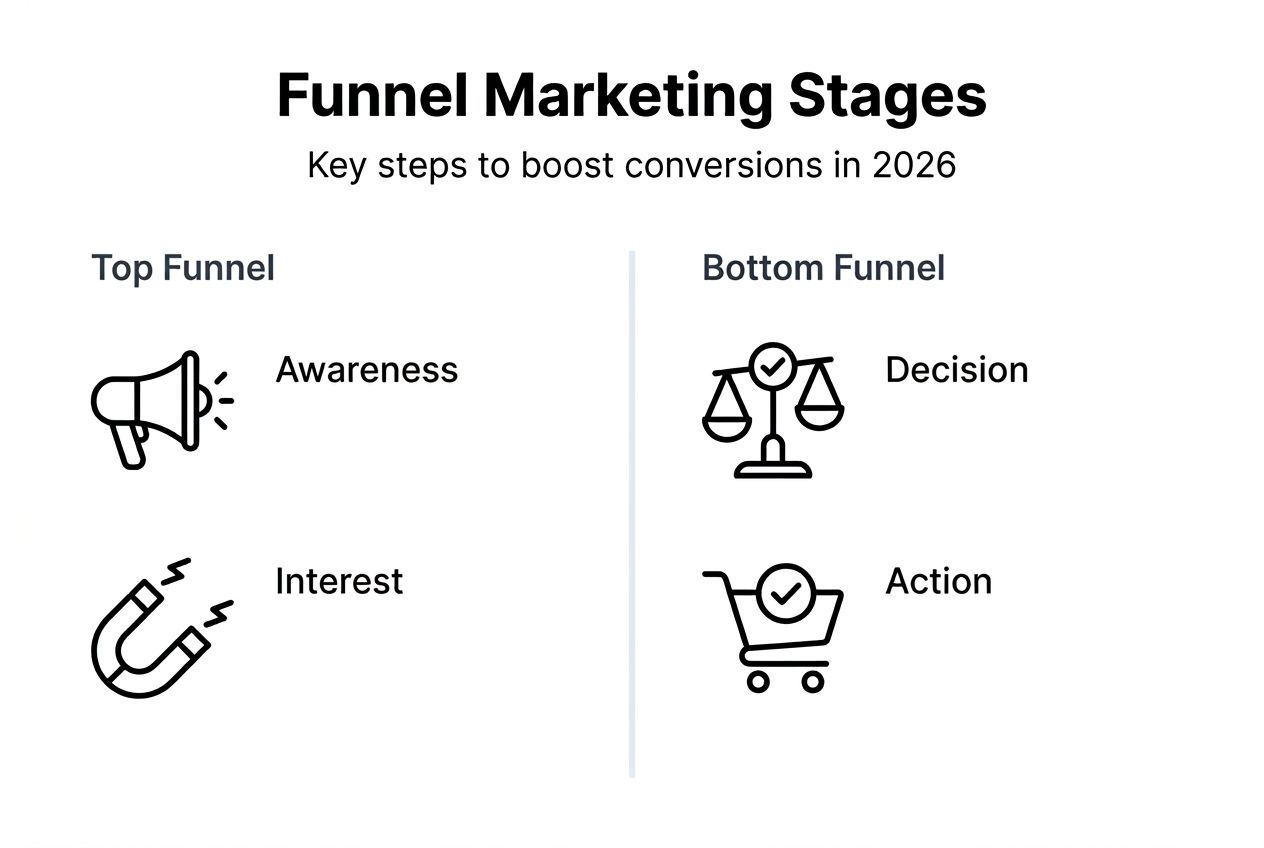
Funnel marketing is a strategic approach that guides potential customers through distinct stages from initial awareness to loyal advocacy. Instead of hoping leads magically convert, you design touchpoints and messages tailored to each stage of their decision journey.
The Brand Tracking Funnel provides a proven measurement framework with five stages: Awareness, Consideration, Preference, Usage, and Loyalty. Each stage connects brand health metrics to tangible business outcomes like revenue growth and pricing power. This model combines attitudinal data (what customers think and feel) with behavioral signals (what they actually do).
Here’s how the stages break down:
- Awareness: Potential customers recognize your brand exists
- Consideration: They actively research and evaluate your offerings
- Preference: Your solution becomes their top choice
- Usage: They make a purchase and experience your product or service
- Loyalty: They become repeat buyers and advocates
The framework’s strength lies in quantifiable metrics at each stage. You can measure aided and unaided brand recall at Awareness, track consideration set inclusion, monitor preference rankings, analyze purchase frequency at Usage, and gauge Net Promoter Scores for Loyalty.
| Funnel Stage | Primary Metric | Business Impact |
|---|---|---|
| Awareness | Brand recall percentage | Market reach expansion |
| Consideration | Inclusion in evaluation set | Qualified lead volume |
| Preference | Top-of-mind ranking | Conversion probability |
| Usage | Purchase frequency | Revenue generation |
| Loyalty | Net Promoter Score | Customer lifetime value |
Pro Tip: The most efficient funnels diagnose which specific stage is weakest, then concentrate marketing investments there rather than spreading resources evenly across all stages.
Building a strong brand identity at the Awareness stage creates a foundation that makes every subsequent funnel stage more effective. When customers recognize and trust your brand early, they progress through Consideration and Preference faster.
Modern challenges: why traditional funnels fall short today
The neat funnel diagram you learned in marketing school? It doesn’t match how people actually buy anymore. Streaming accounts for nearly half of all TV viewing, fragmenting attention across countless platforms. Your prospects bounce between devices, channels, and contexts in unpredictable patterns.

Consider a typical B2B buyer’s journey today. They might discover your brand through a LinkedIn ad, research on mobile during their commute, compare options on a work desktop, discuss with colleagues in Slack, revisit your site on a tablet at home, then finally convert via phone call. That’s six different touchpoints across four devices and three locations, nothing linear about it.
Marketing experts warn against outdated assumptions. As BCG researchers note, marketers continue to force-fit complex consumer paths into linear models, missing critical insights about how decisions actually happen. The traditional funnel assumes customers move predictably from Awareness to Purchase, but real journeys loop back, skip stages, or stall indefinitely.
The complexity creates measurement nightmares. Marketers now juggle 15 distinct channels on average, making it nearly impossible to track full-funnel effectiveness accurately. Which touchpoint deserves credit when a customer interacts with your brand seven times across five platforms before buying?
Key challenges facing funnel marketers in 2026:
- Attribution confusion: Walled gardens like Facebook and Google limit cross-platform tracking
- Journey fragmentation: Customers control their own research paths, not your planned funnel
- Channel proliferation: More options mean diluted attention and harder measurement
- Attention scarcity: Standing out requires more creativity and budget than ever
- Privacy regulations: Cookie deprecation and data restrictions reduce targeting precision
Understanding ROI in marketing becomes critical when you can’t clearly see which channels drive results. Traditional funnel models that assign simple percentages to each stage miss the messy reality of modern attribution.
Performance marketing tactics help by focusing on measurable outcomes, but even performance channels struggle with accurate funnel stage attribution across fragmented customer journeys. The solution isn’t abandoning funnel thinking but evolving it to match current buyer behavior.
Optimizing funnel marketing for better lead conversion and sales
Knowing the challenges is step one. Converting more leads requires strategic optimization at every funnel stage backed by data and industry benchmarks.
Start by understanding where you stand. Funnel conversion rate benchmarks for 2026 reveal that average conversion rates vary dramatically by industry and stage. Comparing your performance against these standards identifies your biggest gaps and opportunities.
| Funnel Stage | Average Conversion Rate | Top Performer Rate | Opportunity Gap |
|---|---|---|---|
| Visitor to Lead | 2-5% | 10-15% | 3-5x improvement possible |
| Lead to Opportunity | 13-20% | 30-40% | 2-3x improvement possible |
| Opportunity to Customer | 6-10% | 20-30% | 3-4x improvement possible |
| Overall Funnel | 0.5-2% | 5-8% | 4-10x improvement possible |
Remember, 79% of leads never convert, emphasizing how much room exists for optimization. Even small percentage improvements at each stage compound into major revenue gains.
Here’s your step-by-step optimization roadmap:
- Audit current funnel performance: Map every stage and measure actual conversion rates between them
- Identify the weakest link: Focus on the stage with the biggest gap versus benchmarks
- Segment your audience: Different customer types need different messaging and nurturing paths
- Test stage-specific improvements: Run A/B tests on messaging, offers, and touchpoints at your weakest stage
- Align sales and marketing operations: Ensure lead routing and territory design supports smooth progression
- Implement marketing automation: Nurture leads systematically rather than relying on manual follow-up
- Measure and iterate: Track improvements monthly and adjust tactics based on what works
Operational alignment matters more than most marketers realize. When sales planning, lead assignment, and RevOps processes create friction, even qualified leads stall in your funnel. The core RevOps challenge is coordinating these moving parts so leads flow smoothly from marketing to sales to customer success.
Your digital marketing workflow should mirror your funnel stages, with specific campaigns and content designed for Awareness, Consideration, and Decision phases. Generic messages blast to everyone rarely work, stage-specific communication converts.
Conversion rate optimization focuses on removing friction at each transition point. Small improvements compound. Boosting your visitor-to-lead rate from 3% to 5% and your lead-to-customer rate from 8% to 12% doesn’t just add, it multiplies your overall results.
Landing page optimization plays a crucial role at multiple funnel stages. Your Awareness stage landing pages need different elements than Decision stage pages. Match the page design, copy, and calls-to-action to where the prospect sits in their journey.
Pro Tip: Continuously adapt your go-to-market plan and lead segmentation based on real funnel data signals rather than assumptions. What worked last quarter may not work next quarter as market conditions and buyer behavior evolve.
Enhance your funnel marketing with expert digital solutions
Optimizing funnel marketing requires coordinated expertise across brand strategy, design, and marketing technology. Most businesses lack the specialized skills or bandwidth to execute effectively across all funnel stages.
Lind Creative specializes in building high-converting funnel systems that turn more leads into customers. Our brand identity expertise strengthens your Awareness and Consideration stages by creating memorable, trust-building brand experiences. Strong brands see higher conversion rates at every funnel stage because customers already know and trust you before entering sales conversations.
Our signature Growth Engine automates lead capture, nurturing, and conversion across your entire funnel. We design high-converting digital marketing workflows that guide prospects smoothly from first touch to loyal customer, with the right message at the right time.
When your website fails to convert, website redesign for growth creates conversion-optimized touchpoints at critical funnel stages. We don’t just make sites look good, we engineer them to move prospects through your funnel efficiently.
Whether you need funnel strategy, implementation, or ongoing optimization, our collaborative approach ensures every project delivers measurable ROI and real business growth.
Frequently asked questions about funnel marketing
What is the difference between a marketing funnel and sales funnel?
A marketing funnel focuses on building awareness and generating qualified leads through content, ads, and brand building. A sales funnel picks up where marketing ends, guiding qualified leads through demos, proposals, and negotiations to close deals. The best results come when both funnels align seamlessly with shared definitions of lead quality and smooth handoff processes.
How can I measure funnel stages effectively?
Track specific conversion rates between each stage using your CRM and analytics tools. Set up goal tracking in Google Analytics for micro-conversions like email signups, content downloads, and demo requests. Monitor time-to-conversion at each stage and identify where prospects stall or drop off. Landing page optimization helps improve measurement by creating clear conversion points.
What are common pitfalls to avoid in funnel marketing?
The biggest mistake is treating all leads identically regardless of funnel stage. Sending sales-heavy messages to Awareness stage prospects scares them away. Other pitfalls include neglecting mid-funnel nurturing, ignoring mobile experience, failing to align sales and marketing teams, and optimizing for vanity metrics instead of revenue. Focus on stage-appropriate messaging and actual conversion rates.
How often should I update my funnel strategy?
Review funnel performance monthly and conduct comprehensive strategy updates quarterly. Markets, competitors, and buyer behavior shift constantly, especially in digital channels. What converts well in Q1 may underperform in Q3. Conversion rate optimization is an ongoing process, not a one-time project. Run continuous A/B tests and implement winners as soon as statistical significance is reached.
Why do most leads never convert to sales?
Leads fail to convert for several reasons: poor lead quality from the start, lack of nurturing between stages, misalignment between marketing promises and sales delivery, too much friction in the buying process, or simply not being ready to buy yet. Many businesses give up on leads too quickly instead of implementing long-term nurture campaigns. The solution is better lead scoring, persistent multi-touch nurturing, and patience with longer sales cycles.
Recommended
- Build a High-Converting Digital Marketing Workflow – Lind Creative
- Email marketing how to: boost engagement and sales in 2026 – Lind Creative
- How to Create Service Landing Page for Lead Generation – Lind Creative
- How to Optimize Website Conversions for eCommerce Success – Lind Creative