
Juggling dozens of digital tactics without a clear picture of what is actually driving results leaves many hospitality marketing teams feeling stuck. For upscale brands across California, every marketing investment needs to deliver visible ROI and tangible lead quality. By focusing on a systematic process to assess current assets, automate lead capture, develop targeted content, and integrate marketing tools, you can build a digital marketing workflow that not only attracts qualified leads but also measures and improves your outcomes at every step.
Table of Contents
- Step 1: Assess Current Marketing Assets
- Step 2: Define Automated Lead Capture Processes
- Step 3: Develop Targeted Content And Funnels
- Step 4: Integrate And Automate Marketing Tools
- Step 5: Test And Monitor Workflow Performance
- Step 6: Optimize For Continuous Improvement
Quick Summary
| Key Point | Explanation |
|---|---|
| 1. Assess existing marketing assets | Evaluate your resources to identify strengths and weaknesses, guiding improvements in your digital marketing workflow. |
| 2. Define automated lead capture | Create streamlined processes for collecting customer information at various touchpoints to enhance lead quality and conversion. |
| 3. Develop targeted content | Design content that aligns with every stage of the buyer’s journey to effectively engage and convert your audience. |
| 4. Integrate marketing tools | Synchronize technologies to streamline operations, improve communication, and amplify your marketing effectiveness. |
| 5. Optimize for continuous improvement | Implement ongoing assessments and adjustments to ensure your marketing strategy remains agile and aligned with business goals. |
Step 1: Assess current marketing assets
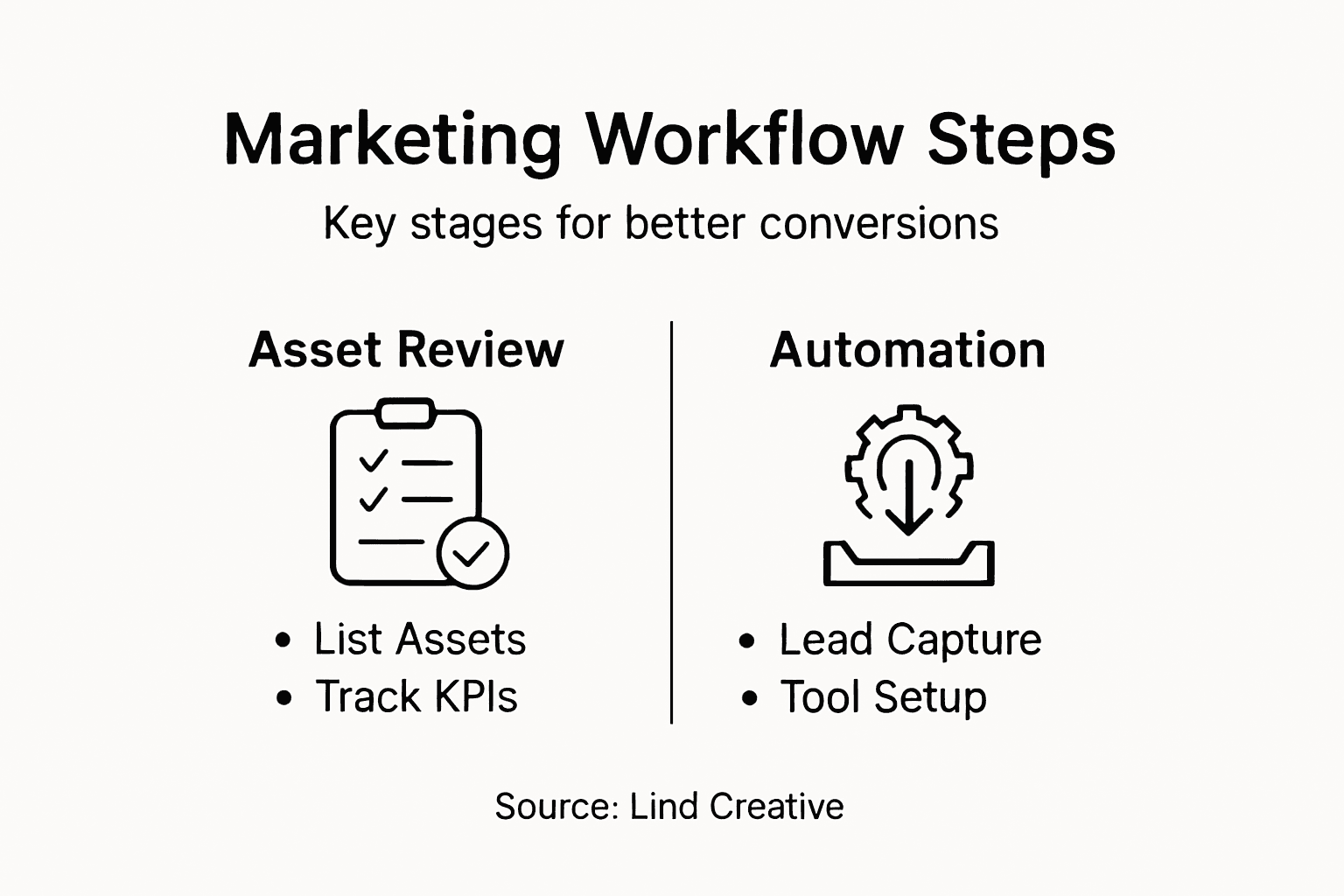
Assessing your current marketing assets is the critical first phase of building a high-converting digital marketing workflow. This strategic evaluation helps you understand your existing resources, identify strengths, and pinpoint areas for improvement.
To conduct a comprehensive marketing asset assessment, start by gathering all your current marketing materials across different channels. Marketing performance measurement requires a systematic approach that examines your entire digital ecosystem. Here are the key elements to review:
- Website content: Analyze blog posts, landing pages, and existing web copy
- Social media accounts: Review profile consistency, engagement metrics, and content quality
- Email marketing materials: Examine past campaign templates, newsletters, and automation sequences
- Digital advertising assets: Collect previous ad creatives, copy variations, and performance reports
- Multimedia resources: Catalog existing videos, infographics, podcasts, and visual content
Carefully document each asset’s current performance, including metrics like engagement rates, conversion numbers, and audience reach. By creating a comprehensive inventory, you’ll gain critical insights into your marketing landscape. This step helps you understand which assets are working effectively and which need refinement.

The table below summarizes key metrics for assessing different marketing asset types:
| Asset Type | Main Metric | Common Strength | Typical Weakness |
|---|---|---|---|
| Website Content | Organic traffic | SEO performance | Outdated messaging |
| Social Media Accounts | Engagement rate | Audience interaction | Inconsistent branding |
| Email Marketing | Open/click rates | Subscriber loyalty | Low deliverability |
| Digital Advertising | Conversion rate | Targeted reach | High cost |
| Multimedia Resources | Completion rate | Visual appeal | Low discoverability |
Successful marketing assessment integrates metrics across awareness, consideration, and decision stages to optimize resource allocation.
Pro tip: Use a spreadsheet to track each marketing asset’s key performance indicators, creation date, and potential optimization opportunities.
Step 2: Define automated lead capture processes
Defining automated lead capture processes is crucial for transforming your digital marketing workflow into a streamlined, high-converting system. This step helps you create strategic mechanisms that effortlessly collect and nurture potential customer information.
Automated lead management encompasses methodologies designed to transform consumer interactions into actionable sales opportunities. Begin by mapping out your lead capture strategy across multiple digital touchpoints:
- Website forms: Design strategic contact forms with minimal required fields
- Landing pages: Create targeted pages with compelling value propositions
- Pop-up triggers: Implement exit-intent and scroll-based capture mechanisms
- Content upgrades: Develop downloadable resources in exchange for contact details
- Social media integrations: Connect lead generation tools with social platforms
The goal is to create a seamless system that captures potential customer information while providing genuine value. Focus on crafting lead magnets that solve specific problems for your target audience. These might include comprehensive guides, webinars, checklists, or industry research reports that demonstrate your expertise.
Effective lead capture systems integrate technology-driven automation with personalized customer interactions to maximize conversion potential.
Pro tip: Implement progressive profiling techniques to gradually collect more detailed information from leads without overwhelming them in a single interaction.
Step 3: Develop targeted content and funnels
Developing targeted content and marketing funnels is a strategic approach to guiding potential customers through their purchasing journey with precision and purpose. This step transforms your digital marketing workflow into a powerful conversion machine that speaks directly to your audience’s needs and motivations.
Content strategy requires addressing every stage of the marketing funnel—awareness, consideration, and purchase—with carefully crafted messaging. Break down your content development process into strategic stages:
- Awareness content: Create blog posts, social media content, and educational resources
- Consideration materials: Develop detailed guides, comparison articles, and case studies
- Decision-stage content: Design product demos, testimonials, and direct conversion assets
- Retention resources: Produce onboarding materials, success stories, and ongoing value content
- Loyalty builders: Craft exclusive insights, advanced tutorials, and community-focused resources
Understand that each piece of content serves a specific purpose in guiding potential customers through their decision-making process. Your goal is to create a seamless narrative that anticipates and addresses customer questions, concerns, and aspirations at every touchpoint.
Effective marketing funnels strategically align content with customer journey stages to optimize engagement and conversion potential.
Pro tip: Map your content explicitly to specific buyer personas and funnel stages, ensuring each asset has a clear purpose and target audience.
Step 4: Integrate and automate marketing tools
Integrating and automating marketing tools transforms your digital workflow from fragmented processes into a seamless, high-performance system. This critical step enables you to synchronize technologies, streamline communication, and maximize the efficiency of your marketing efforts.
Digital transformation in marketing focuses on leveraging AI, machine learning, and automation to enhance customer journey management. Consider these key integration strategies:
- Data synchronization: Connect CRM, email marketing, and analytics platforms
- Workflow automation: Implement tools that trigger actions based on customer behaviors
- Communication platforms: Unify messaging across email, social media, and chat systems
- Reporting dashboards: Create centralized analytics that track cross-platform performance
- Customer segmentation: Use AI-powered tools to dynamically categorize and target audiences
Successful tool integration requires a strategic approach that prioritizes compatibility, scalability, and seamless data flow. Select platforms that communicate effortlessly and provide comprehensive insights into your marketing performance.
Technology integration amplifies digital marketing efforts by enabling real-time adjustments and personalized customer experiences.
Pro tip: Start with a core marketing automation platform and gradually integrate specialized tools, ensuring each new technology adds measurable value to your workflow.
Step 5: Test and monitor workflow performance
Testing and monitoring your digital marketing workflow is the critical final stage that ensures your carefully constructed system delivers the results you demand. This step transforms your strategy from theoretical planning into measurable, actionable performance optimization.
Testing and evaluation methods involve systematically assessing marketing initiatives using data-driven techniques. Implement a comprehensive monitoring approach with these key strategies:
- Performance metrics: Track conversion rates, engagement levels, and ROI
- Funnel analysis: Identify bottlenecks and drop-off points in customer journeys
- A/B testing: Compare different workflow variations to determine optimal configurations
- Real-time dashboards: Create visual representations of key performance indicators
- Continuous feedback loops: Regularly review and adjust workflow components
Successful workflow monitoring requires a holistic view that goes beyond surface-level metrics. Look for patterns, understand the interconnections between different marketing elements, and be prepared to make dynamic adjustments that improve overall system performance.
Effective workflow management transforms raw data into strategic insights that drive continuous improvement.
Pro tip: Set up automated reporting that sends weekly performance summaries to key stakeholders, ensuring everyone stays informed about the marketing workflow’s effectiveness.
Step 6: Optimize for continuous improvement
Optimizing your digital marketing workflow for continuous improvement transforms your marketing strategy from a static system into a dynamic, evolving machine. This final stage ensures your workflow remains agile, responsive, and consistently aligned with your business objectives.
Continuous improvement practices require integrating technical and adaptive strategies that foster organizational learning and problem-solving. Implement these key optimization approaches:
- Performance analysis: Regularly review workflow metrics and performance data
- Iterative refinement: Make incremental adjustments based on insights
- Cross-functional collaboration: Engage team members from different departments
- Learning mechanisms: Create structured feedback and knowledge-sharing processes
- Innovation protocols: Establish clear pathways for experimenting with new strategies
Successful continuous improvement demands a cultural commitment to learning and adaptation. Encourage an environment where team members feel empowered to identify inefficiencies, propose solutions, and participate actively in workflow enhancement.
Here’s a comparison of automation tool benefits at different workflow stages:
| Workflow Stage | Primary Automation Benefit | Example Outcome |
|---|---|---|
| Lead Capture | Data collection efficiency | More qualified leads |
| Content Delivery | Timely personalization | Higher engagement rates |
| Reporting & Testing | Real-time insights | Faster optimization |
| Continuous Improvement | Feedback integration | Sustained growth |
Sustained innovation transforms marketing workflows from rigid systems into flexible, responsive frameworks that consistently deliver exceptional results.
Pro tip: Schedule quarterly workflow audits with key stakeholders, using structured frameworks like Plan-Do-Check-Act to systematically evaluate and improve your marketing processes.
Build a High-Converting Marketing Workflow That Drives Real Growth
If you are struggling to transform your digital marketing assets into a smooth, automated system that captures leads and converts them consistently you are not alone. This article highlights how critical it is to assess your marketing materials and implement automated lead capture, targeted funnels, and tool integration to unlock measurable results. Lind Creative understands these challenges and brings a strategy-driven approach to build exactly that kind of high-performance workflow.
Digital Marketing – Lind Creative offers insights and solutions designed to help you automate lead capture, personalize content delivery, and continuously optimize your marketing efforts.
Take your marketing from fragmented efforts to a unified, conversion-focused engine today. Visit Lind Creative to explore how our Growth Engine system combines creativity, technology, and strategy for real ROI. Start building a workflow that not only looks great but delivers measurable business growth right now.
Frequently Asked Questions
How do I assess my current marketing assets?
Assess your current marketing assets by gathering and reviewing all existing marketing materials, such as website content, social media accounts, email marketing templates, and digital advertising assets. Document the performance of each asset using metrics like engagement rates and conversion numbers to identify strengths and areas for improvement.
What are the key elements of an automated lead capture process?
Key elements of an automated lead capture process include website forms, landing pages, pop-up triggers, content upgrades, and social media integrations. Design contact forms with minimal required fields and create valuable resources to encourage potential customers to share their information.
How can I develop targeted content for different stages of the marketing funnel?
To develop targeted content for different stages of the marketing funnel, create specific assets for awareness, consideration, and decision stages. For example, produce blog posts for awareness, detailed guides for consideration, and product demos or testimonials for the decision stage to guide potential customers effectively.
What should I monitor in my digital marketing workflow performance?
In your digital marketing workflow performance, monitor key metrics such as conversion rates, engagement levels, and return on investment (ROI). Conduct funnel analysis to identify bottlenecks and perform A/B testing to compare different workflow variations for continuous optimization.
How do I optimize my digital marketing workflow for continuous improvement?
To optimize your digital marketing workflow for continuous improvement, regularly review performance data and make incremental adjustments based on insights. Create structured feedback and knowledge-sharing processes within your team to encourage innovation and efficiency.
Recommended
- Defining High-Converting Websites for Results-Driven Growth – Lind Creative
- How to Optimize Website Conversions for eCommerce Success – Lind Creative
- 8 Essential Website Elements for High Conversions – Lind Creative
- Website Conversion Optimization Guide for Shopify Success – Lind Creative
- Services – Sikuro