
Every luxury hospitality brand faces mounting pressure to prove the true value of its marketing investments in an ever-changing digital space. Without a clear approach, it can be difficult to pinpoint which campaigns spark meaningful revenue growth or justify higher spending. By focusing on data-driven ROI measurement and advanced attribution models, your brand can gain clarity and confidence to make smarter resource decisions.
Table of Contents
- Defining ROI in Modern Marketing
- Ways to Measure ROI Across Channels
- Common Misconceptions About Marketing ROI
- How ROI Impacts Digital Growth Strategies
- Costly Mistakes When Tracking ROI
Key Takeaways
| Point | Details |
|---|---|
| Understanding ROI is Crucial | ROI quantifies the financial return of marketing strategies, allowing for informed decisions on resource allocation. |
| Comprehensive Measurement is Essential | Utilize multiple metrics and attribution models to gain a holistic view of marketing performance across channels. |
| Avoid Common Misconceptions | Recognize that ROI includes both tangible and intangible benefits, not just direct financial returns. |
| Data Integrity Matters | Implement robust tracking systems to ensure accurate ROI measurements and avoid costly evaluation errors. |
Defining ROI in Modern Marketing
Return on Investment (ROI) represents the critical financial metric that measures the efficiency and profitability of marketing strategies across digital and traditional channels. At its core, ROI quantifies the direct financial return generated from marketing investments by comparing the revenue gained against the total expenses incurred during a specific campaign or timeframe.
Understanding ROI requires analyzing several key components that demonstrate marketing performance and financial impact:
- Revenue Generated: Total monetary value produced by marketing efforts
- Marketing Expenses: Direct costs associated with campaign development and execution
- Profit Margin: Net financial gain after subtracting marketing expenditures
- Performance Metrics: Conversion rates, customer acquisition costs, and lifetime value
Contemporary marketing ROI measurement has evolved dramatically with advanced digital analytics platforms. Modern marketers can now track precise performance indicators that provide granular insights into campaign effectiveness, moving beyond traditional broad-stroke evaluation methods.

The calculation of marketing ROI typically follows a straightforward formula: (Net Profit from Marketing / Total Marketing Expenditure) x 100. This percentage reveals the direct financial impact of marketing strategies, enabling businesses to make data-driven decisions about resource allocation and future investment.
Pro Tip: Always track multiple ROI metrics simultaneously to gain a comprehensive understanding of your marketing performance and identify potential optimization opportunities.
Ways to Measure ROI Across Channels
Measuring marketing ROI effectively requires a comprehensive approach that evaluates performance across multiple digital and traditional channels. Advanced digital marketing metrics provide businesses with nuanced insights into campaign effectiveness and financial performance.
Key metrics for measuring ROI across different marketing channels include:
- Website Traffic: Total visitors, unique pageviews, time on site
- Social Media Engagement: Likes, shares, comments, click-through rates
- Email Marketing: Open rates, conversion rates, subscriber growth
- Advertising Performance: Cost per click, conversion rates, total ad revenue
- Customer Acquisition Cost: Total spending divided by number of new customers
Multi-channel attribution models enable marketers to understand how different touchpoints contribute to final conversions. These sophisticated tracking methods help businesses assign accurate value to each marketing channel by analyzing:
Here’s a comparison of common marketing ROI attribution models and how they impact decision-making:
| Attribution Model | Main Benefit | Limitation |
|---|---|---|
| First-touch | Pinpoints initial engagement | Ignores later influences |
| Last-touch | Credits final conversion step | Misses previous touchpoints |
| Linear | Balances channel credit | May dilute key influences |
| Time decay | Prioritizes recent actions | Undervalues early touchpoints |
| Position-based | Highlights key touchpoints | Complex to implement |
- First-touch attribution
- Last-touch attribution
- Linear attribution
- Time decay attribution
- Position-based attribution
Successful ROI measurement demands integrated analytics platforms that can consolidate data from various sources, providing a holistic view of marketing performance. By leveraging advanced tracking technologies, companies can make data-driven decisions that optimize resource allocation and maximize marketing effectiveness.
Pro Tip: Implement a blended attribution approach that combines multiple measurement techniques to gain a comprehensive understanding of your marketing channels’ true performance.
Common Misconceptions About Marketing ROI
Common marketing ROI misconceptions often prevent businesses from developing a nuanced understanding of their marketing performance. Many organizations mistakenly view ROI as a straightforward, immediate financial calculation, overlooking the complex nature of marketing impact and long-term value creation.
Several key misconceptions about marketing ROI persist across industries:
- Immediate Results Myth: Expecting precise ROI calculations immediately after a campaign
- Single Metric Fallacy: Believing ROI is the only meaningful performance indicator
- Positive ROI Guarantee: Assuming a positive ROI automatically indicates campaign success
- Uniform Measurement: Treating all marketing channels with identical evaluation methods
- Short-Term Focus: Prioritizing immediate financial returns over long-term brand building
Marketers must recognize that ROI encompasses more than just direct financial returns. Intangible benefits like brand awareness, customer loyalty, and market positioning play crucial roles in determining true marketing effectiveness. A comprehensive approach considers multiple dimensions of value beyond simple monetary calculations.
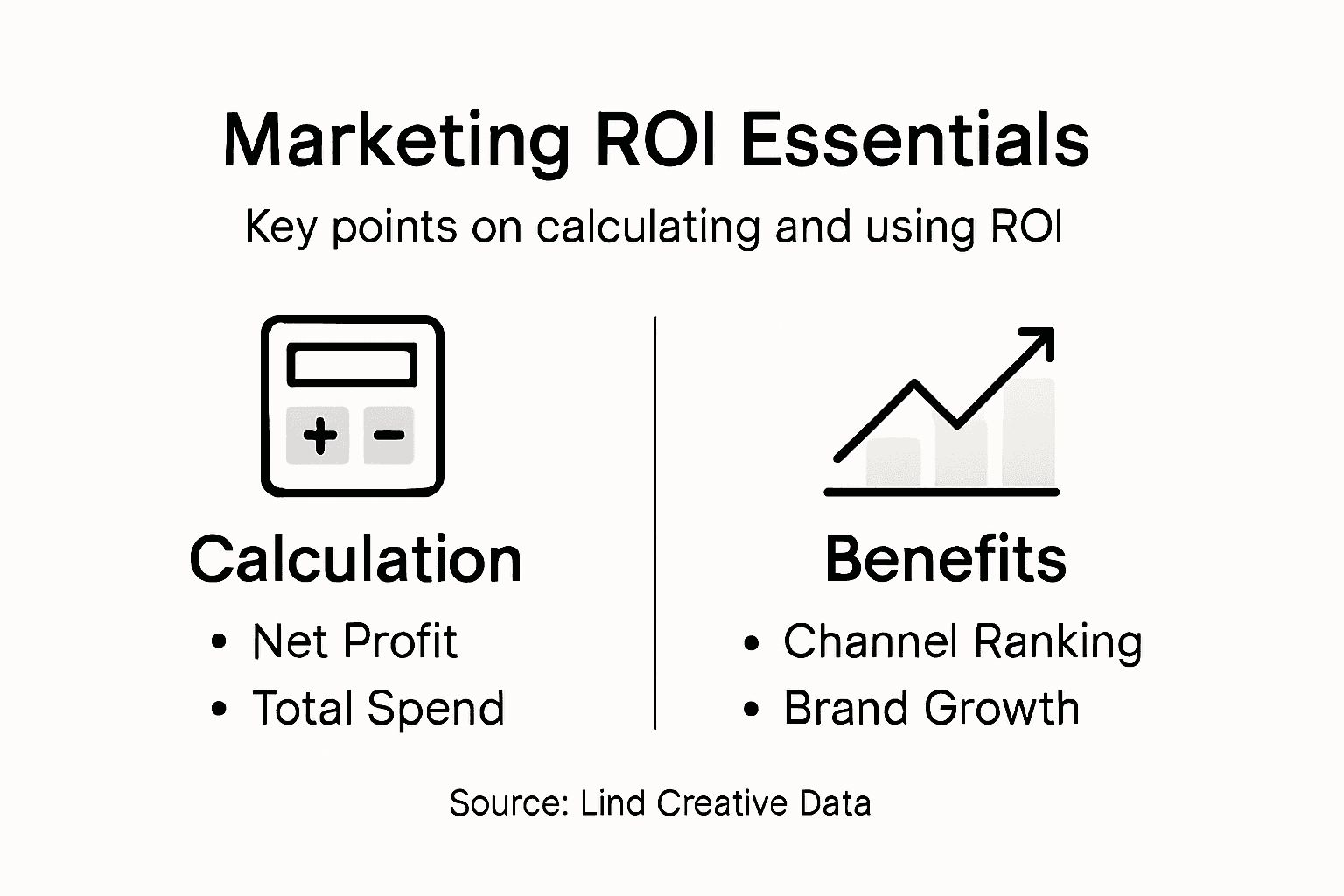
Understanding these misconceptions helps businesses develop more sophisticated marketing strategies that balance immediate financial metrics with broader strategic objectives. By adopting a holistic view, companies can make more informed decisions about resource allocation and marketing investments.
Pro Tip: Develop a multi-dimensional ROI framework that integrates financial metrics with qualitative performance indicators to gain a more comprehensive understanding of marketing success.
How ROI Impacts Digital Growth Strategies
ROI measurement strategies are fundamental to driving effective digital growth across modern marketing landscapes. By transforming raw data into actionable insights, businesses can systematically optimize their digital strategies and allocate resources with unprecedented precision.
Key ways ROI directly influences digital growth strategies include:
- Resource Allocation: Identifying high-performing channels and investment opportunities
- Performance Optimization: Targeting marketing efforts with maximum efficiency
- Strategic Refinement: Continuously adapting tactics based on measurable outcomes
- Budget Planning: Making data-driven decisions about marketing expenditures
- Competitive Positioning: Understanding market dynamics through quantitative analysis
Successful digital growth demands a dynamic approach to ROI measurement that goes beyond traditional financial calculations. Sophisticated marketers utilize advanced attribution models that track customer journeys across multiple touchpoints, providing comprehensive insights into marketing effectiveness.
Understanding ROI’s multidimensional impact allows businesses to develop agile digital strategies that respond quickly to changing market conditions. By integrating sophisticated measurement techniques, companies can create more responsive, targeted, and efficient marketing approaches that drive sustainable growth.
The table below highlights how ROI drives digital growth strategies across key business areas:
| Strategy Impact | Example Action | Result for Business |
|---|---|---|
| Resource Allocation | Invest more in high-ROI channels | Improved marketing efficiency |
| Performance Optimization | Refine targeting and messaging | Higher conversion rates |
| Budget Planning | Adjust spend based on ROI trends | Better cost control |
| Competitive Positioning | Benchmark versus competitors | Stronger market presence |
Pro Tip: Implement a comprehensive ROI tracking system that captures both quantitative financial metrics and qualitative performance indicators to develop a holistic view of digital marketing success.
Costly Mistakes When Tracking ROI
ROI performance evaluation errors can dramatically undermine marketing effectiveness and strategic decision-making. Understanding these pitfalls is crucial for businesses seeking accurate insights into their marketing investments and overall financial performance.
Most common and costly ROI tracking mistakes include:
- Incomplete Cost Tracking: Failing to account for all direct and indirect marketing expenses
- Single-Metric Obsession: Relying exclusively on financial returns while ignoring qualitative indicators
- Inconsistent Measurement: Using different tracking methods across marketing channels
- Neglecting Customer Lifetime Value: Focusing only on immediate transaction revenues
- Data Integrity Issues: Implementing unreliable or fragmented data collection processes
Precision in data collection and analysis represents the cornerstone of accurate ROI measurement. Sophisticated marketers recognize that statistical uncertainties can lead to significant misinterpretations, potentially causing misguided strategic decisions that impact overall business performance.
Businesses must develop robust, integrated tracking systems that capture comprehensive performance metrics across multiple dimensions. By implementing rigorous measurement protocols and maintaining data integrity, organizations can transform ROI tracking from a simple financial exercise into a powerful strategic tool for continuous improvement.
Pro Tip: Develop a standardized ROI tracking framework with clear, consistent metrics that can be applied uniformly across all marketing channels and campaigns.
Unlock Real Marketing ROI with Strategy-Driven Solutions
Understanding and measuring ROI in marketing is critical to avoid costly mistakes like incomplete cost tracking and single-metric obsession. If you’re facing challenges like tracking multi-channel performance or turning marketing data into actionable insights, Lind Creative can help. Our signature Growth Engine combines automation, design, and strategy to deliver measurable results that align with your goals such as improved resource allocation, higher conversion rates, and optimized budget planning.

Ready to stop guessing and start growing? Explore how our Digital Marketing – Lind Creative services can simplify ROI tracking and amplify your brand impact. Visit Lind Creative today to learn more and access a wealth of insights in our Resources – Lind Creative. Turn your marketing investment into real business growth now.
Frequently Asked Questions
What is ROI in marketing?
Return on Investment (ROI) in marketing measures the efficiency and profitability of marketing strategies by comparing the revenue generated against the total expenses incurred during a specific campaign or timeframe.
How do you calculate marketing ROI?
Marketing ROI is calculated using the formula: (Net Profit from Marketing / Total Marketing Expenditure) x 100. This percentage indicates the financial impact of marketing strategies, helping businesses make informed decisions.
Why is measuring ROI important for brands?
Measuring ROI is crucial for brands as it helps identify high-performing channels, optimize marketing efforts, refine strategies, and allocate resources effectively, ultimately driving growth and profitability.
What are common misconceptions about marketing ROI?
Common misconceptions include believing that ROI provides immediate results, that it’s the only meaningful performance indicator, and that all marketing channels should be evaluated using identical methods. Understanding ROI’s complexity can lead to better marketing strategies.
Recommended
- The Essential Guide to Investing in Branding – Lind Creative
- Role of Branding in Business Success Today – Lind Creative
- Why Branding Matters: Complete Guide for Businesses – Lind Creative
- Why Invest in Design – Unlocking Business Growth – Lind Creative
- Advertising Performance Metrics: Complete Guide – playablemaker.com Advertising Performance Metrics: Complete Guide
- 10 Powerful Retail Marketing Strategies for AU SMEs in 2025