
A 5% improvement in customer retention can boost profits by 25% to 95%, yet many established businesses focus disproportionately on acquisition. Understanding customer retention is essential for sustainable growth through automated marketing. This guide clarifies what customer retention truly means, why it drives profitability, and how AI-powered automation makes scalable retention strategies accessible in 2026.
Table of Contents
- Introduction To Customer Retention
- Why Customer Retention Matters: Economic Impact And Definition
- Automation And AI: Transforming Customer Retention In 2026
- Key Metrics To Measure And Optimize Customer Retention
- Common Misconceptions About Customer Retention
- Bridging Understanding To Practical Application: Implementing Automated Retention
- Conclusion: Driving Sustainable Growth Through Customer Retention
- Discover Tailored Marketing Solutions To Boost Your Retention
- Frequently Asked Questions About Customer Retention
Key takeaways
| Point | Details |
|---|---|
| Retention drives profits | Improving retention by 5% increases profits 25%-95%, while acquisition costs 5-25x more. |
| AI enables personalization | Automated marketing platforms deliver real-time, personalized engagement across channels at scale. |
| Metrics guide optimization | Track Customer Retention Rate (CRR), churn rate, and customer lifetime value (CLV) to measure success. |
| Myths limit growth | Retention is more than churn prevention; it includes proactive value creation and referral generation. |
| Implementation drives results | Companies using AI retention reduced churn from 8% to 3.2% and increased referrals by 47%. |
Introduction to customer retention
Customer retention is the practice of maintaining relationships with existing customers over time, ensuring they continue purchasing and engaging with your business. Unlike customer acquisition, which focuses on attracting new buyers, retention nurtures existing relationships to maximize long-term value. This distinction matters because keeping current customers costs significantly less than finding new ones.
Retention reduces marketing expenses while increasing profit margins through repeat purchases and referrals. Existing customers already trust your brand, making them more receptive to upsells and new offerings. They also provide valuable feedback and word-of-mouth marketing that acquisition efforts cannot replicate.
For established U.S. business owners, retention forms the foundation for sustainable growth. While acquisition fuels initial expansion, retention ensures stability and profitability. Strong branding role in loyalty reinforces emotional connections that keep customers returning.
Key retention benefits include:
- Lower marketing costs compared to acquisition campaigns
- Higher average order values from loyal customers
- Increased customer lifetime value through repeat purchases
- Stronger brand advocacy and organic referrals
- More predictable revenue streams for planning
Why customer retention matters: economic impact and definition
The financial case for prioritizing retention is compelling. Research shows that improving retention by 5% increases profits 25%-95%, a range that reflects different industry dynamics and business models. Meanwhile, acquiring new customers costs 5-25 times more than retaining existing ones.
This cost differential stems from several factors. Acquisition requires significant investment in advertising, lead generation, and sales conversion. Retained customers already understand your value proposition and require less convincing. They also tend to purchase more frequently and spend more per transaction as trust deepens.
Long-term customers provide stable revenue that supports strategic planning and investment. They generate valuable referrals that convert at higher rates than cold prospects. Their feedback helps refine products and services, creating competitive advantages.
The economic impact becomes clear when comparing retention versus acquisition:
| Metric | Retention Focus | Acquisition Focus |
|---|---|---|
| Cost per customer | Lower (5-25x less) | Higher baseline |
| Profit margin | 25%-95% increase potential | Standard margins |
| Revenue stability | Predictable recurring | Variable pipeline |
| Referral value | High quality, low cost | Paid channels |
Established businesses benefit most from retention strategies because they have existing customer bases to nurture. Rather than constantly replacing churned customers, retention efforts compound over time. Each percentage point improvement in retention cascades through branding role in loyalty and customer advocacy.
Key economic advantages:
- Reduced marketing budgets through organic growth
- Higher profitability per customer over time
- Improved cash flow from predictable renewals
- Lower customer acquisition cost (CAC) ratios
Automation and AI: transforming customer retention in 2026
Automated marketing and AI technologies have revolutionized customer retention by enabling personalized engagement at scale. Modern platforms analyze customer behavior in real time, predict churn risk, and trigger relevant communications automatically. This level of sophistication was impossible with manual processes.

AI-driven segmentation groups customers by behavior patterns, preferences, and engagement levels. Predictive analytics identify at-risk customers before they churn, allowing proactive intervention. Businesses using AI retention strategies achieve higher customer lifetime value and generate more referrals than traditional methods.
Automated workflows handle onboarding sequences, re-engagement campaigns, and loyalty programs without manual effort. These systems send personalized emails, SMS messages, and in-app notifications based on individual customer actions. The result is timely, relevant communication that strengthens relationships.
Omnichannel automation unifies customer experiences across email, social media, web, and mobile. Customers expect consistent engagement regardless of channel, and automation ensures seamless transitions. This integration meets modern expectations while reducing operational complexity.
Key automation capabilities transforming retention:
- Predictive churn modeling identifies risk before customers leave
- Behavioral triggers send personalized messages at optimal moments
- Dynamic content adapts to individual preferences and history
- Automated loyalty programs reward engagement without manual tracking
- Real-time dashboards monitor retention metrics and campaign performance
Pro Tip: Start with one automated retention workflow, such as win-back campaigns for inactive customers. Measure results for 60 days, then expand to additional workflows. This incremental approach builds expertise while minimizing risk.
Integrating AI tools with existing systems requires strategic planning. Digital marketing workflow high conversion frameworks help structure implementation. Growth marketing for ecommerce strategies demonstrate practical applications.
Key metrics to measure and optimize customer retention
Measuring retention success requires tracking specific metrics that quantify customer behavior and business outcomes. Customer Retention Rate (CRR) is the foundational metric, calculated by comparing customers at period start versus end, accounting for new acquisitions.
The CRR formula is: (Customers at end – New customers) / Customers at start] × 100. For example, if you start with 1,000 customers, gain 200 new ones, and end with 1,100, your CRR is 90%. [SaaS companies target CRR above 85% as a healthy benchmark.
Churn rate measures the inverse: the percentage of customers lost during a period. If CRR is 90%, churn rate is 10%. Lower churn rates indicate stronger retention and more predictable revenue. Tracking both metrics provides complete visibility into customer movement.
Customer lifetime value (CLV) quantifies the total revenue a customer generates over their entire relationship. Higher CLV indicates successful retention strategies that extend customer relationships and increase purchase frequency. CLV also guides acquisition spending decisions.
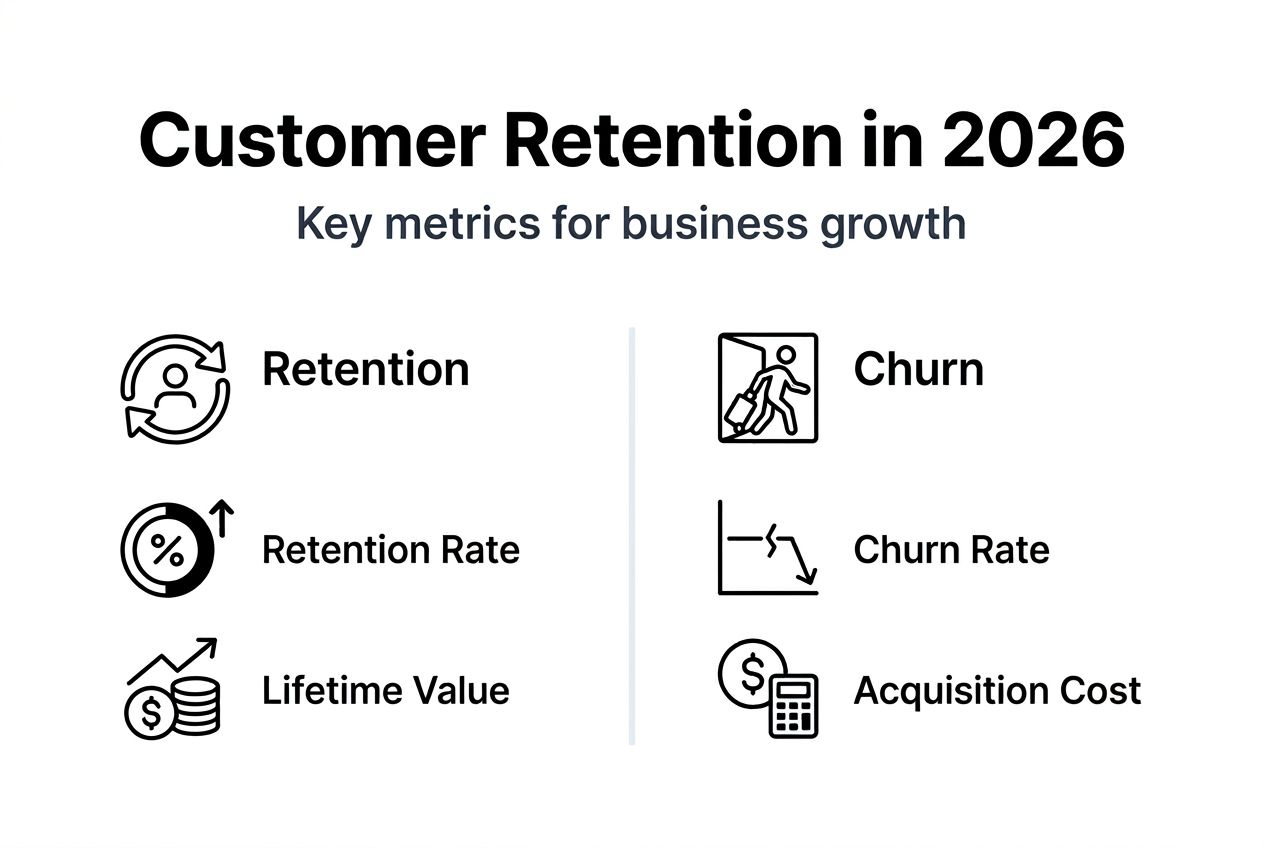
Referral rates measure how many new customers come from existing customer recommendations. High referral rates signal strong satisfaction and advocacy, both retention indicators. This metric also reduces acquisition costs by generating organic leads.
Essential retention metrics to track:
- Customer Retention Rate (CRR) for overall health
- Churn rate to identify problem areas
- Customer lifetime value (CLV) for profitability
- Referral rate for advocacy measurement
- Repeat purchase rate for engagement levels
- Net Promoter Score (NPS) for satisfaction
| Metric | Calculation | Healthy Benchmark |
|---|---|---|
| CRR | [(End – New) / Start] × 100 | 85%+ (SaaS) |
| Churn Rate | 100% – CRR | <15% (SaaS) |
| CLV | Avg purchase × frequency × lifespan | 3x CAC minimum |
| Referral Rate | New referrals / Total customers | 10-15% |
Analyze website traffic patterns to understand engagement behaviors. Retargeting hospitality techniques can re-engage at-risk segments identified through metrics.
Common misconceptions about customer retention
Several widespread myths limit retention effectiveness by focusing efforts on the wrong priorities. Understanding these misconceptions helps business owners develop more strategic approaches to customer relationships.
Myth one: Retention only prevents churn. Reality is that retention includes proactive value creation such as personalized experiences and referral generation. Effective retention strategies grow customer value beyond simply stopping departures. They deepen engagement and transform customers into advocates.
Myth two: Automation will replace human marketing strategy entirely. AI and automation enhance marketing efficiency but cannot substitute strategic thinking and creative direction. Technology executes tactics at scale, while humans define goals, craft messaging, and interpret results. The most successful retention programs blend automated execution with human oversight.
Myth three: Acquisition outpaces retention in importance. This belief persists despite clear evidence that retention costs far less and generates higher profitability. Many businesses chase new customers while neglecting existing relationships, creating a leaky bucket effect. Balanced strategies prioritize both, but retention often delivers better ROI.
Myth four: Retention metrics are too complex for small businesses. Modern analytics platforms simplify tracking with automated dashboards and clear visualizations. Even small teams can monitor CRR, churn, and CLV without dedicated analysts. The key is starting with core metrics and expanding as capacity grows.
Common retention misconceptions:
- Believing retention is passive rather than proactive
- Assuming automation eliminates need for strategy
- Prioritizing acquisition over retention investment
- Thinking retention metrics require large teams
- Expecting instant results from retention programs
Pro Tip: Balance automation with regular human review of campaign performance and customer feedback. Schedule monthly retention audits to assess metric trends, identify issues, and refine strategies. This combination maximizes efficiency while maintaining strategic control.
Bridging understanding to practical application: implementing automated retention
Adopting AI-powered automated retention requires a structured approach that minimizes disruption while maximizing results. Follow these steps to implement effective retention workflows that drive measurable growth.
- Audit your current retention baseline by calculating CRR, churn rate, and CLV for the past 12 months. This establishes benchmarks for measuring improvement.
- Identify your highest-value customer segments based on purchase frequency, average order value, and engagement levels. Prioritize retention efforts on segments with greatest revenue impact.
- Select an automation platform that integrates with your existing CRM and marketing tools. Evaluate options based on AI capabilities, ease of use, and scalability.
- Design your first automated workflow, such as a win-back campaign for customers who have not purchased in 90 days. Keep initial campaigns simple to learn the platform.
- Create personalized content for different customer segments, varying messaging based on purchase history, preferences, and behavior patterns. Test multiple variations to optimize performance.
- Launch a pilot program with a limited segment before full deployment. Monitor results weekly, adjusting triggers, timing, and content based on engagement data.
- Scale successful workflows to additional segments and create new campaigns for different retention objectives, such as upselling or referral generation.
Companies shifting to AI retention saw dramatic improvements. Businesses reduced churn from 8% to 3.2% and increased referrals by 47% after implementation. These results came from personalized automation that traditional methods could not achieve.
| Approach | Personalization | Scalability | Churn Impact | Referral Impact |
|---|---|---|---|---|
| Traditional | Limited, manual | Low | Baseline | Baseline |
| AI-Driven | Real-time, automated | High | -60% churn | +47% referrals |
Pro Tip: Start your automation journey with a single customer segment that represents 20% of revenue but shows declining engagement. Perfect the workflow here before expanding. This focused approach builds confidence and demonstrates ROI quickly.
Digital marketing workflow high conversion systems provide frameworks for implementation. Digital marketing strategy 2025 approaches adapt to retention contexts. Growth marketing for ecommerce tactics offer proven retention tactics. Marketing strategy checklist ensures comprehensive planning.
Conclusion: driving sustainable growth through customer retention
Customer retention is a powerful growth lever that established businesses cannot afford to ignore. The economics are clear: retention costs less and generates higher profits than acquisition. Modern automation and AI make sophisticated retention strategies accessible to businesses of all sizes.
Measurable benefits include higher profit margins, increased customer loyalty, and stronger referral networks. These outcomes compound over time, creating sustainable competitive advantages. Businesses that prioritize retention build stable revenue foundations that support long-term growth.
The key to success is treating retention as a strategic priority backed by appropriate technology and continuous optimization. Start with baseline metrics, implement focused automation workflows, and scale based on results. The combination of strategic thinking and automated execution delivers transformative outcomes.
Now is the time to invest in retention strategies that position your business for sustainable growth. The tools, data, and proven approaches exist today. The only question is whether you will act before competitors gain the advantage.
Discover tailored marketing solutions to boost your retention
Ready to transform customer retention into your strongest growth engine? Lind Creative specializes in building automated marketing systems that drive measurable results. Our Growth Engine platform integrates lead capture, email automation, and personalized campaigns to keep customers engaged and loyal.
We combine strategy, design, and technology to create retention workflows that reduce churn and increase lifetime value. From digital marketing workflow high conversion frameworks to growth marketing for ecommerce tactics, our solutions deliver real ROI. Explore our website builders for agencies comparison to see how technology choices impact retention capabilities. Let’s build your retention strategy together.
Frequently asked questions about customer retention
What is the difference between customer retention and loyalty?
Retention measures whether customers continue purchasing over time, while loyalty reflects emotional commitment to your brand. You can retain customers without loyalty through contracts or lack of alternatives. True loyalty means customers choose your brand even when competitors offer similar options.
How can small businesses measure retention effectively?
Small businesses should focus on Customer Retention Rate (CRR) and repeat purchase rate as starting metrics. Calculate CRR monthly using the formula [(End – New) / Start] × 100. Most CRM and email platforms provide automated retention reports that eliminate manual calculation.
What role does AI play in personalizing customer retention?
AI analyzes customer behavior patterns to predict churn risk and recommend optimal engagement timing. It personalizes content based on individual preferences, purchase history, and engagement levels. This automation scales personalized communication that would be impossible manually.
How soon can businesses expect ROI from automated retention strategies?
Most businesses see measurable improvements within 60 to 90 days of implementing automated retention workflows. Initial results include higher email engagement rates and reduced churn among targeted segments. Full ROI typically materializes in six months as campaigns optimize and scale.
What are common pitfalls to avoid when automating retention processes?
Avoiding over-automation is critical; customers still value human touchpoints for high-value interactions. Don’t launch multiple workflows simultaneously without testing, as this prevents clear attribution. Never automate without regular performance reviews; algorithms require human oversight to maintain relevance and effectiveness.
Recommended
- What is customer segmentation? 2-3x higher conversions 2026 – Lind Creative
- Role of Branding in Loyalty – Driving Long-Term Growth – Lind Creative
- Growth Marketing for eCommerce – Driving Scalable ROI – Lind Creative
- Why Invest in Design – Unlocking Business Growth – Lind Creative