
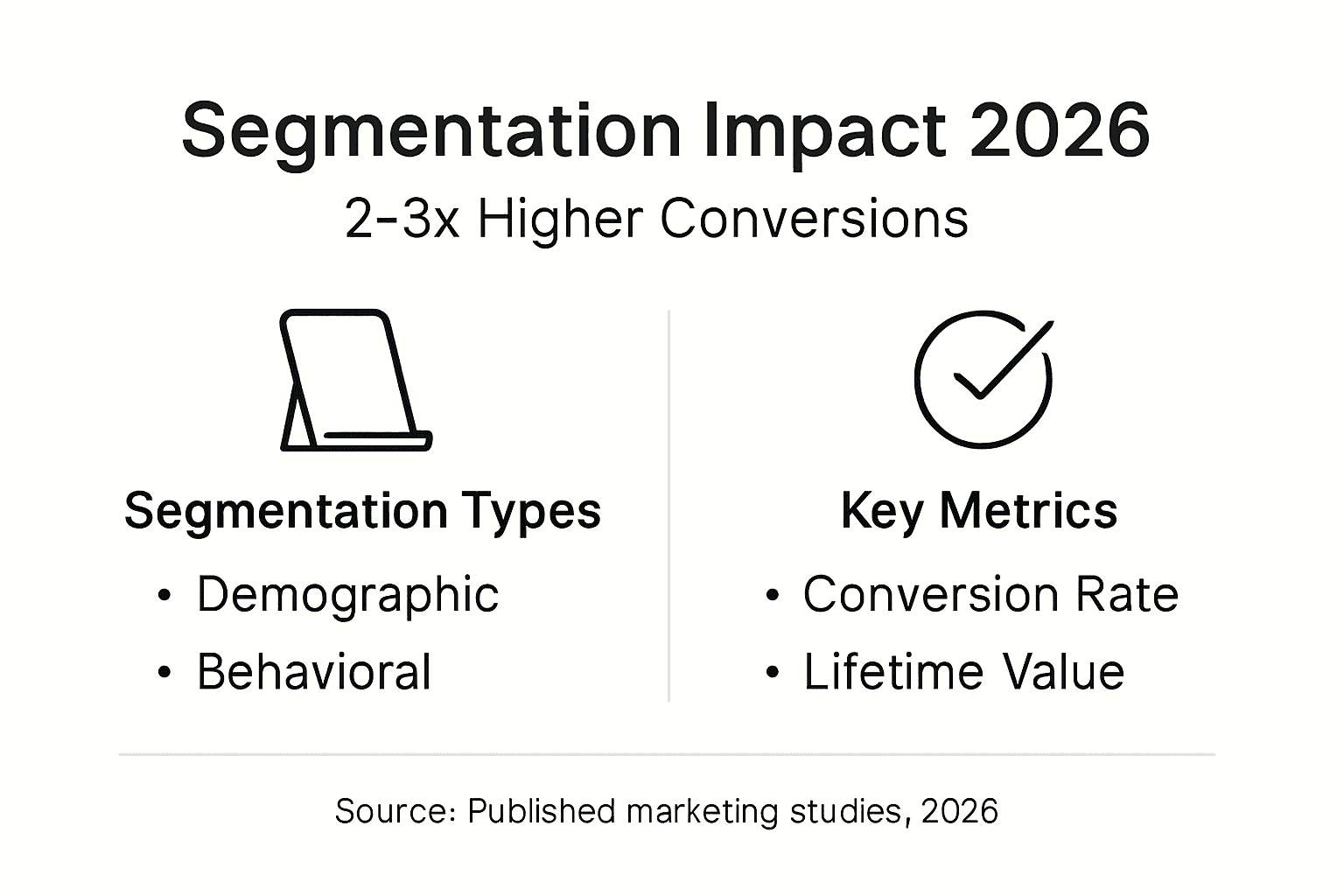
Companies using advanced customer segmentation techniques achieve conversion rates 2 to 3 times higher than those relying on generic marketing approaches. Customer segmentation transforms how you understand and connect with your audience by grouping customers based on shared characteristics. This guide walks you through what segmentation is, the types available, proven benefits, common pitfalls to avoid, and actionable steps to implement segmentation strategies that drive marketing effectiveness and revenue growth in 2026.
Table of Contents
- Understanding Customer Segmentation And Its Business Importance
- Types Of Customer Segmentation And How They Work
- Quantifying The Impact: How Segmentation Drives Marketing Results And Revenue
- Common Misconceptions And Pitfalls In Customer Segmentation
- Real-World Examples: Successful Customer Segmentation Case Studies
- Implementing Customer Segmentation: Best Practices For Business Owners
- Unlock Marketing Growth With Lind Creative
- Frequently Asked Questions
Key takeaways
| Point | Details |
|——-|———||
| Segmentation boosts precision | Dividing customers into targeted groups increases marketing relevance and improves conversion rates significantly. |
| Four core segmentation types | Demographic, behavioral, psychographic, and firmographic segmentation each serve distinct business needs. |
| Proven performance gains | Advanced segmentation delivers up to 3x higher conversions and 14% better email engagement. |
| Regular updates essential | Outdated segments reduce effectiveness; monthly refreshes maintain targeting accuracy. |
| Balance data with insight | Combining quantitative analytics with qualitative customer understanding optimizes segmentation results. |
Understanding customer segmentation and its business importance
Customer segmentation divides your customer base into distinct groups based on shared characteristics like demographics, behaviors, or preferences. This approach enables personalized marketing that speaks directly to each group’s needs rather than broadcasting generic messages. 86% of companies view customer segmentation as essential for growth, demonstrating its widespread recognition as a core strategy.
Segmentation differs from broader market segmentation. While market segmentation analyzes potential customers you haven’t reached yet, customer segmentation focuses specifically on your existing customer base to deepen relationships and maximize lifetime value. Understanding this difference between customer and market segmentation helps you allocate resources effectively.
The benefits extend across your entire marketing operation:
- Improved personalization that resonates with specific customer needs
- Higher conversion rates through targeted messaging and offers
- Better marketing ROI by focusing spend on high-value segments
- Strategic targeting that identifies growth opportunities
“Customer segmentation transforms marketing from guesswork into precision targeting, enabling businesses to deliver the right message to the right person at the right time.”
Implementing segmentation strategies requires commitment to data collection and analysis, but the payoff in marketing effectiveness and revenue growth makes it worthwhile. Companies that embrace segmentation gain competitive advantages through deeper customer understanding and more efficient resource allocation. Why segmentation matters for marketing ROI becomes clear when you see how targeted campaigns outperform generic approaches across every metric.
Types of customer segmentation and how they work
Four major segmentation types form the foundation of effective customer targeting. 48% of companies primarily use demographic segmentation, while 39% rely on behavioral, 34% on psychographic, and 52% of B2B companies use firmographic segmentation. Each type serves different business needs and marketing objectives.
| Segmentation Type | Focus Area | Data Requirements | Best Applications | Key Advantage |
|---|---|---|---|---|
| Demographic | Age, gender, income, education | Basic customer profiles | Mass market products, retail | Easy to collect and implement |
| Behavioral | Purchase history, engagement patterns | Transaction data, website analytics | Ecommerce, subscription services | Reveals actual customer actions |
| Psychographic | Values, interests, lifestyle | Surveys, social listening | Luxury brands, lifestyle products | Deepest emotional connection |
| Firmographic | Company size, industry, revenue | Business databases, CRM | B2B services, enterprise sales | Targets organizational needs |
Demographic segmentation provides the simplest starting point. You group customers by observable characteristics like age brackets, income levels, or geographic location. This approach works well for products with clear demographic appeal, though it may oversimplify complex buying motivations.

Behavioral segmentation tracks what customers actually do. Purchase frequency, average order value, product categories browsed, and email engagement patterns all reveal actionable insights. This data-driven approach identifies your most valuable customers and those at risk of churning.
Psychographic segmentation digs into why customers buy. Values, aspirations, lifestyle choices, and personality traits create segments based on emotional and psychological factors. Brands selling aspirational products find this particularly powerful for crafting messages that resonate deeply.
Firmographic segmentation applies demographic principles to businesses. Company size, industry vertical, annual revenue, and growth stage help B2B companies target organizations most likely to benefit from their solutions. Understanding examples of segmentation types in action clarifies how to apply each approach.
Key facts about segmentation adoption:
- Demographic remains most popular due to data accessibility
- Behavioral segmentation shows strongest correlation with purchase intent
- Psychographic insights command premium pricing in luxury markets
- Firmographic targeting reduces B2B sales cycle length
Pro Tip: Start with demographic and behavioral segmentation if you’re a smaller business with limited data resources. These deliver quick wins and build your segmentation capability. Add psychographic layers over time as you gather deeper customer insights through surveys and engagement tracking.
Choose segmentation types aligned with your specific business goals. Ecommerce thrives on behavioral data, while professional services benefit from firmographic targeting. Many successful businesses combine multiple types for comprehensive customer understanding. Your workflow for segmentation-based marketing should integrate seamlessly with existing systems.
Quantifying the impact: how segmentation drives marketing results and revenue
Strong evidence proves customer segmentation directly improves both marketing performance and financial outcomes. Companies implementing advanced segmentation strategies see measurable gains across conversion rates, engagement metrics, revenue growth, and customer lifetime value.
| Metric | Improvement | Business Impact |
|---|---|---|
| Conversion Rate | 2-3x higher | More customers from same traffic |
| Email Open Rate | 14% increase | Better message relevance |
| Email Click Rate | Up to 101% higher | Stronger engagement and interest |
| Revenue Growth | Average 12% increase | Direct bottom-line improvement |
| Customer Lifetime Value | 22% increase | Higher long-term profitability |
Advanced segmentation drives personalized messaging that resonates with specific customer groups. When you tailor offers, content, and timing to segment preferences, engagement naturally increases. Generic campaigns can’t compete with messages addressing individual needs and pain points.
Segmented email campaigns produce 14% higher open rates and up to 101% more clicks compared to non-segmented campaigns. These aren’t marginal improvements. Doubling your click-through rate means twice as many potential customers engaging with your offers without increasing traffic or ad spend.
Core performance improvements enabled by segmentation include:
- Higher conversion rates through relevant targeting
- Improved customer retention via personalized experiences
- Increased revenue from optimized product recommendations
- Better resource allocation focusing on high-value segments
Key Statistic: Segmented campaigns deliver 14% higher open rates and 101% more clicks than generic emails.
The revenue impact extends beyond immediate sales. Customers receiving personalized experiences show 22% higher lifetime value because they purchase more frequently and remain loyal longer. This compounds over time, making segmentation one of the highest-ROI marketing investments.
Customer retention improves when segmentation identifies at-risk customers early. Behavioral signals like declining purchase frequency or reduced engagement trigger targeted win-back campaigns before customers churn completely. Preventing one lost customer costs far less than acquiring a new one.
These metrics validate segmentation as profitable marketing strategy rather than optional nice-to-have. Companies tracking performance before and after implementing segmentation consistently report double-digit improvements. Understanding how segmentation increases ROI helps justify the investment in data infrastructure and analysis required.
Common misconceptions and pitfalls in customer segmentation
Despite proven benefits, many businesses stumble implementing customer segmentation due to persistent misconceptions and avoidable mistakes. Recognizing these pitfalls early saves time, money, and frustration while maximizing your segmentation effectiveness.
Top misconceptions holding businesses back:
- Segmentation only requires demographic data like age and location
- Customer segments remain stable and don’t need regular updates
- Implementing segmentation automatically guarantees growth
- Small businesses lack resources for effective segmentation
The belief that demographics alone suffice represents the most damaging misconception. Age and location provide starting points, but behavioral and psychographic data reveal why customers buy and how they prefer to engage. Ignoring these deeper insights leaves money on the table through missed personalization opportunities.
Common pitfalls undermining segmentation success:
- Collecting demographic data while ignoring behavioral patterns and preferences
- Creating segments once then never updating as customer needs evolve
- Treating segmentation as a one-time project instead of ongoing strategy
- Over-segmenting into too many tiny groups that dilute marketing impact
- Under-segmenting with overly broad categories that miss nuances
Static or outdated segmentation data harms marketing effectiveness, yet only 22% of companies update segmentation monthly. Customer preferences shift constantly. Economic conditions change. New competitors emerge. Segments created six months ago may no longer reflect current reality.
Static segmentation creates false confidence. You think you understand your customers while actually targeting outdated personas. This explains why some businesses implement segmentation but see disappointing results. The strategy works, but stale data undermines execution.
Pro Tip: Establish a regular monthly cadence for reviewing and updating your segmentation data. Set calendar reminders to analyze new purchase patterns, survey recent customers, and adjust segment definitions based on performance metrics. Treat segmentation as living strategy that evolves with your business.
Segmentation requires integration with broader marketing strategy for success. Creating perfect segments accomplishes nothing if you don’t adjust messaging, offers, and channels accordingly. The segments inform decisions but don’t replace strategic thinking about positioning, value propositions, and competitive differentiation.
Avoiding common marketing mistakes with segmentation means staying vigilant about data quality and maintaining commitment to regular updates. Understanding risks of outdated segmentation helps prioritize ongoing refinement over set-it-and-forget-it approaches.
Real-world examples: successful customer segmentation case studies
Examining how leading companies implement segmentation provides practical inspiration and validates the strategies discussed. Nike demonstrates particularly effective segmentation that drives both engagement and revenue through sport-specific targeting.
Nike segments audiences by sports like running, basketball, and golf, using psychographic and behavioral data to enhance engagement and product fit. Rather than treating all athletic customers identically, Nike recognizes that runners have different needs, values, and purchase patterns than basketball players or golfers.
Benefits Nike achieved through strategic segmentation:
- Increased customer engagement through sport-specific content and communities
- Improved product relevance by designing offerings for specific athletic pursuits
- Higher sales conversion from targeted recommendations matching customer interests
- Stronger brand loyalty within each sport vertical
Nike’s approach extends beyond simple demographic targeting. They collect behavioral data through their apps tracking workouts, purchase history, and engagement with digital content. Psychographic insights about athletic identity, performance goals, and lifestyle preferences inform product development and marketing campaigns.
This multilayered segmentation enables Nike to send running shoe recommendations to marathon trainers while promoting basketball gear to court athletes. The same customer might belong to multiple segments if they participate in various sports, receiving relevant messaging for each interest.
Continuous data collection maintains Nike’s competitive advantage. As customer preferences evolve and new sports gain popularity, Nike adjusts segments accordingly. They don’t rely on assumptions made years ago but actively listen to customer behavior and feedback.
The Nike example illustrates how strategic segmentation inspires innovation. Understanding specific segment needs led Nike to develop specialized products like trail running shoes versus road running shoes. Segmentation insights drive business decisions beyond marketing into product development, retail strategy, and digital experience design.
Business owners can apply similar principles regardless of company size. Start by identifying your customer’s primary use cases or needs. Group customers facing similar challenges or pursuing comparable goals. Use available data like purchase history and survey responses to refine these groups. Test targeted messaging with each segment and measure results.
Your step-by-step segmentation strategy should build incrementally. Begin with two or three clear segments rather than attempting complex models immediately. Prove value with initial segments before expanding.
Implementing customer segmentation: best practices for business owners
Transforming segmentation knowledge into action requires systematic approach and commitment to ongoing refinement. These best practices guide business owners through implementation while avoiding common pitfalls that undermine effectiveness.
Follow this five-step sequence for implementing customer segmentation:
- Collect comprehensive customer data including demographics, purchase history, website behavior, email engagement, and survey responses
- Choose segmentation criteria aligned with your business goals and customer journey stages
- Analyze customer clusters to identify meaningful patterns and segment boundaries
- Implement targeted campaigns with customized messaging, offers, and channel strategies for each segment
- Regularly update segmentation based on performance metrics and evolving customer behaviors
Each step builds foundation for the next. Data collection provides raw material for analysis. Choosing appropriate criteria ensures segments align with business objectives rather than creating arbitrary groups. Analysis transforms data into actionable insights about customer patterns.
Implementing targeted campaigns represents where segmentation delivers tangible value. Create distinct email sequences, landing pages, and ad campaigns for major segments. Test messaging variations to discover what resonates with each group. Track conversion rates, engagement metrics, and revenue by segment.
Regular updates keep segmentation relevant as markets evolve. Review segment performance monthly. Add new customers to appropriate segments as they join. Migrate existing customers between segments when behavior changes signal shifting needs or lifecycle stages.
Pro Tip: Integrate emotional and contextual qualitative insights with quantitative data to deepen customer understanding. Numbers reveal what customers do, but conversations explain why they make those choices. Conduct customer interviews or analyze support tickets to uncover motivations behind behavioral patterns.
Effective segmentation requires balancing analytic rigor with emotional and contextual insights, along with frequent updates. Pure data analysis misses nuances that qualitative research reveals. Combining both approaches creates richer, more actionable segments.
Technology platforms automate much of the segmentation process. Customer relationship management systems, marketing automation tools, and analytics platforms can automatically assign customers to segments based on rules you define. This scales segmentation beyond manual spreadsheet management.
Commit to iterative refinement tied to performance metrics. No segmentation model starts perfect. Test, measure, adjust, and repeat. Track metrics like conversion rate by segment, customer lifetime value by segment, and campaign ROI by segment. Let data guide improvements rather than relying on assumptions.
View segmentation as core ongoing marketing strategy rather than one-time project. Markets shift. Customer preferences evolve. Competitors launch new offerings. Your segmentation must adapt continuously to maintain effectiveness. Companies treating segmentation as living process outperform those creating static models.
Your digital workflow for segmentation should integrate with existing marketing systems. Segments flow into email platforms, ad targeting, content personalization, and sales processes. Segmentation works best when embedded throughout customer experience rather than isolated in analytics.
Unlock marketing growth with Lind Creative
Implementing effective customer segmentation requires expertise, technology, and ongoing commitment that many business owners struggle to maintain alongside daily operations. Lind Creative specializes in developing digital marketing strategies for 2026 that incorporate advanced segmentation techniques proven to boost conversions and revenue.
Our Growth Engine system combines segmentation insights with automated lead capture, personalized funnels, targeted email campaigns, and optimized ad strategies that deliver measurable results. We handle the technical complexity while you focus on running your business. Our collaborative approach ensures segmentation aligns with your specific goals, customer base, and competitive landscape.
Whether you’re launching segmentation for the first time or refining existing strategies, Lind Creative provides the expertise and marketing workflows that leverage segmentation to maximize ROI. Visit our website to explore how our strategy-driven approach transforms customer understanding into revenue growth through precision targeting and personalized experiences.
Frequently asked questions
What is the difference between customer and market segmentation?
Customer segmentation focuses on dividing your existing customer base into groups based on shared characteristics, behaviors, or preferences. Market segmentation analyzes the broader potential market including people who aren’t yet customers to identify opportunities for expansion and new customer acquisition.
How often should customer segments be updated for best results?
Update customer segments monthly to maintain accuracy and relevance as customer behaviors and market conditions evolve. Only 22% of companies currently update segmentation this frequently, giving businesses that commit to regular updates a significant competitive advantage through more precise targeting.
Can small businesses apply advanced customer segmentation techniques?
Small businesses can absolutely implement effective segmentation by starting with basic demographic and behavioral data already available in their CRM or ecommerce platform. Begin with two or three clear segments, prove value through improved conversion rates, then gradually expand segmentation sophistication as data collection improves.
What are the top types of data to collect for effective segmentation?
Prioritize collecting purchase history, email engagement rates, website browsing behavior, customer lifetime value, and demographic information like location and age. Survey data about preferences, pain points, and motivations adds valuable psychographic insights that deepen understanding beyond behavioral patterns alone.
How does segmentation improve customer retention and lifetime value?
Segmentation enables personalized experiences that make customers feel understood and valued, increasing loyalty and reducing churn. Targeted messaging addresses specific needs at appropriate lifecycle stages, leading to 22% higher customer lifetime value through increased purchase frequency, higher average order values, and extended customer relationships.
Recommended
- How to Optimize Website Conversions for eCommerce Success – Lind Creative
- Defining High-Converting Websites for Results-Driven Growth – Lind Creative
- Website Conversion Optimization Guide for Shopify Success – Lind Creative
- How to Design Ecommerce Homepage for Conversions – Lind Creative