
Every Digital Marketing Manager at an American luxury hospitality brand knows the challenge of reconnecting with guests who browse your website but leave without booking. The competition for attention is fierce, and retargeting offers a powerful way to reclaim lost opportunities. By harnessing multi-channel retargeting techniques that include web, email, and social platforms, you can deliver personalized messaging that nudges interested travelers toward conversion. You’ll discover how precision tracking and segmentation can transform casual browsers into loyal guests.
Table of Contents
- Defining Retargeting and How It Works
- Key Retargeting Types and Channels Explained
- Effectiveness of Retargeting for Hospitality Brands
- Best Practices for Engaging High-Value Guests
- Common Pitfalls and Compliance in U.S. Retargeting
Key Takeaways
| Point | Details |
|---|---|
| Retargeting Strategy | Retargeting effectively reconnects with potential customers through personalized ads, enhancing the likelihood of conversions. |
| Compliance Importance | Hospitality brands must navigate data privacy regulations to maintain trust and avoid penalties in U.S. retargeting efforts. |
| Audience Segmentation | Segmenting audiences based on behavior enhances marketing precision and engagement, ultimately driving higher conversion rates. |
| High-Value Guest Engagement | Creating tailored experiences for high-value guests through advanced data analytics fosters loyalty and strengthens brand relationships. |
Defining Retargeting and How It Works
Retargeting is a precision digital marketing strategy that re-engages potential customers who have previously interacted with a hospitality brand’s website or digital platforms. By tracking user behavior and delivering targeted advertisements across different online channels, businesses can strategically remind interested visitors about their offerings and encourage them to complete a booking or purchase.
The core mechanism of retargeting involves sophisticated tracking pixels and browser cookies that capture essential user interaction data. When a potential customer visits a hotel website, views specific room types, or explores package deals, these digital markers enable marketers to create personalized ad experiences that reconnect with those users across various platforms like social media, search engines, and display networks. Specific customer behavior tracking plays a critical role in making these targeted campaigns effective.
Retargeting works through several key strategies:
- Tracking initial website visitor interactions
- Segmenting audiences based on specific behaviors
- Creating customized ad content matching user interests
- Displaying ads on platforms where users are most likely to re-engage
The primary objective of retargeting in hospitality is converting interested browsers into confirmed bookings. By presenting tailored messaging, special offers, or highlighting unique property features, brands can significantly increase their conversion rates. Research indicates that retargeting is particularly powerful when implemented close to a potential customer’s purchase decision stage.
Pro tip: Optimize your retargeting frequency to avoid ad fatigue by limiting display to 3-5 impressions per user per week.
Key Retargeting Types and Channels Explained
Retargeting encompasses multiple strategic approaches that hospitality brands can leverage to reconnect with potential customers across diverse digital platforms. Multi-channel retargeting techniques enable businesses to create sophisticated, personalized marketing experiences that dramatically improve conversion potential.
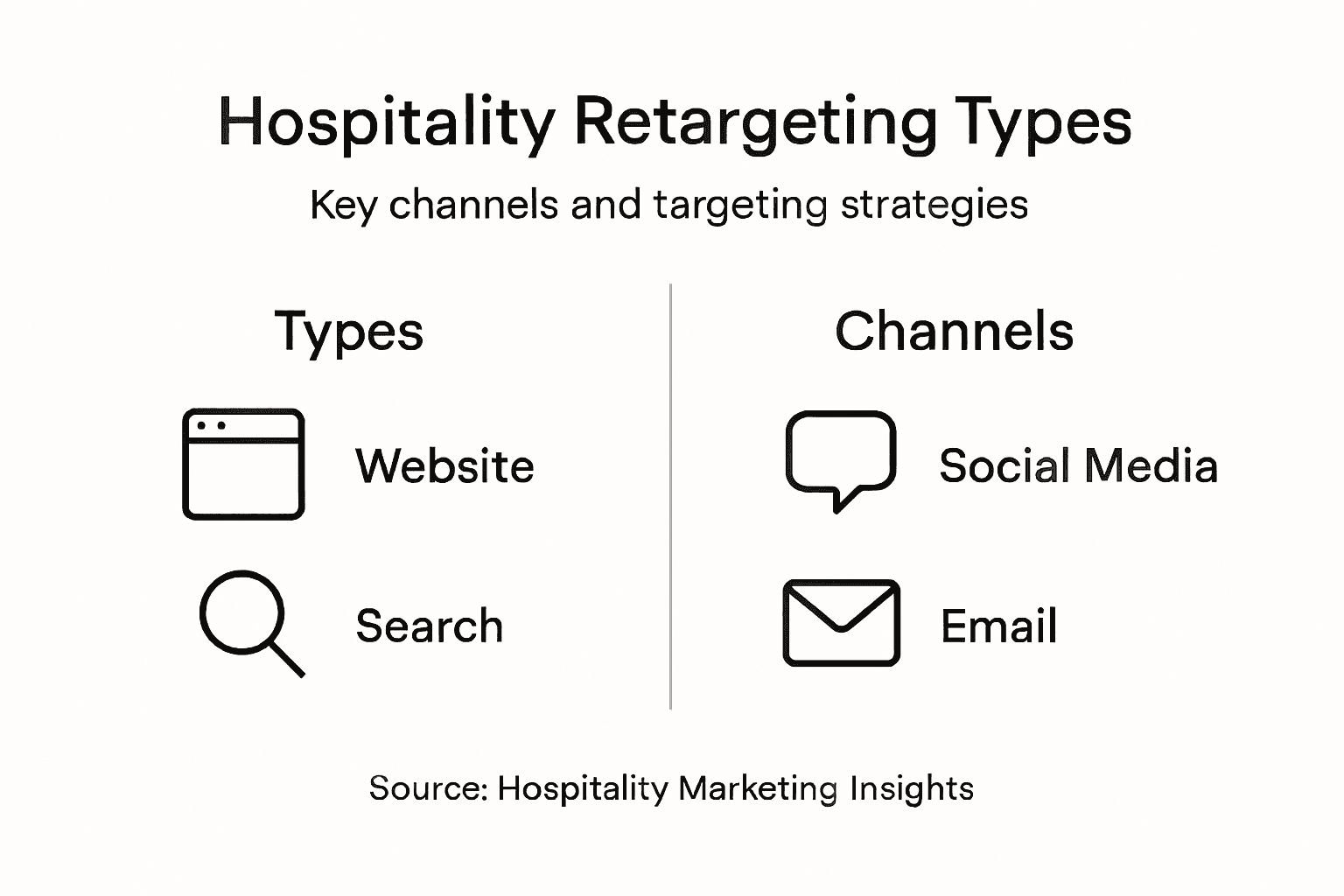
Three primary types of retargeting dominate the digital marketing landscape for hospitality brands:
- Website Retargeting: Tracking and re-engaging visitors who previously browsed hotel websites
- Search Retargeting: Targeting users based on their previous search engine behaviors
- Social Media Retargeting: Displaying customized ads on platforms like Facebook and Instagram
The most effective retargeting channels include:
Here’s a summary comparing the main retargeting types in hospitality marketing:
| Retargeting Type | Target Audience | Core Benefit | Example Application |
|---|---|---|---|
| Website Retargeting | Recent website visitors | Boosts booking conversions | Hotel room viewers |
| Search Retargeting | Users with relevant searches | Reaches high-intent travelers | People searching destinations |
| Social Media Retargeting | Social platform users | Enhances brand engagement | Instagram sponsored posts |
- Display advertising networks
- Social media platforms
- Email marketing campaigns
- Search engine marketing
Successful retargeting requires precision and strategic segmentation. Predictive targeting allows marketers to create highly personalized ad experiences that resonate with specific customer segments. By analyzing browsing behaviors, past interactions, and demographic data, hospitality brands can craft laser-focused advertising that speaks directly to potential guests’ preferences and interests.
Pro tip: Implement cross-channel retargeting strategies that maintain consistent messaging across different platforms to maximize customer engagement and recall.
Effectiveness of Retargeting for Hospitality Brands
Targeted marketing strategies have revolutionized how hospitality brands connect with potential guests, with retargeting emerging as a powerful tool for driving conversions and enhancing customer engagement. By strategically re-engaging visitors who have previously shown interest, hotels can significantly improve their booking rates and overall marketing efficiency.
The impact of retargeting in the hospitality industry is substantial, with key benefits including:
- Increased brand recall
- Higher conversion rates
- More personalized marketing experiences
- Cost-effective customer acquisition
- Reduced marketing waste
Research demonstrates that personalized retargeting can dramatically transform marketing outcomes. By analyzing user behaviors and preferences, hospitality brands can create hyper-targeted advertisements that speak directly to potential guests’ specific interests. This approach goes beyond traditional marketing by delivering contextually relevant messaging that resonates with individual travelers.

Successful retargeting strategies typically involve multiple touchpoints across different digital platforms. From social media ads to display networks, the goal is to maintain consistent brand visibility and gently guide potential guests through the booking journey. The most effective campaigns combine strategic timing, compelling visuals, and irresistible offers that trigger an emotional connection with the target audience.
Pro tip: Develop a retargeting strategy that segments audiences based on specific behaviors, such as destination preferences, booking history, or engagement levels, to maximize marketing precision.
Best Practices for Engaging High-Value Guests
Creating exceptional guest experiences requires a sophisticated approach that goes beyond traditional hospitality marketing. High-value guests demand personalized, memorable interactions that make them feel uniquely understood and appreciated.
Key strategies for engaging premium guests include:
- Leveraging advanced data analytics for personalization
- Developing hyper-targeted communication approaches
- Anticipating guest needs before they arise
- Creating emotionally resonant brand experiences
- Delivering consistently exceptional service
Successful engagement relies on strategic personalization techniques. By collecting and analyzing guest data, hospitality brands can craft tailored experiences that speak directly to individual preferences. This might involve remembering a guest’s preferred room type, anticipating dietary restrictions, or offering curated local experiences that align with their interests.
Technology plays a critical role in elevating guest experiences. Advanced customer relationship management (CRM) systems, artificial intelligence, and machine learning enable brands to create nuanced, dynamic profiles that transform generic interactions into deeply personalized connections. The most sophisticated hospitality brands view each guest interaction as an opportunity to build long-term loyalty and emotional attachment.
Pro tip: Implement a comprehensive guest feedback system that captures granular insights, allowing continuous refinement of personalization strategies and service delivery.
Common Pitfalls and Compliance in U.S. Retargeting
Compliant retargeting strategies have become increasingly critical for hospitality brands navigating the complex landscape of data privacy regulations. U.S. businesses must carefully balance marketing effectiveness with stringent legal requirements to avoid potential penalties and maintain consumer trust.
Key compliance challenges for retargeting include:
- Obtaining explicit user consent
- Implementing transparent data collection practices
- Ensuring robust data security protocols
- Maintaining comprehensive user privacy controls
- Adapting to evolving state and federal privacy laws
The legal landscape surrounding digital marketing continues to evolve rapidly. Hospitality brands must navigate multiple regulatory frameworks, including the California Consumer Privacy Act (CCPA) and emerging state-level privacy regulations. This requires a proactive approach to data management that prioritizes user consent, data transparency, and robust privacy protection mechanisms.
Implementing effective compliance strategies involves several critical steps. Hospitality brands should invest in consent management platforms, develop clear privacy policies, and create transparent opt-out mechanisms. Technology plays a crucial role, with advanced tools enabling brands to track user preferences, manage data collection, and ensure compliance across multiple digital platforms.
This table outlines key compliance risks versus recommended solutions for U.S. retargeting campaigns:
| Compliance Risk | Potential Impact | Best-Practice Solution |
|---|---|---|
| Lacking user consent | Legal penalties, lost trust | Robust consent management platform |
| Data collection opacity | Regulatory investigation | Transparent privacy policy |
| Weak security protocols | Data breaches, fines | Regular security audits |
| Evolving state laws | Non-compliance fines | Ongoing legal and tech updates |
Pro tip: Conduct quarterly privacy compliance audits and maintain a dynamic consent management system that adapts to changing regulatory requirements.
Elevate Your Hospitality Marketing with Precision Retargeting Solutions
Retargeting is essential for hospitality brands aiming to transform casual website visitors into loyal guests. If you struggle with converting high-intent browsers or worry about wasted marketing spend due to ineffective audience targeting retargeting can be your breakthrough. By using personalized ad experiences and multi-channel strategies your hotel or travel service can increase brand recall and drive more bookings with laser-focused messaging that speaks to each guest’s unique preferences.
Ready to eliminate guesswork and maximize conversions Lind Creative offers full-service digital solutions that blend creativity technology and strategic insight. Our signature Growth Engine helps automate lead capture funnels and targeted advertising campaigns that Keep your brand visible and compelling across platforms. Discover how our expert team can craft a high-converting website and tailored retargeting campaigns specifically for the hospitality industry. Take the next step to grow your bookings and brand with Lind Creative. Explore more about our approach to strategy-driven design and marketing and start transforming your digital presence today.
Frequently Asked Questions
What is retargeting in hospitality marketing?
Retargeting in hospitality marketing is a digital strategy that re-engages potential customers who have previously visited a hotel’s website or digital platforms. It uses tracking pixels and browser cookies to deliver personalized advertisements, reminding users about the hotel’s offerings and encouraging them to complete a booking.
How does retargeting increase conversion rates for hotels?
Retargeting can increase conversion rates by targeting users who have shown interest in specific room types or packages. By delivering tailored messaging and special offers based on users’ behaviors, hotels can effectively turn interested browsers into confirmed bookings.
What are the types of retargeting strategies used by hospitality brands?
The main types of retargeting strategies include website retargeting, search retargeting, and social media retargeting. Each of these methods targets users based on their online behaviors and interactions, enabling highly personalized marketing experiences.
What are some best practices for effective retargeting campaigns in the hospitality industry?
Best practices for hospitality retargeting campaigns include optimizing ad frequency to avoid user fatigue, implementing predictive targeting to personalize ad experiences, maintaining consistent messaging across platforms, and developing segmented audiences based on specific behaviors and interests.
Recommended
- What Is a Landing Page and Its Impact on Hospitality Leads – Lind Creative
- Key Digital Marketing Terms Driving Hotel Growth – Lind Creative
- How to Analyze Website Traffic for Better Guest Acquisition – Lind Creative
- Why Rebrand: Elevating Luxury Hospitality Success – Lind Creative