
Most American companies now understand that effective design is far more than decoration—studies show that design-focused businesses outperform standard market indices by over 200 percent. In a crowded landscape where every detail shapes perception, strategic design investment is redefining how brands capture attention and loyalty. This article explains how purposeful design decisions elevate business value, fuel growth, and help American organizations stand out where it matters most.
Table of Contents
- Defining Design Investment And Its Value
- Design Types And Their Business Impact
- How Design Drives Customer Conversion
- Brand Perception And Market Differentiation
- Measuring Roi And Avoiding Costly Design Mistakes
Key Takeaways
| Point | Details |
|---|---|
| Design Investment is Strategic | Viewing design as a critical investment rather than a mere expense can lead to enhanced brand perception and improved operational effectiveness. |
| Diverse Design Types Drive Growth | Embracing various design types, such as product and service design, allows organizations to create targeted solutions that enhance competitive positioning. |
| Design is Essential for Conversion | Effective design influences customer conversion by creating intuitive user experiences and fostering emotional connections with the brand. |
| Measuring Design ROI is Crucial | Implementing comprehensive frameworks to quantify design impact ensures businesses can optimize their design investments for sustainable growth. |
Defining Design Investment and Its Value
Design investment transcends mere aesthetic improvements—it represents a strategic approach to enhancing business performance and competitive positioning. At its core, design investment involves purposefully allocating resources to create visual, functional, and experiential elements that drive measurable business outcomes. Design-focused companies outperform traditional market indices by significant margins, demonstrating the profound financial potential of strategic design integration.
Businesses that prioritize design recognize it as a powerful differentiator in crowded marketplaces. By viewing design not as an expense but as a critical investment, companies can transform their brand perception, customer engagement, and operational effectiveness. Investing in design enhances market position and improves customer loyalty, creating tangible advantages that extend far beyond visual appeal. Effective design strategies can streamline product development, reduce production costs, and create more intuitive user experiences that resonate with target audiences.
The multifaceted nature of design investment encompasses several key dimensions:
- Strategic Branding: Developing visual identities that communicate company values
- User Experience Design: Creating intuitive interfaces and customer journeys
- Product Development: Integrating design thinking into innovation processes
- Operational Optimization: Utilizing design principles to improve efficiency
Pro Tip – Design Investment Strategy: Approach design as a holistic business strategy by establishing clear metrics to measure design’s impact, such as conversion rates, customer satisfaction scores, and brand recognition, ensuring your design investments deliver measurable business value.
By understanding design as a strategic asset rather than a cosmetic expense, businesses can unlock significant growth potential and create meaningful connections with their target audiences.
Design Types and Their Business Impact
Design is not a monolithic concept but a dynamic ecosystem of strategic approaches that drive business transformation. Different design types offer unique pathways for organizational growth and innovation, each addressing specific business challenges and opportunities. From product design to brand experience, these specialized design methodologies provide targeted solutions that enhance competitive positioning and operational effectiveness.
The primary design types critical to business success include:
- Product Design: Creating physical and digital products that solve customer problems
- Service Design: Developing comprehensive customer interaction frameworks
- Brand Design: Crafting visual and narrative identities that communicate core values
- Experience Design: Engineering holistic user journeys across multiple touchpoints
- Business Model Design: Reimagining organizational structures and revenue generation strategies
Business models represent strategic frameworks that integrate multiple design approaches to drive innovation and scalability. These models enable businesses to diversify revenue streams, optimize operational processes, and create adaptive strategies that respond to rapidly changing market dynamics. By understanding and implementing sophisticated design approaches, organizations can transform potential challenges into strategic opportunities.
Here’s a comparison of key design types and their unique business impact:
| Design Type | Main Focus | Primary Business Benefit |
|---|---|---|
| Product Design | Improving product usability and appeal | Drives sales through product value |
| Service Design | Streamlining customer interaction processes | Enhances retention and satisfaction |
| Brand Design | Solidifying brand image and values | Boosts recognition and loyalty |
| Experience Design | Shaping holistic user journeys | Increases engagement and trust |
| Business Model Design | Innovating revenue and operational models | Supports scalability and resilience |
The interconnected nature of design types means that businesses should view them as complementary rather than isolated strategies. Successful organizations integrate these design approaches to create cohesive, responsive systems that anticipate and meet customer needs with precision and creativity.
Pro Tip – Design Integration Strategy: Conduct a comprehensive design audit to identify how different design types can be strategically aligned across your organization, ensuring a holistic approach that maximizes innovation and operational efficiency.
By embracing a multifaceted design approach, businesses can unlock unprecedented levels of adaptability, customer engagement, and sustainable growth.

How Design Drives Customer Conversion
Design is a powerful psychological tool that transforms passive observers into active customers. Graphic design serves as a critical mechanism for building corporate identity and establishing customer trust, creating visual narratives that speak directly to consumer emotions and decision-making processes. By strategically crafting visual experiences, businesses can guide potential customers through sophisticated conversion pathways that feel intuitive and compelling.
The conversion process is fundamentally driven by several key design elements:
- Visual Hierarchy: Directing attention to critical information and call-to-action points
- Color Psychology: Using color schemes that evoke specific emotional responses
- User Experience Design: Creating seamless, friction-free interaction paths
- Emotional Resonance: Developing visual stories that connect with audience values
- Cognitive Simplicity: Reducing cognitive load through clean, purposeful design
Successful design-driven conversion strategies recognize that visual communication transcends aesthetic appeal. Each design element serves a strategic purpose—from typography that enhances readability to layout configurations that subtly guide user behavior. Professional design signals credibility, reduces user uncertainty, and creates unconscious trust signals that lower psychological barriers to purchase.
Modern consumers are increasingly design-literate, making visual communication more critical than ever. They rapidly evaluate brands through design quality, making split-second decisions based on perceived professionalism, reliability, and alignment with personal values. Businesses that invest in sophisticated, purposeful design can transform their conversion rates by speaking a visual language that resonates deeply with their target audience.
Pro Tip – Conversion Design Audit: Regularly conduct user experience testing to identify and eliminate design friction points that might prevent potential customers from completing desired actions.
By understanding design as a strategic conversion tool, businesses can create powerful visual experiences that transform casual interest into genuine customer commitment.
Brand Perception and Market Differentiation
Design establishes a powerful dialogue with customers, transforming brand perception from a passive communication channel into an active strategic asset. In today’s competitive marketplace, design serves as the critical interface between a business’s core values and audience expectations, creating visual narratives that communicate authenticity, professionalism, and unique market positioning.
Key dimensions of brand differentiation through design include:
- Visual Identity: Creating distinctive visual language
- Emotional Resonance: Connecting through meaningful aesthetic experiences
- Consistency: Maintaining uniform brand representation across platforms
- Storytelling: Communicating brand narrative through strategic visual elements
- Innovation: Demonstrating forward-thinking approach through design choices
Product packaging and decor represent crucial touchpoints for brand perception, offering tangible opportunities to communicate brand personality. These design elements transcend mere aesthetic considerations, functioning as silent brand ambassadors that communicate quality, values, and market positioning to potential customers. Sophisticated design choices signal professionalism, creativity, and attention to detail, differentiating businesses in crowded marketplaces.
Successful market differentiation requires a holistic approach where design becomes a strategic tool for building brand recognition and customer loyalty. By developing a cohesive visual language that resonates with target audiences, businesses can transform design from a cosmetic consideration into a powerful competitive advantage that communicates brand essence more effectively than words alone.
Pro Tip – Brand Design Audit: Conduct a comprehensive visual audit annually to ensure your design elements consistently reflect your brand’s evolving narrative and market positioning.
By viewing design as a strategic communication platform, businesses can create meaningful connections that transform casual interactions into lasting brand relationships.
Measuring ROI and Avoiding Costly Design Mistakes
The Design Value Index provides crucial tools for quantifying design investment returns, transforming design from a subjective creative process into a measurable strategic asset. Design ROI goes beyond traditional financial metrics, encompassing both tangible financial outcomes and intangible brand value that drive long-term business growth. Businesses must develop comprehensive frameworks that capture the multidimensional impact of design investments.
Key performance indicators for measuring design ROI include:
- Conversion Rate Improvements: Tracking user engagement and purchase behavior
- Customer Acquisition Cost: Analyzing design’s impact on marketing efficiency
- Brand Perception Metrics: Measuring shifts in audience sentiment and recognition
- Operational Efficiency: Quantifying cost reductions through streamlined design processes
- Competitive Differentiation: Assessing market positioning and unique value proposition
Effective design integration can dramatically reduce production costs and improve operational workflows, preventing expensive redesign cycles and strategic missteps. Common design mistakes that businesses must avoid include inconsistent branding, neglecting user experience, overcomplicating visual communication, and failing to align design with core business objectives. Proactive design audits and iterative testing can help organizations identify and mitigate potential design-related risks before they escalate.
Successful design ROI measurement requires a holistic approach that balances quantitative metrics with qualitative insights. Businesses must move beyond surface-level evaluations and develop nuanced understanding of how design drives value across multiple organizational dimensions.
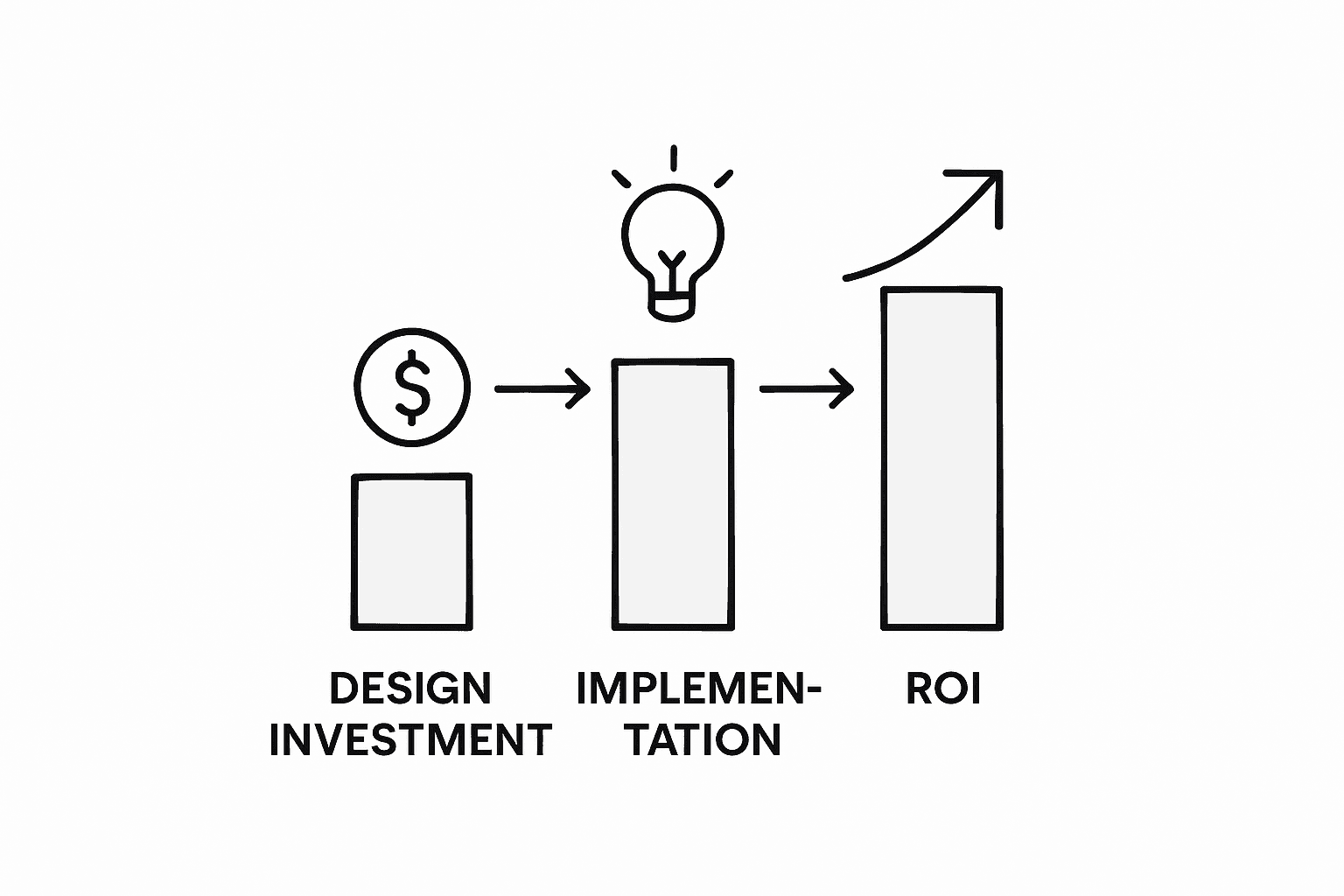
Pro Tip – Design Performance Tracking: Implement a quarterly design performance review that combines data-driven metrics with strategic alignment assessments, ensuring continuous improvement and ROI optimization.
By adopting a systematic, strategic approach to design investment, businesses can transform design from a cost center into a powerful engine of sustainable growth and competitive advantage.
This table summarizes the main ways design investments deliver measurable business results:
| Business Result | Design-Driven Mechanism | Example Metric |
|---|---|---|
| Improved Conversion | Enhanced visual and UX cues | Increased sales or sign-ups |
| Reduced Costs | Streamlined workflows via design | Lower production expenses |
| Stronger Brand Equity | Consistent, appealing visual identity | Higher brand recall and reputation |
| Greater Customer Loyalty | Emotional connection through design | Repeat purchases, higher retention |
Drive Business Growth by Investing in Strategic Design
Struggling to translate your design investment into measurable business results is a common challenge. This article highlights how viewing design as a strategic asset—not just an aesthetic element—can unlock growth through enhanced brand perception, improved customer conversion, and operational efficiency. If your goal is to create a high-performing brand identity, optimize user experience, and avoid costly design mistakes, you need a partner that understands these complex dynamics.
At Lind Creative, we combine creativity, technology, and strategy to deliver design solutions that drive real ROI. Whether you want to launch a new brand, refresh your online presence, or scale with a proven marketing system, our team will help you measure success and accelerate growth. Discover how our approach aligns with the industry insights featured in Industry Trends – Lind Creative and explore how we craft high-converting digital solutions in Web Design – Lind Creative.
Ready to transform your design investment into tangible business growth? Visit Lind Creative today to start your journey toward a strategy-driven brand that attracts, converts, and retains customers. Together, we can unlock your full growth potential.
Frequently Asked Questions
What is design investment and why is it important for businesses?
Design investment is the strategic allocation of resources to enhance visual, functional, and experiential elements of a business. It plays a critical role in improving brand perception, customer engagement, and operational effectiveness, ultimately driving measurable business outcomes.
How can design improve customer conversion rates?
Design enhances customer conversion rates by utilizing visual hierarchy, color psychology, and seamless user experiences. Well-crafted design elements guide users effectively through the conversion process, making it visually intuitive and emotionally resonant.
What are the primary types of design that businesses should focus on?
Businesses should consider several primary design types: Product Design, Service Design, Brand Design, Experience Design, and Business Model Design. Each of these types addresses specific challenges and contributes uniquely to organizational growth and innovation.
How can businesses measure the return on investment (ROI) from their design efforts?
Businesses can measure design ROI through various key performance indicators, including conversion rate improvements, customer acquisition cost, brand perception metrics, operational efficiency, and competitive differentiation. A comprehensive framework that encompasses both quantitative and qualitative metrics is essential for accurate assessment.
Recommended
- The Essential Guide to Investing in Branding – Lind Creative
- Role of Design in Marketing: Driving Brand Growth and Impact – Lind Creative
- Role of Website Design: Complete Guide for Businesses – Lind Creative
- The Essential Guide to Website Role in Business Growth – Lind Creative