
Allocating marketing dollars can feel risky when you’re unsure which channels truly drive bookings for your luxury hotel. In the United States hospitality market, the guest journey is shaped by a complex blend of online and offline touches from Instagram ads to Google reviews. Understanding marketing attribution means identifying which interactions actually influence reservations, helping you shift from guesswork to clear, data-backed decisions that maximize digital marketing ROI.
Table of Contents
- Defining Marketing Attribution for Hospitality
- Why Attribution Matters for Your Hotel
- The Complexity of Hospitality Attribution
- How This Improves Your Hotel’s ROI
- Major Marketing Attribution Model Types
- Simple Rule-Based Models
- Advanced Multi-Touch Models
- Which Model Fits Your Hotel?
- Mapping Guest Journeys in Luxury Hospitality
- Why Guest Journey Mapping Matters
- Building Your Guest Journey Map
- Using Data to Personalize Without Intrusion
- Common Attribution Pitfalls and How to Avoid Them
- Mistaking Attribution for Causation
- The Last-Click Attribution Trap
- Ignoring Brand Equity and Loyalty
- Data Integration Failures
- Moving Beyond Simple Models
- Proven Tactics to Improve Attribution ROI
- Integrate Your Data Systems
- Implement Consistent Tracking Across Channels
- Segment Your Attribution Analysis
- Test and Optimize Continuously
- Audit Your Channel Mix Quarterly
Key Takeaways
| Point | Details |
|---|---|
| Understanding Marketing Attribution | Marketing attribution is crucial for luxury hotels to make informed budget decisions by evaluating which marketing channels effectively drive bookings. |
| Guest Interaction Complexity | Guests typically engage with an average of five to seven touchpoints before making a reservation, highlighting the need for a multi-channel attribution approach. |
| Importance of Accurate Data | Accurate attribution helps hotels allocate budget more effectively, optimizing marketing strategies towards channels that yield the highest returns. |
| Utilizing Guest Journey Mapping | Mapping guest journeys transforms raw attribution data into actionable insights, enhancing the overall guest experience and increasing conversion rates. |
Defining Marketing Attribution for Hospitality
For luxury hotel marketers, understanding marketing attribution is the difference between making smart budget decisions and throwing money at channels that don’t drive bookings. Attribution is the process of identifying and assigning value to the marketing touchpoints that lead a potential guest from initial awareness to a completed reservation.
Think of your guest’s journey like a multi-course dining experience at your property. They might first see your Instagram ad, then click through to your website after receiving an email, browse reviews on Google, and finally complete their booking after visiting your landing page. Without attribution, you wouldn’t know which course was most memorable or necessary for their decision.
Why Attribution Matters for Your Hotel
Luxury hospitality operates in a crowded marketplace where decision-making involves multiple touchpoints and extended consideration periods. Guests don’t wake up and immediately book—they research, compare, read reviews, and interact with your brand across different channels before committing their money.
Marketing attribution helps you understand:
- Which channels actually drive conversions (bookings and revenue)
- How different marketing efforts work together across your guest’s journey
- Where to allocate your budget for maximum impact
- The true cost per acquisition across your entire marketing mix
Your guests interact with your brand across an average of five to seven touchpoints before booking. Attribution reveals which ones matter most for your specific property and audience.
Many hotel marketers make budget decisions based on incomplete data. They see paid search generating high traffic and assume it’s the most valuable channel, missing that email campaigns and organic search actually sealed the deals by reinforcing the decision at the right moment.
The Complexity of Hospitality Attribution
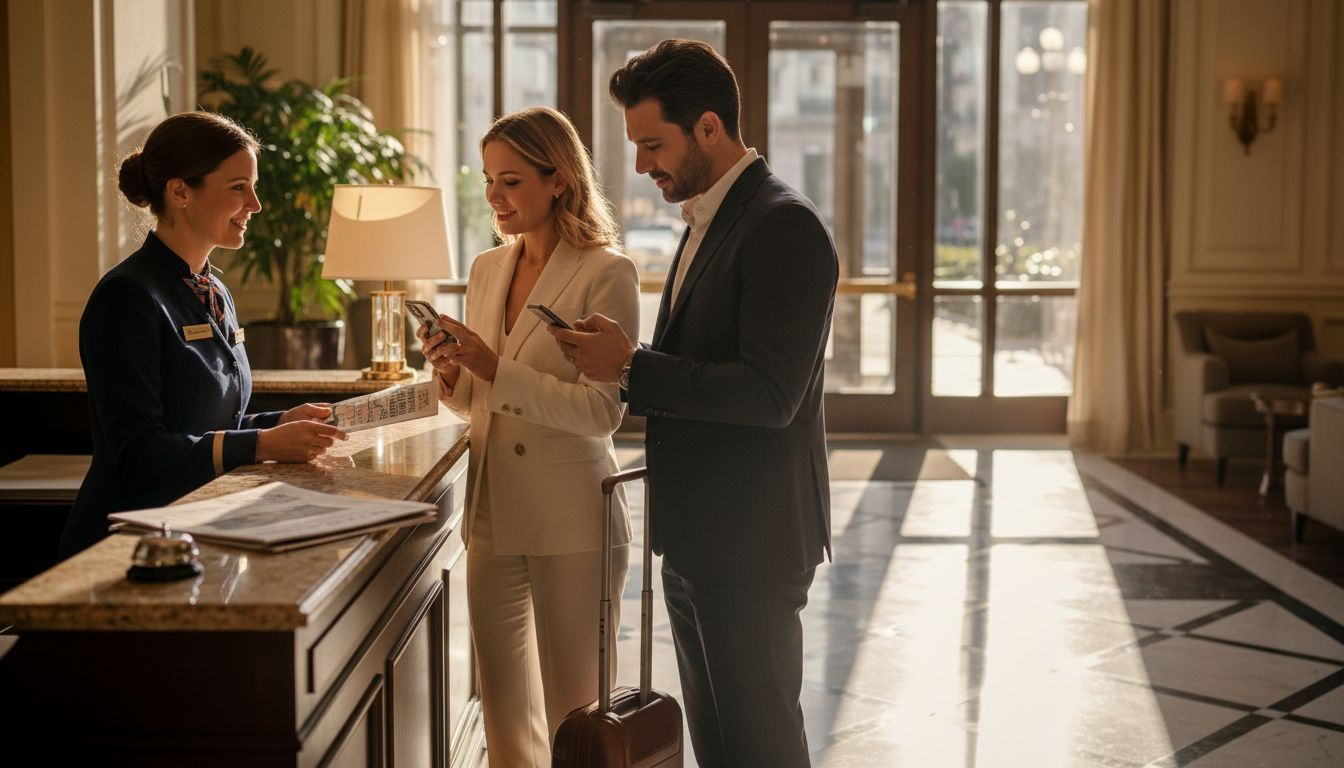
Hospitality attribution is uniquely complex because it involves both online and offline activities. A guest might see your billboard on their drive to the airport, receive a targeted Facebook ad weeks later, read a travel blog featuring your property, check booking sites for availability, and finally call your front desk before reserving.
Marketing attribution in hospitality) requires data-driven models that track these diverse interactions and quantify how each channel influenced the final booking decision. This multi-channel approach goes beyond simple last-click attribution, which only credits the final touchpoint before conversion.
Your hotel likely uses multiple channels:
- Paid search (Google Ads, Bing)
- Social media advertising (Instagram, Facebook, TikTok)
- Email campaigns and newsletters
- Organic search rankings
- Direct website visits
- Travel booking sites (Expedia, Booking.com)
- Public relations and reviews
- Partnerships and referrals
Each channel plays a different role at different stages of the guest’s journey. Attribution models help you assign credit fairly based on their actual influence.
How This Improves Your Hotel’s ROI
Accurate attribution directly impacts your bottom line. When you know which marketing channels and combinations drive bookings, you can optimize your spending. Some channels might seem expensive until you understand they’re actually responsible for closing deals that other channels initiated.
With proper attribution, you shift from guessing to knowing. You stop over-investing in channels that generate awareness but no conversions. You identify hidden channel combinations that work exceptionally well together for your luxury positioning.
This knowledge compounds over time. Each quarter, you refine your understanding, shift budget to higher-performing channels, improve campaign messaging based on what resonates with bookers, and ultimately reduce your cost per reservation while increasing booking quality.
Pro tip: Start tracking guest touchpoints across all channels immediately if you aren’t already. The longer your data collection period, the more accurate your attribution model becomes and the faster you’ll identify profitable channel combinations.
Major Marketing Attribution Model Types
Not all attribution models work equally well for luxury hotels. Understanding the main types helps you choose the right approach for your property’s marketing strategy. Each model assigns credit differently across your guest’s journey, revealing different insights about what actually drives bookings.
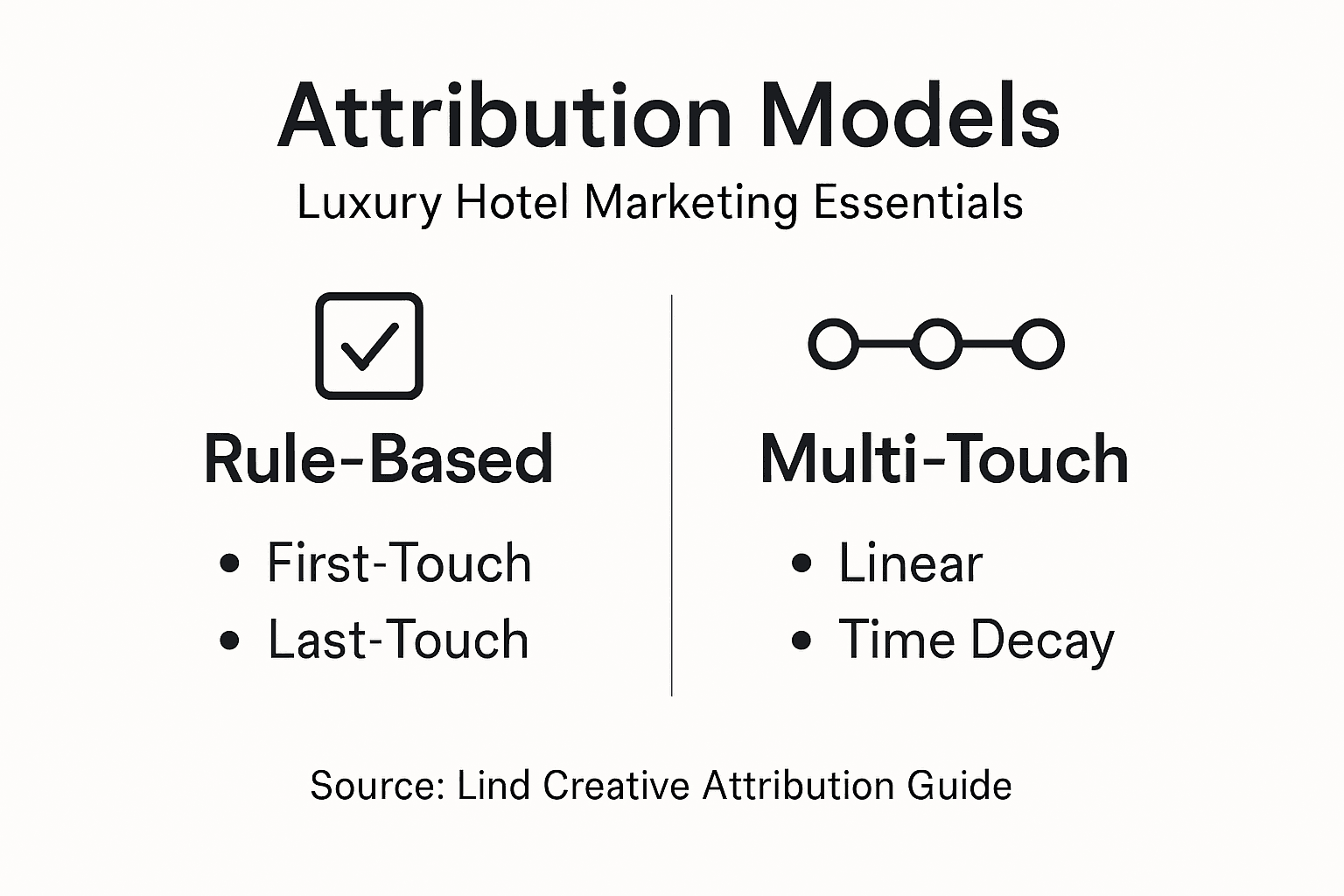
Attribution models fall into two categories: rule-based models use predetermined formulas to assign credit, while algorithmic models use data-driven methods to analyze actual customer pathways. Rule-based approaches are simpler to implement but less precise. Algorithmic models require more sophistication but deliver more accurate insights into which channels truly influence bookings.
Simple Rule-Based Models
First-touch attribution gives all credit to the first marketing touchpoint that introduced a guest to your hotel. This model works well for understanding awareness channels like display ads, billboards, or PR that initially spark interest.
Last-touch attribution credits only the final interaction before booking. This model often overvalues performance marketing channels like paid search while undervaluing the channels that built trust earlier in the journey.
Linear attribution distributes credit equally across all touchpoints. If a guest interacted with your brand five times before booking, each touchpoint receives 20% credit. This approach is fair but doesn’t reflect reality—the first ad and the final email reminder don’t have equal influence.
Time decay attribution gives more weight to recent interactions. Touchpoints closer to the booking date receive higher credit. This makes sense for hospitality because guests are more likely to book after seeing your property recently in their feed or inbox.
Luxury hotels often see guests booking within days or weeks after their final touchpoint. Time decay captures this behavior better than linear models.
Here’s a quick comparison of common marketing attribution models for hospitality:
| Attribution Model | How Credit Is Assigned | Best Use Case | Typical Limitation |
|---|---|---|---|
| First-touch | 100% to first interaction | Awareness channel evaluation | Misses later influences |
| Last-touch | 100% to last interaction | Direct booking optimization | Ignores earlier touchpoints |
| Linear | Equal split across touchpoints | Holistic channel assessment | Not all touchpoints equal |
| Time decay | More credit to recent actions | Short booking cycles | May undervalue early steps |
| Position-based (U-shaped) | Most to first & last, rest split | Combined awareness/conversion | Can be complex to interpret |
| Algorithmic/Multi-touch | Data-driven credit for all | Advanced budget decisions | Needs lots of data/resources |
Advanced Multi-Touch Models
Position-based attribution (sometimes called bathtub or U-shaped) gives extra credit to the first and last touchpoints while distributing remaining credit across middle interactions. Many luxury marketers favor this model because awareness channels and conversion channels both matter.
Multi-touch attribution models analyze all customer touchpoints using advanced methods. These include Markov chains, which simulate how guests move between channels, and Shapley value calculations, which assign credit based on the incremental impact of each channel.
These sophisticated approaches require more data and technical expertise but reveal hidden patterns:
- Which channel combinations drive the highest-value bookings
- Which channels amplify each other’s effectiveness
- True incremental impact of removing a channel from your mix
- Optimal budget allocation for your specific guest segments
The right attribution model depends on your data maturity and analytical resources, not which one sounds most impressive. Start simple, master it, then graduate to advanced approaches.
Which Model Fits Your Hotel?
Your choice depends on complexity tolerance, budget, and technical capabilities. Smaller luxury properties might start with time decay or position-based models using basic analytics tools. Larger hotels with dedicated marketing teams can implement Markov chain or regression-based models through advanced analytics platforms.
Consider your guest booking timeline too. Hotels with longer consideration periods benefit from models that credit awareness channels. Properties with fast-decision bookings might rely more heavily on last-touch or time decay approaches.
Many successful luxury hotels use hybrid approaches—combining two models to get complementary insights. For example, using position-based attribution for budget allocation while tracking last-touch performance separately for paid channel optimization.
Pro tip: Start with position-based attribution for 60-90 days, then layer in time decay or Markov chain analysis using a platform like Google Analytics 4 or specialized attribution software to compare results and identify which model resonates with your actual booking patterns.
Mapping Guest Journeys in Luxury Hospitality
Mapping guest journeys is where attribution becomes actionable for your hotel. It’s not enough to know which channels drive bookings—you need to understand exactly when, where, and how your guests interact with your brand across every stage from awareness through post-stay.
A guest journey map visually displays every touchpoint a guest encounters, from their first discovery of your property through check-out and beyond. For luxury hospitality, these journeys are complex. A guest might see your Instagram ad on Monday, research reviews on Wednesday, receive a personalized email Thursday, browse your website Friday, and book Saturday after calling your front desk.
Why Guest Journey Mapping Matters
Your attribution data only tells you which channels are credited with bookings. Guest journey mapping reveals the story behind those numbers. It shows you where guests encounter friction, which touchpoints build trust, and where personalization makes the biggest impact.
Luxury travelers expect seamless experiences across channels. They don’t want to repeat information they’ve already shared. They expect your team to know their preferences without being asked. Journey mapping identifies where you’re falling short and exceeding expectations.
When you understand your guest’s complete path to booking, you can:
- Identify redundant or confusing touchpoints that waste budget
- Spot friction points where guests abandon their booking process
- Discover high-impact moments where personalization drives conversions
- Optimize messaging to match guest mindset at each stage
- Allocate marketing budget to the stages with highest abandonment
Building Your Guest Journey Map
Mapping guest journeys requires consolidating data from multiple systems including your booking system, email platform, website analytics, social media, and customer relationship management tools. Without unified data, you’re missing pieces of the puzzle.
Start by identifying your core guest segments. A couple booking an anniversary getaway has a different journey than a corporate group booking conference accommodations. Journey maps should be segment-specific because these groups interact with different channels and have different decision timelines.
For each segment, map out:
- Pre-awareness stage (how they discover your property type)
- Awareness stage (first interaction with your brand)
- Consideration stage (researching your property vs. competitors)
- Decision stage (final steps before booking)
- Booking stage (reservation process)
- Pre-arrival stage (communications before check-in)
- Stay experience (all in-property interactions)
- Post-stay stage (follow-up and loyalty engagement)
Guest journey mapping transforms raw attribution data into strategic insights that drive revenue. The hotels winning in luxury hospitality aren’t just tracking channels—they’re designing experiences.
Using Data to Personalize Without Intrusion
Luxury guests value privacy deeply. Effective journey mapping enables you to personalize experiences based on preferences they’ve explicitly shared, not invasive data collection. If a guest noted they prefer morning coffee service, have it ready at check-in. If they traveled with you previously and chose a corner suite, offer the same upgrade.
This balance between personalization and privacy makes the difference between a guest feeling known and a guest feeling surveilled. Your data should make experiences smoother, not creepy.
Identify key decision moments in your map—moments where a small personalization creates disproportionate impact. These are typically:
- First welcome communication after booking
- Pre-arrival confirmation email
- Check-in arrival
- Special occasion recognition
- Post-stay thank you and feedback request
These moments compound. One personalized email might increase conversion by 5%, but five personalized touchpoints across the journey might increase lifetime value by 40%.
Pro tip: Audit your current guest journeys by actually walking through your booking process from a guest’s perspective across all channels, then overlay this with your attribution data to spot where guests are completing bookings despite friction, not because of streamlined experiences.
Common Attribution Pitfalls and How to Avoid Them
Attribution seems straightforward until you start digging into your data. Most luxury hotel marketers encounter pitfalls that silently distort their understanding of what’s actually driving bookings. These mistakes lead to budget cuts in channels that work and overspending on channels that don’t.
The biggest pitfall is confusing attributed revenue with incremental revenue. A guest might book after seeing your email, so attribution credits email with that booking. But would they have booked anyway without the email? Probably not—but you won’t know unless you test it.
Mistaking Attribution for Causation
Attribution models show correlation, not causation. Just because a guest clicked your Facebook ad before booking doesn’t mean Facebook caused the booking. The guest might have booked regardless after finding your property through word-of-mouth or a travel blog.
Over-attributing causality to marketing touchpoints without accounting for external factors leads to inflated ROI claims. Maybe your property sold out because of a celebrity feature in a magazine. Attribution might credit your paid search instead if guests searched for your property after reading the article.
Luxury travelers are influenced by factors outside your control:
- Brand reputation and word-of-mouth
- Travel trends and seasonal demand
- Competitor actions and pricing
- Media coverage and public relations
- Economic conditions affecting discretionary spending
- Personal circumstances and life events
Strong attribution models acknowledge these factors rather than pretending marketing operates in a vacuum.
The Last-Click Attribution Trap
Many hotels default to last-click attribution because it’s simple. A guest searches for your property, clicks your paid search ad, and books. Last-click attributes 100% of credit to paid search.
But what created that search demand? Your Instagram campaign introducing guests to your property two weeks earlier. Your email retargeting after they visited your website. Your PR placement in a luxury travel magazine.
Last-click ignores all the awareness and trust-building work. You’ll cut your awareness budget to fuel paid search, then watch search demand decline as fewer people know about your property.
Ignoring Brand Equity and Loyalty
Repeat guests book differently than first-time visitors. A loyal guest might book after seeing one email because they already trust your property. A first-timer needs multiple touchpoints across several weeks.
Standard attribution treats both journeys equally, which masks what actually drives loyalty revenue. Your attribution might show email is ineffective for acquisition, when really it’s highly effective for retention.
Segment your attribution analysis:
- New guest acquisitions (longer journeys, multiple touchpoints)
- Repeat bookings (shorter journeys, single or two-touch paths)
- High-value guests (different channel preferences)
- Seasonal visitors (unique consideration timelines)
Attribution without segmentation is like reading a hotel review without knowing if the reviewer stayed in a basic room or penthouse suite. Context completely changes the story.
Data Integration Failures
Many hotels can’t properly attribute because their data lives in silos. Your PMS doesn’t talk to your email platform. Your website analytics don’t connect to your CRM. Your social media platform reports separately from your booking system.
Without unified data, you’re attributing based on incomplete journeys. A guest might see a Facebook ad, visit your website, and book via email—but if your systems don’t connect, you’ll only see the email touchpoint.
Start fixing this immediately. Connect your systems through APIs or choose an attribution platform that integrates multiple data sources. Incomplete attribution data leads to wrong decisions.
Moving Beyond Simple Models
If you’re using first-touch, last-touch, or linear models exclusively, you’re missing insights. These simple approaches work for initial testing, but graduate to position-based or multi-touch models once you have basic data maturity.
Position-based models credit first and last touchpoints while acknowledging middle touchpoints. Multi-touch models like Markov chains show how channels work together. These advanced approaches take more effort but reveal patterns simple models hide.
You don’t need perfection. You need accuracy that’s good enough to make better budget decisions than you’re making now.
Pro tip: Before implementing a new attribution model, run it parallel with your current model for 30-60 days to validate assumptions, then compare the insights each generates to identify which one actually changes your budget decisions.
Proven Tactics to Improve Attribution ROI
Improving your attribution ROI isn’t about finding the perfect model. It’s about systematically learning what works, eliminating what doesn’t, and reallocating budget accordingly. The hotels winning at attribution share common practices that compound over time.
These tactics work regardless of your hotel size or attribution sophistication. You don’t need advanced Markov chains to see immediate ROI improvements. Start with the fundamentals, master them, then layer in complexity as your data maturity grows.
Integrate Your Data Systems
Your attribution is only as good as your data integration. A guest journey that spans email, website, social, and phone calls requires all those systems talking to each other. If they don’t, you’re flying blind.
Start by connecting your core systems:
- PMS to CRM (guest history to marketing data)
- Email platform to analytics (email opens and clicks to website behavior)
- Google Analytics to booking system (traffic sources to actual reservations)
- Ad platforms to CRM (ad interactions to customer records)
- Social media to website tracking (clicks to conversions)
Many platforms offer native integrations. If not, use tools like Zapier or custom APIs. The investment pays for itself through better attribution insights.
Without integration, you’re making budget decisions based on incomplete data. You might cut social advertising because you can’t see the connection between a social click and a later booking.
Implement Consistent Tracking Across Channels
UTM parameters are your foundation for attribution. Every marketing link should have consistent, standardized UTM tags so you can track traffic sources accurately. A guest clicking your Instagram ad should land with tracked parameters showing source, medium, campaign, and content.
Establish UTM naming conventions your team follows religiously:
- Source: instagram, google, email, facebook, direct
- Medium: paid_social, organic_social, email, cpc, referral
- Campaign: property name or promotion (summer_sale_2024)
- Content: specific ad or email subject line
Inconsistent UTM tags create attribution chaos. “Instagram” and “instagram” are different tags. “Meta_paid” and “facebook” are different tags. Pick standards and enforce them.
Beyond UTM parameters, implement pixel-based tracking on your website and booking system. Facebook Pixel, Google Analytics 4, and other tracking tools let you see conversions that originated from specific sources.
Segment Your Attribution Analysis
Learning from performance feedback through accurate attribution requires comparing results across different guest segments, not lumping everyone together. A tactic that works for acquisition might fail for retention.
Analyze attribution separately for:
- New guest acquisitions vs. repeat bookings
- High-value guests vs. budget-conscious travelers
- Seasonal visitors vs. year-round guests
- Different property locations or room types
- Guests from different geographic regions
You’ll discover that email drives 40% of repeat bookings but only 5% of new bookings. Paid search dominates acquisition but underperforms for loyalty. These insights change everything about budget allocation.
Segmented attribution reveals hidden patterns that aggregate data buries. The hotel that understands what drives each guest type wins the budget allocation game.
Test and Optimize Continuously
Attribution models are hypotheses to be tested, not facts to be accepted. Run A/B tests on channel combinations. If you hypothesize that social + email drives better results than social alone, test it.
Set up simple experiments:
- Choose two comparable guest segments
- Expose one to channel A alone
- Expose the other to channel A plus channel B
- Compare conversion rates and booking values
- Let results guide budget decisions
Small tests with 500-1000 guests per group reveal patterns your attribution models might miss. A channel that seems ineffective in attribution data might outperform in direct testing.
Audit Your Channel Mix Quarterly
Don’t let attribution sit static. Every 90 days, analyze which channels are underperforming and which are overperforming relative to their cost. Reallocate 10-15% of budget from underperformers to emerging opportunities.
If organic search is driving 30% of bookings but consuming 20% of budget, you’re underinvesting there. If social media is driving 5% of bookings while consuming 30% of budget, you need to optimize or reduce spend.
This quarterly rhythm keeps your marketing efficient. Budgets stuck in yesterday’s decisions become budget waste.
Pro tip: Start with a simple spreadsheet tracking bookings by source monthly, then layer in booking value and cost per acquisition to see which channels truly drive ROI—you’ll spot budget allocation mistakes immediately.
Unlock the Full Potential of Your Luxury Hotel Marketing Attribution
Struggling to turn complex marketing data into clear budget decisions that actually boost your bookings and revenue This article highlights the challenge luxury hotels face in accurately tracking every guest touchpoint across channels like paid search, social media, and email campaigns. If you find yourself overwhelmed by attribution models or trapped by incomplete, siloed data Lind Creative can help transform how you analyze and act on your marketing insights.
By integrating your data systems and deploying our signature Growth Engine you gain a seamless, strategy-driven marketing system designed to capture leads, personalize guest journeys, and optimize your spend with data-backed precision. Our expertise in creating high-converting websites and cohesive brand identities means your marketing not only attracts attention but converts it to reservations and loyalty.
Take the guesswork out of your hotel’s marketing spend and start maximizing ROI today Visit us at Lind Creative to explore how our full-service digital solutions can elevate your attribution strategies. Learn more about our tailored branding and marketing services and how we can help you build, brand, and grow with measurable results that matter now.
Frequently Asked Questions
What is marketing attribution in the context of luxury hotels?
Marketing attribution for luxury hotels is the process of identifying and assigning value to marketing touchpoints that lead potential guests from initial awareness to a completed reservation. It helps hotel marketers understand which channels effectively drive bookings and how different marketing efforts work together throughout the guest’s journey.
Why is marketing attribution important for luxury hotels?
Marketing attribution is essential for luxury hotels as it informs budget allocation, reveals the true cost per acquisition, and identifies the channels that genuinely drive conversions. This knowledge allows for optimized marketing strategies and improved return on investment (ROI).
What are the common models of marketing attribution used in hospitality?
Common marketing attribution models in hospitality include first-touch attribution, last-touch attribution, linear attribution, time decay attribution, position-based attribution, and algorithmic/multi-touch models. Each model offers different insights into how marketing channels contribute to bookings.
How can I improve my hotel’s ROI through marketing attribution?
To improve ROI, integrate data systems across all channels, implement consistent tracking methods, segment your analysis by guest types, continuously test and optimize marketing efforts, and audit your channel mix quarterly to make informed budget decisions.
Recommended
- What Is Retargeting: Boosting Conversions for Hospitality – Lind Creative
- 7 Key Benefits of Branding for Luxury Hospitality Success – Lind Creative
- Multi Channel Strategy: Boosting Luxury Hotel Bookings – Lind Creative
- Why Market Research Matters for Luxury Hospitality – Lind Creative
- Managed WordPress Website + SEO & PPC – $2,750/Month | MonsterWP