
When a potential guest visits your website, every digital moment shapes their perception of your hotel’s sophistication and service. Luxury hospitality brands across the United States face growing pressure to offer not just elegant design, but intuitive and anticipatory digital experiences. By prioritizing dynamic, context-aware user interfaces, you can create seamless journeys that exceed guest expectations, deepen engagement, and drive higher conversion rates in an increasingly competitive market.
Table of Contents
- User Interface Defined For Hospitality Brands
- Types Of User Interfaces In Luxury Websites
- Key UI Elements That Influence Guest Journey
- Design Principles For High-Converting Experiences
- Common UI Mistakes To Avoid In Hospitality
Key Takeaways
| Point | Details |
|---|---|
| User Interface Evolution | Modern luxury hospitality interfaces focus on real-time personalization and seamless interactions to enhance guest experiences. |
| Interface Types | Different types of interfaces, including immersive visual, personalization, and conversational, cater to distinct aspects of guest engagement. |
| Design Principles | Effective design principles prioritize visual clarity, emotional resonance, and frictionless interaction to optimize conversion rates. |
| UI Mistakes to Avoid | Common errors include complex navigation and visual inconsistency, which can detract from user experience and brand perception. |
User Interface Defined for Hospitality Brands
A user interface represents the digital gateway through which guests interact with a hospitality brand’s digital platforms, bridging the gap between technological functionality and human experience. Unlike traditional static screens, modern hospitality interfaces are dynamic, intelligent systems designed to create seamless, personalized interactions.
In the luxury hospitality sector, user interfaces have evolved dramatically, moving beyond simple transaction points to become sophisticated, adaptive digital environments. These interfaces now incorporate multiple critical elements:
- Real-time personalization capabilities
- Context-aware interaction design
- Intelligent recommendation systems
- Streamlined booking and service request mechanisms
- Responsive design across multiple digital touchpoints
Advanced hospitality user interfaces prioritize not just visual aesthetics, but also functional efficiency. They transform complex backend systems into intuitive, user-friendly experiences that anticipate guest needs before they are explicitly expressed. By integrating artificial intelligence and machine learning, these interfaces can now predict preferences, suggest personalized options, and create a more engaging digital interaction.

The core objective of a sophisticated hospitality user interface is to reduce friction in the guest journey. Whether a user is exploring room options, making reservations, or requesting special services, the interface should feel natural, responsive, and effortlessly aligned with the brand’s luxury positioning.
Pro tip: Invest in user interface design that feels like a concierge — anticipatory, elegant, and intuitively responsive to individual guest needs.
Types of User Interfaces in Luxury Websites
Luxury hospitality websites demand sophisticated user interface designs that transcend traditional digital interactions. These interfaces are not merely functional tools, but sophisticated digital experiences that reflect the brand’s premium positioning and commitment to exceptional customer service.
The primary types of user interfaces in luxury hospitality websites include:
- Immersive Visual Interfaces
- High-resolution image galleries
- Panoramic room and property views
- Interactive virtual tour systems
- Personalization Interfaces
- Dynamic content recommendation engines
- Customizable booking experiences
- Tailored service suggestion platforms
- Conversational Interfaces
- AI-powered chatbots
- Live customer support integration
- Intelligent concierge systems
These interfaces are strategically designed to enhance luxury website features by creating intuitive, elegant digital environments that mirror the brand’s physical experience. Advanced interfaces seamlessly blend aesthetic sophistication with functional excellence, allowing guests to explore, book, and engage with the brand through highly responsive and visually compelling digital platforms.
Each interface type serves a distinct purpose in crafting a comprehensive digital hospitality experience. Visual interfaces showcase the property’s unique attributes, personalization interfaces anticipate and fulfill individual guest preferences, and conversational interfaces provide immediate, intelligent support that feels both high-tech and deeply human.
Here is a comparison of interface types and their strategic impacts in luxury hospitality:
| Interface Type | Typical Features | Strategic Impact |
|---|---|---|
| Immersive Visual | Virtual tours, rich media | Enhances visual brand storytelling |
| Personalization | Tailored content, smart suggestions | Drives loyalty and repeat bookings |
| Conversational | AI chat, live concierge | Increases guest engagement |
Pro tip: Design user interfaces that transform digital interactions into luxurious, memorable experiences that extend your brand’s storytelling beyond physical spaces.
Key UI Elements That Influence Guest Journey
User interface elements in luxury hospitality are strategic touchpoints that transform digital interactions into memorable brand experiences. These carefully designed components go far beyond simple functionality, serving as sophisticated narrative tools that guide guests through a seamless, personalized journey.
The critical UI elements that profoundly influence the guest experience include:
- Navigation and Interaction Design
- Intuitive menu structures
- Responsive search functionalities
- Clear visual hierarchies
- Personalization Mechanisms
- Dynamic content recommendations
- Preference memory systems
- Customizable user dashboards
- Emotional Engagement Features
- High-resolution visual storytelling
- Interactive property exploration tools
- Ambient sound and video integration
Luxury hospitality brands are now implementing customer journey mapping strategies that create intelligent, anticipatory digital environments. These interfaces seamlessly blend aesthetic sophistication with functional excellence, anticipating guest needs before they are explicitly expressed and providing a frictionless, emotionally resonant digital experience.
Each UI element is meticulously crafted to address specific stages of the guest journey. Navigation elements provide clarity and ease, personalization features create a sense of individual recognition, and emotional engagement tools transform digital interactions into immersive brand narratives that extend far beyond transactional experiences.
The following table summarizes how core UI elements support each stage of the guest journey:
| Guest Journey Stage | Supporting UI Element | Benefit for Guests |
|---|---|---|
| Discovery | Visual storytelling | Inspires and builds interest |
| Decision | Personalized recommendations | Simplifies selection process |
| Booking | Streamlined forms and navigation | Reduces friction and confusion |
| Post-booking | Interactive dashboards | Helps manage reservations easily |
Pro tip: Design UI elements that feel like a digital concierge — intuitive, responsive, and deeply attuned to individual guest preferences.
Design Principles for High-Converting Experiences
Digital design principles in luxury hospitality are strategic frameworks that transform user interfaces from mere functional tools into compelling conversion engines. These meticulously crafted principles bridge the gap between aesthetic elegance and measurable business performance, creating digital experiences that not only attract but actively convert potential guests.
The core design principles for high-converting luxury hospitality experiences include:
- Visual Clarity and Hierarchy
- Clean, uncluttered page layouts
- Strategic use of negative space
- Intuitive visual navigation paths
- Emotional Resonance
- High-resolution, immersive imagery
- Storytelling through visual design
- Color palettes that evoke brand identity
- Frictionless Interaction Design
- Minimal required form fields
- One-click booking capabilities
- Smooth, predictive form completion
Luxury brands can significantly improve digital performance by optimizing website elements for conversions. These design principles work synergistically to create a digital environment that feels simultaneously sophisticated, effortless, and deeply personalized—transforming casual browsers into committed guests.
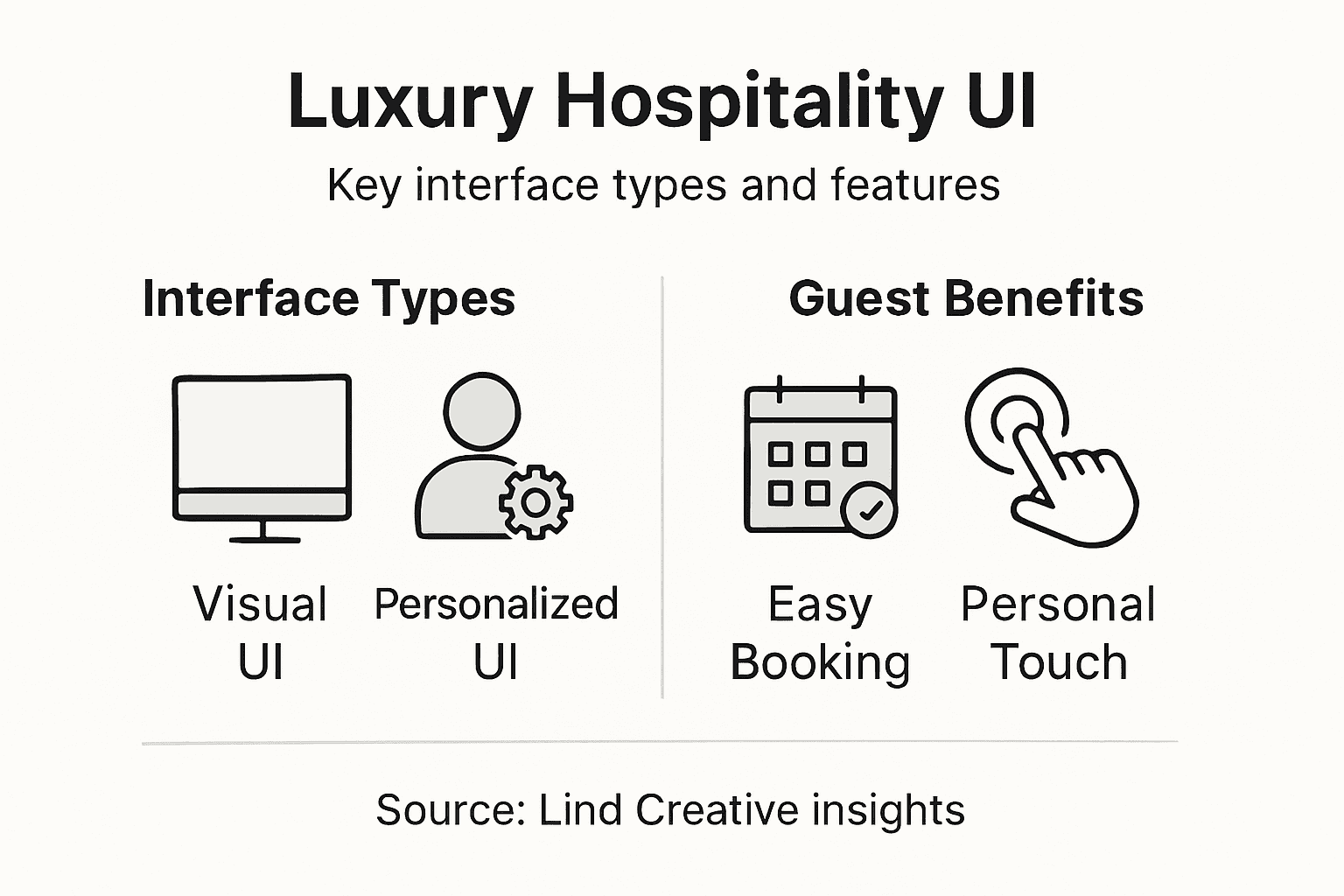
Successful conversion-oriented design goes beyond aesthetics. It requires a deep understanding of user psychology, leveraging visual cues, interaction patterns, and emotional triggers that guide potential guests seamlessly from initial interest to confirmed reservation. Each design element serves a strategic purpose, reducing cognitive load while increasing emotional engagement.
Pro tip: Design interfaces that feel like a natural conversation with a trusted concierge — intuitive, responsive, and elegantly simple.
Common UI Mistakes to Avoid in Hospitality
In the competitive landscape of luxury hospitality, user interface design can make or break the digital guest experience. Small design missteps can quickly transform a potential booking into a missed opportunity, causing significant revenue loss and brand reputation damage.
The most critical UI mistakes luxury hospitality brands frequently encounter include:
- Navigation Complexity
- Overcrowded menu structures
- Confusing site hierarchies
- Non-intuitive search functionalities
- Visual Inconsistency
- Misaligned color schemes
- Inconsistent typography
- Jarring design transitions
- Performance Barriers
- Slow-loading image galleries
- Complex booking processes
- Unresponsive mobile designs
Brands can significantly improve their digital performance by understanding user experience principles. These common UI mistakes often stem from a disconnect between aesthetic aspirations and functional user needs, creating digital environments that look impressive but fail to convert effectively.
Successful UI design in luxury hospitality requires a delicate balance between visual sophistication and intuitive functionality. Each design element must serve a strategic purpose, reducing cognitive friction while maintaining the brand’s premium positioning. The goal is to create interfaces that feel effortless, anticipatory, and deeply personalized.
Pro tip: Conduct regular user testing and heat map analysis to identify and eliminate friction points in your digital interfaces.
Elevate Your Luxury Hospitality Brand with Strategic User Interface Design
Struggling to bridge the gap between stunning aesthetics and seamless guest experiences It is clear the challenge lies in creating a user interface that not only reflects your luxury brand’s sophistication but also anticipates and simplifies every step of the guest journey From intuitive navigation to personalized recommendations your digital presence must feel like a trusted concierge that engages and converts visitors effortlessly
At Lind Creative we understand these unique challenges and specialize in designing high-converting websites that blend creativity technology and strategy Our full-service digital agency approach ensures your online platforms feature streamlined booking processes intelligent personalization and responsive designs ready to delight your guests 24/7
Isn’t it time your digital interface worked as hard as your hospitality brand does Craft a memorable and frictionless guest experience that drives bookings and loyalty today Explore how we can help you build a powerful brand identity and deploy our signature Growth Engine for measurable results Visit Lind Creative now to start transforming your luxury hospitality user interface into a compelling conversion machine
Frequently Asked Questions
What is a user interface in luxury hospitality?
A user interface in luxury hospitality refers to the digital platforms through which guests interact with a brand. It aims to create seamless, personalized experiences and embodies the sophistication and efficiency of the brand.
How do user interfaces enhance the guest experience in luxury hotels?
User interfaces enhance the guest experience by providing real-time personalization, context-aware design, and intelligent recommendations, making the process of exploring, booking, and requesting services smoother and more engaging.
What are the main types of user interfaces used in luxury hospitality websites?
The main types of user interfaces include immersive visual interfaces, personalization interfaces, and conversational interfaces, each designed to reflect the brand’s premium positioning and cater to individual guest preferences.
What design principles should be considered for high-converting user interfaces in luxury hospitality?
Key design principles include visual clarity, emotional resonance, and frictionless interaction design to create an elegant and effortless digital environment that guides potential guests smoothly through their journey.
Recommended
- What Is User Experience and Its Impact on Luxury Hospitality – Lind Creative
- Why UX Matters for Hospitality Conversions – Lind Creative
- What Is User Journey and Why It Matters – Lind Creative
- Why Customer Experience Matters for Luxury Hotels – Lind Creative