
More than 80 percent of American guests say their brand loyalty depends on memorable hospitality experiences. For marketing directors at luxury properties, understanding each touchpoint of the customer journey directly shapes satisfaction and future revenue. With American travelers expecting highly tailored service, mastering this dynamic process gives hospitality brands a competitive edge, reveals guest motivations, and uncovers new strategies to drive engagement that lasts beyond check-out.
Table of Contents
- Defining The Customer Journey In Hospitality
- Key Stages Across Guest Experiences
- Types Of Customer Journey Mapping Techniques
- Personalization And Digital Touchpoints That Matter
- Common Pitfalls And How To Avoid Them
Key Takeaways
| Point | Details |
|---|---|
| Understanding the Customer Journey | The customer journey in hospitality encompasses multiple stages from awareness to post-stay engagement, highlighting the importance of emotional and sensory interactions. |
| Importance of Guest Personas | Recognizing diverse guest personas helps tailor experiences to meet unique expectations, enhancing customer loyalty. |
| Utilizing Mapping Techniques | Employing a combination of qualitative and quantitative mapping techniques enables hotels to create more personalized service strategies. |
| Avoiding Common Pitfalls | Being proactive in addressing communication and technological shortcomings can significantly improve guest satisfaction and loyalty. |
Defining the Customer Journey in Hospitality
The customer journey in hospitality represents a comprehensive framework that tracks guests’ interactions, emotions, and experiences from initial awareness through post-stay engagement. Comprehensive customer journey analysis reveals this process extends far beyond traditional transactional encounters, encompassing cognitive, emotional, and sensory interactions across multiple touchpoints.
At its core, the customer journey integrates multiple stages where guests encounter and interact with a hospitality brand. These stages typically include pre-booking research, reservation, arrival, stay experience, departure, and post-stay communication. Each touchpoint presents an opportunity to create meaningful connections, build trust, and ultimately drive customer loyalty. Holistic guest experience mapping demonstrates that understanding these interactions allows brands to design more personalized and responsive service strategies.
Successful customer journey mapping requires strategic segmentation and deep insights into guest behaviors. Different traveler personas—business executives, leisure tourists, luxury seekers—navigate hospitality experiences with unique expectations and emotional drivers. By recognizing these nuanced differences, hotels can craft targeted experiences that resonate with specific guest segments, transforming standard service interactions into memorable, distinctive encounters that inspire repeat business and positive recommendations.
Here’s a comparison of common guest personas and how their hospitality journey expectations differ:
| Guest Persona | Key Expectations | Emotional Drivers |
|---|---|---|
| Business Executive | Efficient check-in/out | Stress reduction, reliability |
| Leisure Tourist | Local experiences | Fun, relaxation |
| Luxury Seeker | Personalized attention | Exclusivity, prestige |
| Family Vacationer | Safety, child amenities | Comfort, convenience |
Pro tip: Create detailed guest personas that capture emotional and rational decision-making factors to develop more precise and empathetic customer journey strategies.
Key Stages Across Guest Experiences
The hospitality customer journey encompasses multiple interconnected stages that begin long before a guest arrives at a hotel and continue well after departure. Strategic guest experience phases typically include inspiration, discovery, research, booking, arrival, stay, departure, and post-stay engagement, each representing a critical opportunity for creating memorable interactions and building lasting brand loyalty.
These stages are not linear but dynamic and interactive, with each touchpoint offering unique potential for enhancing guest satisfaction. Hotel customer journey stages break down into key moments: pre-booking research where potential guests explore options, the reservation process, arrival and check-in experience, in-stay services and amenities, departure procedures, and post-stay communication. Each of these moments represents a chance to differentiate the brand and create emotional connections that transform transactional interactions into meaningful experiences.
Successful hospitality brands understand that modern travelers expect personalized, seamless interactions across all journey stages. This requires sophisticated strategies that integrate digital technologies, anticipate guest needs, and create consistent experiences that align with individual guest preferences. By mapping and optimizing each stage, hotels can develop targeted approaches that address specific traveler segments—whether business professionals, luxury seekers, or family vacationers—ensuring that every interaction feels tailored and intentional.
Pro tip: Develop comprehensive journey maps that document emotional states, pain points, and opportunities at each stage to create more empathetic and responsive guest experiences.
Types of Customer Journey Mapping Techniques
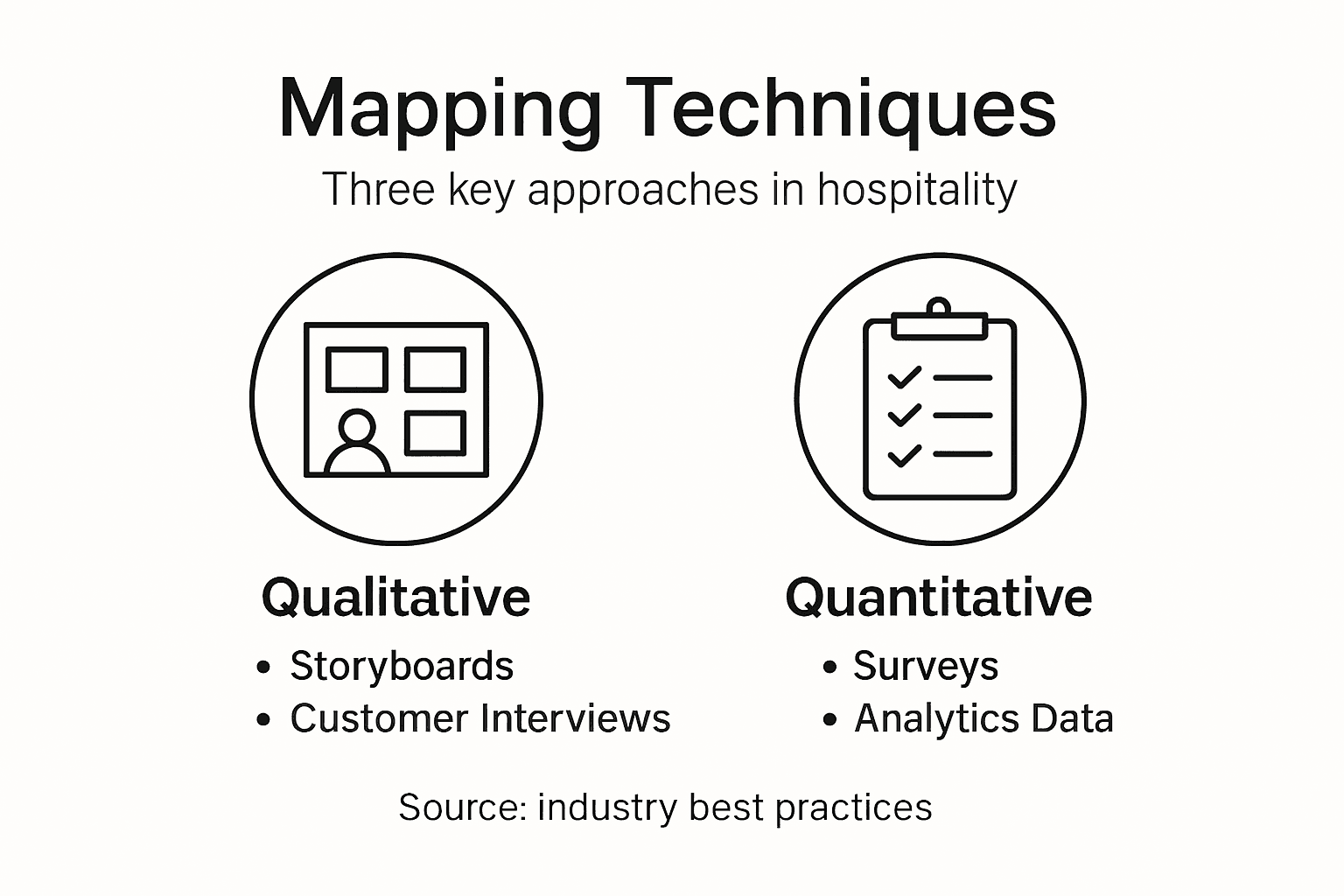
Customer journey mapping techniques in hospitality range from qualitative narrative approaches to sophisticated quantitative data-driven models, each offering unique insights into guest experiences. These methodologies provide strategic frameworks for understanding and optimizing interactions across different stages of the customer journey, enabling hotels to develop more targeted and personalized service strategies.
Three primary categories of customer journey mapping techniques emerge in modern hospitality research. The first involves qualitative narrative mapping, which captures guests’ emotional experiences through storytelling and in-depth interviews. The second approach centers on quantitative data analysis, utilizing statistical clustering and behavioral pattern recognition to identify service optimization opportunities. Hybrid mapping techniques represent the most sophisticated method, integrating both emotional and rational factors to create comprehensive guest experience models.

Successful implementation of these mapping techniques requires a nuanced understanding of traveler segments and their unique expectations. Advanced hospitality brands now leverage multi-dimensional mapping strategies that incorporate digital interaction data, satisfaction surveys, social media sentiment analysis, and direct guest feedback. By triangulating information from diverse sources, hotels can develop increasingly precise and anticipatory service approaches that transform generic interactions into personalized, memorable experiences.
Below is a summary of customer journey mapping techniques and their primary business impact:
| Technique Type | Main Focus | Business Impact |
|---|---|---|
| Qualitative Mapping | Emotional guest storytelling | Reveals loyalty and satisfaction |
| Quantitative Mapping | Behavioral data analysis | Identifies improvement opportunities |
| Hybrid Mapping | Integrates data and emotions | Enables holistic service strategies |
Pro tip: Combine multiple mapping techniques to create a holistic view of your guest journey, ensuring you capture both emotional nuances and quantifiable behavioral insights.
Personalization and Digital Touchpoints That Matter
Digital technologies in hospitality are revolutionizing customer experiences by enabling unprecedented levels of personalization and real-time interaction. Modern hotels now leverage sophisticated digital touchpoints that transform traditional service models, creating immersive, individualized guest journeys that extend far beyond conventional communication channels.
Research identifies six critical types of customer touchpoints that significantly impact guest experiences. These include environmental stimuli, brand communications, technology interfaces, employee interactions, peer interactions, and core service experiences. Customer touchpoint strategies demonstrate that successful digital personalization requires a holistic approach integrating artificial intelligence, mobile applications, conversational interfaces, and data-driven recommendation systems.
Advanced hospitality brands are now creating seamless, predictive experiences by combining data from multiple sources. These integrated digital touchpoints allow hotels to anticipate guest preferences, customize communications, and deliver proactive services that feel intuitive and individually tailored. By analyzing behavioral patterns, past interactions, and real-time feedback, hotels can craft experiences that feel simultaneously high-tech and deeply personal, bridging the gap between technological efficiency and human warmth.
Pro tip: Invest in unified customer data platforms that integrate information across all digital touchpoints to create truly personalized guest experiences.
Common Pitfalls and How to Avoid Them
Customer journey management strategies reveal several critical pitfalls that consistently undermine hospitality experiences. These challenges range from communication breakdowns to technological limitations, often resulting in diminished guest satisfaction and reduced loyalty. Understanding and proactively addressing these potential missteps is crucial for creating seamless, memorable guest interactions.
The most prevalent pitfalls emerge across several key domains. Communication failures include inconsistent messaging, neglecting pre-arrival engagement, and inadequate post-stay follow-up. Technological shortcomings often involve fragmented data systems, poor personalization algorithms, and disconnected digital touchpoints. Hotel guest journey challenges demonstrate that emotional disconnection represents another significant obstacle, where hotels fail to recognize and respond to guests’ underlying needs and expectations.
Successful hospitality brands mitigate these risks through comprehensive, integrated approaches. This involves implementing unified customer data platforms, developing robust feedback collection mechanisms, and training staff to recognize and respond to subtle guest signals. By creating holistic systems that connect digital technologies with human empathy, hotels can transform potential pain points into opportunities for exceptional service, turning momentary challenges into lasting positive impressions that drive customer loyalty and positive word-of-mouth recommendations.
Pro tip: Conduct regular journey mapping audits that systematically identify and address potential communication and experience gaps across all guest interaction points.
Elevate Your Hospitality Brand by Mastering Customer Journey Mapping
Understanding the intricate stages and emotional drivers within your guest’s journey is essential to building lasting loyalty and meaningful connections. This article uncovers key challenges like fragmented digital touchpoints and communication gaps that reduce guest satisfaction. At Lind Creative, we specialize in transforming these challenges into growth opportunities by crafting tailored digital solutions that capture and guide your audience with precision. Our expertise in Branding & Identity – Lind Creative ensures your hospitality brand speaks directly to your unique guest personas.
Ready to deliver personalized, seamless experiences that captivate your guests from discovery to post-stay engagement? Leverage the power of strategy-driven design and marketing with Lind Creative’s Growth Engine system to automate lead capture, nurture communications, and maximize conversions. Discover how staying ahead of Industry Trends – Lind Creative can position your hospitality business for real ROI. Visit Lind Creative today to start crafting a guest journey that not only meets expectations but exceeds them.
Frequently Asked Questions
What is customer journey mapping in hospitality?
Customer journey mapping in hospitality involves analyzing and tracking a guest’s interactions, emotions, and experiences with a brand from the initial awareness through post-stay engagement. It helps identify key touchpoints and opportunities to create meaningful connections with guests.
Why is understanding guest personas important for customer journey mapping?
Understanding guest personas is crucial as it allows hotels to tailor experiences to meet the unique expectations and emotional drivers of different types of travelers, such as business executives, leisure tourists, luxury seekers, and family vacationers.
What are the key stages of the customer journey in hospitality?
The key stages of the customer journey in hospitality typically include inspiration, discovery, research, booking, arrival, stay, departure, and post-stay engagement. Each stage offers opportunities to enhance guest satisfaction and loyalty.
What techniques are commonly used for customer journey mapping?
Common techniques for customer journey mapping include qualitative narrative mapping, which focuses on emotional storytelling; quantitative data analysis, which identifies behavioral patterns; and hybrid mapping, which integrates both emotional and rational factors to create a comprehensive understanding of guest experiences.
Recommended
- Why Customer Experience Matters for Luxury Hotels – Lind Creative
- What Is User Experience and Its Impact on Luxury Hospitality – Lind Creative
- Brand Consistency: Driving Guest Loyalty in Hospitality – Lind Creative
- Why Personalize User Experience for Luxury Hospitality – Lind Creative