
More than 85 percent of American guests say that an exceptional digital journey influences their overall impression of a luxury hospitality brand. For marketing directors in the U.S., understanding user experience means more than seamless bookings or elegant website design. This article breaks down the subtle digital and human factors that shape lasting emotional connections, guiding you to create richer guest interactions and stronger brand loyalty.
Table of Contents
- Defining User Experience In Hospitality
- Core Categories Of User Experience Design
- Key Elements Of Effective User Experience
- UX Process For High-End Hospitality Websites
- Common Pitfalls And How To Avoid Them
Key Takeaways
| Point | Details |
|---|---|
| User Experience is Multidimensional | Successful hospitality experiences depend on emotional, cognitive, and physical interactions that engage guests at every level. |
| Holistic Approach is Crucial | Balancing digital features with genuine human connection enhances satisfaction and fosters memorable experiences. |
| Continuous User Feedback is Essential | Regular testing and feedback loops keep hospitality websites aligned with evolving guest expectations and needs. |
| Avoid Common UX Pitfalls | To improve user experience, focus on clear navigation, accessibility, and user-centered design while avoiding clutter and aesthetic complexity. |
Defining User Experience in Hospitality
User Experience (UX) represents the comprehensive interaction between guests and hospitality services, extending far beyond basic functional transactions. At its core, UX encompasses the emotional, cognitive, and physical journey guests experience from initial contact through their entire service engagement. Understanding the complexity of user interactions reveals that successful hospitality experiences are multidimensional and deeply personal.
In luxury hospitality, UX involves meticulously crafting interactions that transcend traditional service delivery. This means considering every touchpoint – from website navigation and booking processes to physical environment design and personalized service interactions. The goal is creating seamless, emotionally resonant experiences that make guests feel uniquely understood and valued. Modern hospitality professionals recognize that UX is not just about meeting basic needs, but about creating memorable moments that forge lasting emotional connections.
The fundamental elements of hospitality UX include utility, accessibility, efficiency, and emotional engagement. These dimensions work together to shape guest perceptions and satisfaction. Technical aspects like website design, mobile responsiveness, and digital booking platforms must integrate smoothly with human elements such as staff training, personalized service, and intuitive communication channels. Successful UX design requires a holistic approach that balances technological innovation with genuine human connection.
Here’s a summary of how key digital and human factors shape luxury hospitality user experience:
| Aspect | Digital Impact | Human Impact |
|---|---|---|
| Website Design | Enhances online usability | Facilitates clear booking |
| Mobile Platforms | Enables convenient access | Supports instant interaction |
| Staff Training | Ensures smooth processes | Delivers personalized service |
| Communication | Empowers quick response | Builds emotional connection |
| Personalization | Recommends relevant options | Makes guests feel valued |
Pro tip: Conduct regular guest journey mapping to identify and eliminate potential friction points in your hospitality experience, ensuring every interaction feels smooth and intentional.
Core Categories of User Experience Design
User Experience (UX) Design encompasses several interconnected categories that work together to create comprehensive, user-centric interactions. The core design elements integrate multiple strategic approaches to optimize every touchpoint that influences user perception and satisfaction. These core categories include research, interaction design, visual design, information architecture, and usability engineering – each playing a critical role in crafting holistic digital experiences.
Research serves as the foundational category, involving deep understanding of user behaviors, needs, and motivations. This involves techniques like user interviews, persona development, journey mapping, and analyzing user feedback. Interaction design focuses on creating intuitive, meaningful interfaces that guide users seamlessly through digital environments. Visual design translates functional requirements into aesthetically pleasing interfaces that communicate brand identity while maintaining clear navigational structures.
Information architecture represents the strategic organization of content, ensuring users can easily find and understand information. This category involves designing navigation systems, categorizing content logically, and creating intuitive hierarchies that reduce cognitive load. Usability engineering completes the UX design framework by rigorously testing interfaces for efficiency, accessibility, and user satisfaction. These categories are not isolated but deeply interconnected, requiring continuous iteration and refinement to create exceptional user experiences.

Pro tip: Regularly conduct user testing across different demographic groups to validate and refine your UX design categories, ensuring your digital experiences remain adaptive and user-centered.
Key Elements of Effective User Experience
In the realm of luxury hospitality, user experience transcends traditional service delivery by integrating seven critical factors that shape user perception and satisfaction. These foundational elements include usefulness, usability, findability, credibility, desirability, accessibility, and value – each contributing to a holistic approach that transforms guest interactions from transactional to deeply memorable experiences.
Usefulness represents the core functionality of a service, ensuring that digital and physical touchpoints directly address guest needs. Usability focuses on creating intuitive, effortless interactions where guests can navigate services with minimal cognitive effort. Findability ensures that information, amenities, and services are easily discoverable across all platforms, from mobile apps to physical hotel spaces. Credibility builds trust through transparent communication, consistent brand messaging, and reliable service delivery that meets or exceeds guest expectations.
Desirability moves beyond functional requirements, incorporating emotional engagement and aesthetic appeal that resonate with guests on a deeper level. Accessibility guarantees that experiences are inclusive, catering to guests with diverse abilities and preferences. Value encompasses the overall perception of worth, balancing the emotional and financial investment guests make in their luxury hospitality experience. Successful implementation of these elements requires a nuanced understanding of guest personas, continuous feedback loops, and a commitment to iterative design that adapts to evolving guest expectations.
Pro tip: Develop comprehensive guest personas that capture not just demographic data, but emotional drivers and experiential preferences to create truly personalized luxury hospitality interactions.
UX Process for High-End Hospitality Websites
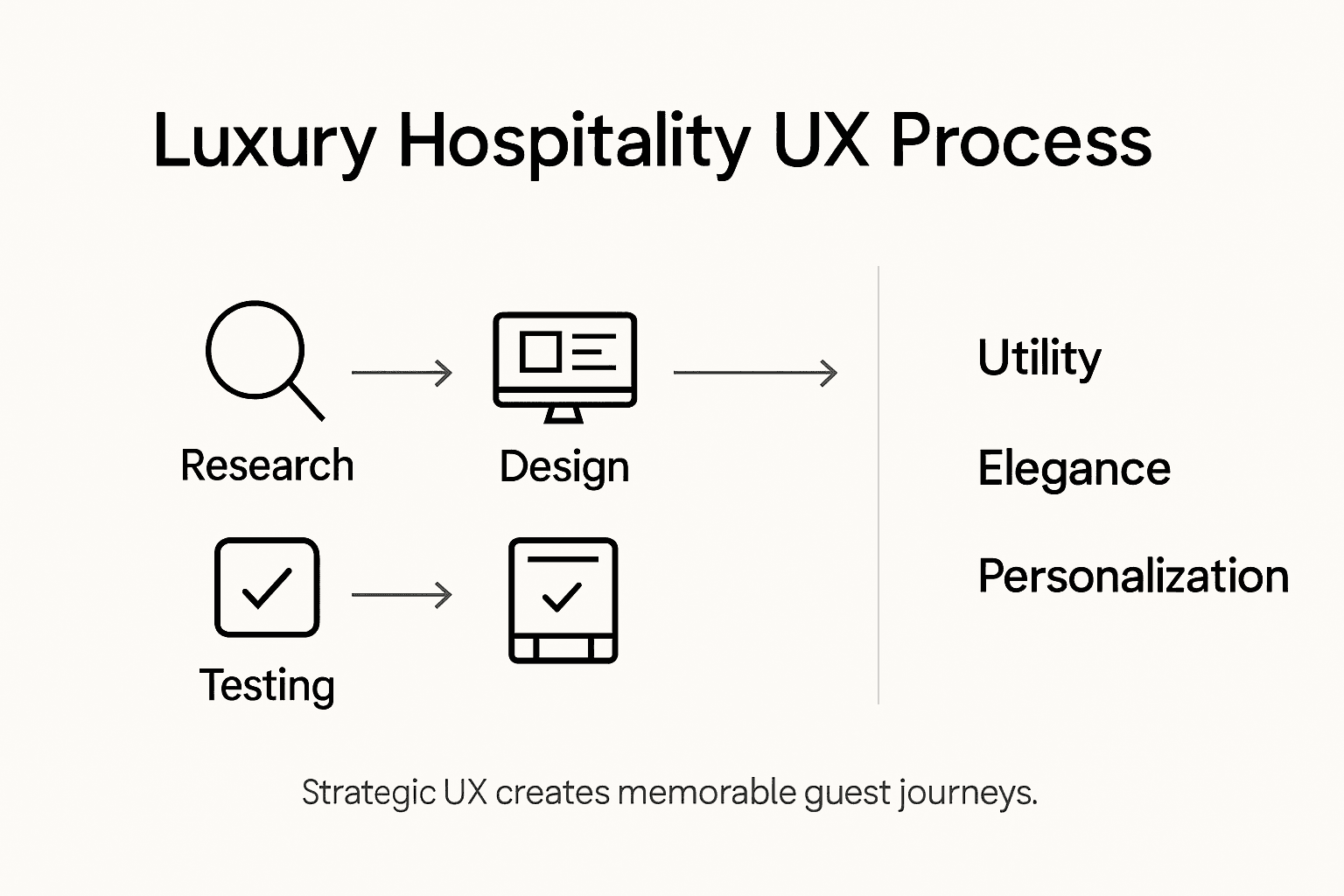
Designing exceptional user experiences for luxury hospitality websites requires a meticulous, strategic approach that transforms complex user interactions into seamless digital journeys. The UX process encompasses six critical stages: problem definition, comprehensive research, analytical insights, strategic design, user validation, and iterative refinement – each stage carefully calibrated to meet the sophisticated expectations of high-end hospitality clients.
The initial problem definition phase involves deeply understanding the unique digital landscape of luxury hospitality. This means conducting extensive research to map guest personas, analyze user behaviors, and identify pain points in current digital experiences. Designers must uncover not just functional requirements, but the emotional expectations of guests seeking premium digital interactions. Analytical insights drive the next phase, where data from user interviews, website analytics, and competitive benchmarking inform design strategies that transform user needs into intuitive digital experiences.
Design execution moves beyond traditional wireframing, requiring the creation of elegant, immersive prototypes that reflect the brand’s luxury positioning. Visual design, information architecture, and interaction design must work harmoniously to create websites that are not just functional, but emotionally compelling. The validation stage involves rigorous user testing, where designs are stress-tested across multiple devices and user scenarios. Iterative refinement ensures that each touchpoint – from booking interfaces to virtual tours – delivers a frictionless, sophisticated experience that resonates with the brand’s high-end positioning.
Compare the stages of UX process for high-end hospitality websites and their unique focuses:
| Stage | Purpose | Hospitality-Specific Focus |
|---|---|---|
| Problem Definition | Define core challenges | Discover luxury guest expectations |
| Research | Gather user insights | Map exclusive service touchpoints |
| Design | Build solutions | Create premium brand experiences |
| Validation | Test with real users | Ensure seamless booking and access |
| Iteration | Refine continually | Adapt to evolving guest demands |
Pro tip: Implement continuous user feedback mechanisms that capture both quantitative metrics and qualitative emotional responses to ensure your hospitality website design remains dynamically aligned with guest expectations.
Common Pitfalls and How to Avoid Them
Luxury hospitality websites frequently encounter critical design challenges that can dramatically undermine user experience. Understanding and mitigating these common UX design pitfalls becomes essential for creating digital platforms that truly reflect high-end brand standards. The most prevalent issues include cluttered interfaces, poor navigation structures, slow loading times, and designs that prioritize aesthetic complexity over functional clarity.
One fundamental mistake is neglecting comprehensive user research, which leads to websites that fail to address genuine guest expectations. Designers often create visually impressive interfaces that look stunning but prove challenging to navigate, particularly for guests seeking quick, efficient booking experiences. Accessibility emerges as another critical concern, with many luxury hospitality websites inadvertently creating barriers for users with diverse technological capabilities or physical requirements. Inconsistent design elements, complex booking processes, and non-responsive layouts can frustrate potential guests, potentially driving them toward competitor platforms.
Successful UX design in luxury hospitality demands a holistic approach that balances aesthetic sophistication with intuitive functionality. This requires continuous user testing, iterative design refinement, and a commitment to understanding evolving digital guest behaviors. Implementing clear information hierarchies, streamlined navigation paths, and responsive design principles can transform potential friction points into seamless, engaging digital experiences. By prioritizing user needs over design trends, hospitality brands can create online platforms that not only showcase their luxury positioning but also demonstrate genuine understanding of guest preferences.
Pro tip: Conduct quarterly comprehensive user experience audits that include both quantitative analytics and qualitative user feedback to proactively identify and address potential website interaction barriers.
Elevate Luxury Hospitality Experiences with Strategy-Driven Digital Solutions
Creating exceptional user experiences in luxury hospitality demands a precise balance of seamless digital interactions and emotional engagement. The article highlights key challenges like addressing guest expectations, streamlining booking processes, and avoiding complex or cluttered websites that frustrate users. If you want your hospitality brand to stand out by delivering memorable, intuitive, and high-converting digital experiences, Lind Creative offers the expertise to make that vision a reality.
Partnering with Lind Creative means more than just building a beautiful website. Our full-service digital agency blends creativity, technology, and strategy to optimize every touchpoint your guests encounter online. From crafting premium website designs that reflect your brand’s luxury positioning to deploying our signature Growth Engine that automates lead capture and marketing funnels, we help you attract and convert discerning guests efficiently. Take the step today to transform your hospitality user experience by working with a team dedicated to both form and function. Visit Lind Creative and discover how we deliver real ROI through strategy-driven design and marketing.
Frequently Asked Questions
What is user experience in luxury hospitality?
User experience (UX) in luxury hospitality refers to the overall interaction and emotional journey that guests experience with hospitality services, from initial contact through the entire service engagement.
How does user experience impact guest satisfaction in luxury hotels?
User experience impacts guest satisfaction by addressing emotional, cognitive, and physical needs. A well-crafted UX creates memorable interactions that make guests feel valued and understood, leading to higher satisfaction and loyalty.
What are the key elements of effective user experience design in hospitality?
Key elements of effective user experience design in hospitality include usefulness, usability, findability, credibility, desirability, accessibility, and overall value—all contributing to a seamless and engaging guest experience.
How can luxury hotels improve their user experience?
Luxury hotels can improve user experience by conducting regular guest journey mapping, performing comprehensive user research, continuously refining their digital platforms, and ensuring that both digital and human elements work harmoniously to meet guest expectations.
Recommended
- Why Personalize User Experience for Luxury Hospitality – Lind Creative
- Why Rebrand: Elevating Luxury Hospitality Success – Lind Creative
- Digital Branding: Driving Luxury Hospitality Growth – Lind Creative
- Unified Brand Presence: Driving Engagement for Luxury Hospitality – Lind Creative