
Luxury hospitality brands now face guests who judge properties long before setting foot in your lobby. Standing out digitally is no longer a bonus, but a business requirement that shapes trust and booking decisions from the start. A comprehensive online presence gives high-end properties a powerful edge, connecting every interaction and channel into an experience that matches what discerning guests expect. Discover how every digital touchpoint can help your brand earn attention, inspire confidence, and drive premium bookings.
Table of Contents
- Defining Online Presence In Hospitality
- Core Elements Of A Robust Online Presence
- Types Of Online Presence Channels
- Optimizing Online Engagement And Bookings
- Common Pitfalls And How To Avoid Them
Key Takeaways
| Point | Details |
|---|---|
| Comprehensive Online Presence is Essential | Luxury hospitality brands must ensure a consistent and compelling digital footprint across all online platforms to enhance visibility and reputation. |
| Integration of Technology is Key | Utilize unified technology systems for seamless operation and accurate guest information across all channels to build trust and prevent operational chaos. |
| Prompt Engagement Improves Conversion | Quick response times and effective management of inquiries and reviews directly influence guest confidence and booking decisions. |
| Ongoing Assessment is Crucial | Regular audits of digital presence, data consistency, and brand messaging across platforms help identify and rectify discrepancies that could harm bookings. |
Defining Online Presence in Hospitality
Online presence in hospitality extends far beyond simply having a website or social media account. It represents the complete digital footprint your luxury brand maintains across every platform where potential guests interact with you, from search engines and booking sites to your email communications and customer review platforms. For hospitality brands, your online presence encompasses how visible, accessible, and compelling you are when guests search for accommodations, read reviews, or engage with your content online. Think of it as the digital equivalent of your lobby, front desk, and concierge combined. Every touchpoint, every image, every response time contributes to how guests perceive your brand before they ever arrive at your property.
The digital transformation in hospitality represents a fundamental shift in how properties operate and engage with guests, not simply a trend you can ignore. Your online presence functions as the primary decision-making tool for most travelers today. When a potential guest considers your luxury resort, they’re evaluating your property based on your website design, photography quality, guest reviews, response times on inquiries, and how you engage across multiple channels. A cohesive unified brand presence across these channels builds trust and makes your property more attractive to discerning guests who expect consistency in every interaction.
What makes online presence particularly critical for luxury hospitality is that it bridges the gap between awareness and conversion. The competitive set for high-end properties isn’t limited to nearby competitors anymore. A guest considering your five-star resort in the Hamptons can instantly compare it to properties worldwide. Your online presence determines whether potential guests even discover you, whether they believe your claims about your amenities and service, and whether they feel confident enough to make a booking. Research shows that adopting digital technologies for customer interaction and online visibility has become essential to modern hospitality business models, especially as guests expect seamless experiences from initial awareness through post-stay engagement.
In practical terms, your online presence includes your website performance and user experience, the accuracy and completeness of your listings on booking platforms, the quality of your visual content across all channels, how you manage and respond to guest reviews and messages, your search engine visibility, your email marketing effectiveness, and your social media engagement. Each element works together to create either a compelling reason for guests to book with you or reasons for them to choose a competitor instead. The goal isn’t just visibility. It’s visibility combined with credibility, engagement, and conversion. When all these elements work together effectively, your online presence becomes one of your most powerful sales and marketing assets.
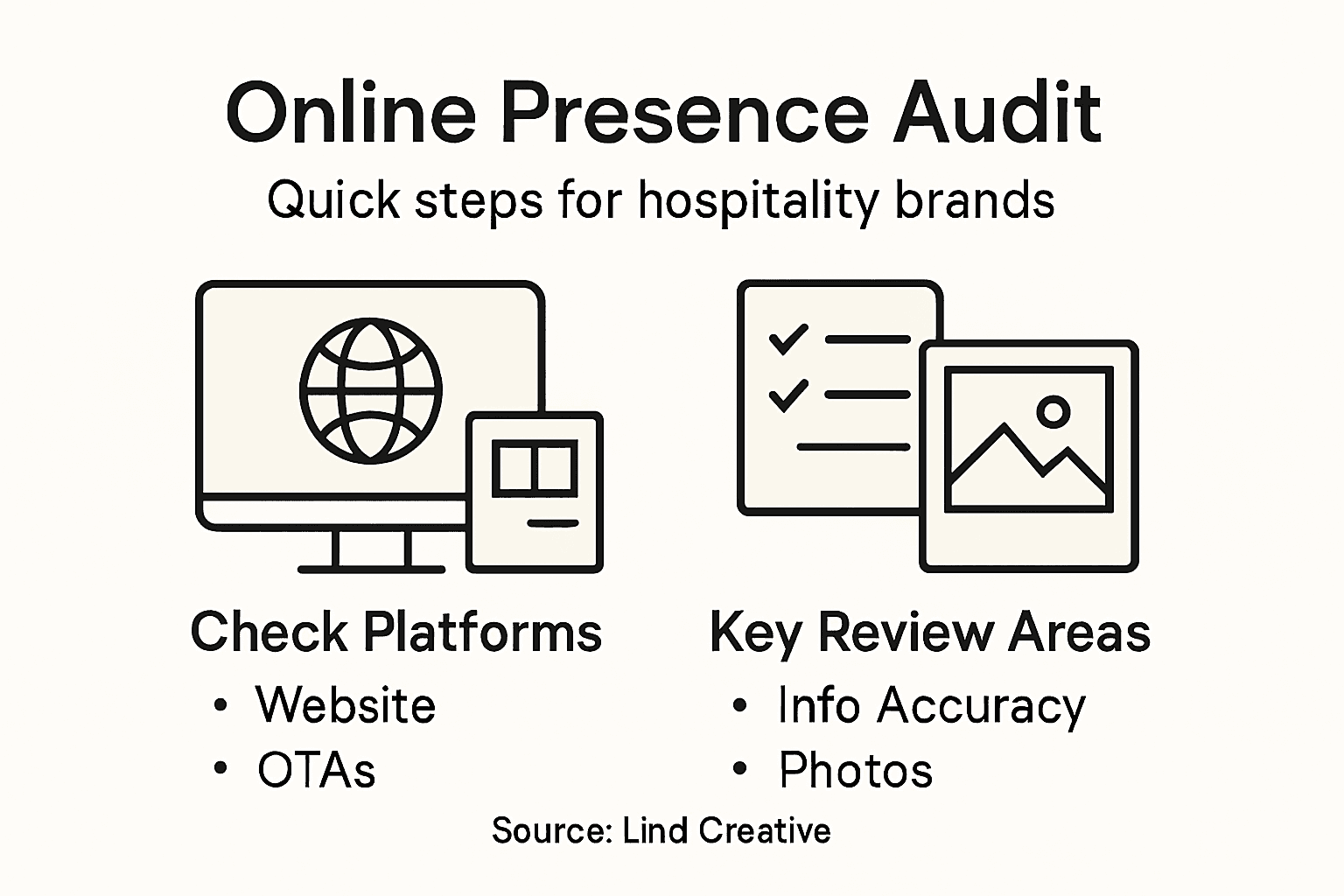
Pro tip: Audit every platform where your property appears right now—your website, Google My Business, all major OTAs, TripAdvisor, social media—and ensure your descriptions, photos, pricing, and contact information are completely consistent and current before implementing any new engagement strategies.
Core Elements of a Robust Online Presence
A robust online presence for luxury hospitality isn’t built on luck or assumptions. It requires deliberate attention to specific elements that work together to attract guests, build credibility, and drive bookings. Your website serves as your digital flagship, but it’s only one piece of a much larger ecosystem. Think of it like your property itself. You can have beautiful architecture, but without proper lighting, clear signage, and functional systems, guests won’t experience it the way you intended. The same applies online. Each element must function properly and integrate seamlessly with the others to create a cohesive guest experience.
Start with your website foundation. This includes mobile optimization, fast loading speeds, intuitive navigation, and compelling visual content that represents your property accurately. Beyond the website itself, your visibility infrastructure encompasses search engine optimization, your presence on major booking platforms like Expedia and Booking.com, and accurate listings across directories like Google My Business and TripAdvisor. Your content strategy involves photography, videography, detailed descriptions, guest testimonials, and blog content that educates potential guests about your property and destination. Then there’s your engagement layer: how quickly you respond to inquiries, how you manage reviews, your email marketing programs, and your social media activity. These elements create multiple entry points for guests to discover you and multiple opportunities to engage with them throughout their journey from awareness to booking to post-stay advocacy.
What many hospitality leaders overlook is the operational backbone these visible elements require. IT strategy and digitalization form the critical foundation for managing all these elements effectively. You need process agility to respond quickly to market changes and guest needs. Your workforce must be adaptable and trained to use digital tools. Technology management ensures your systems work together without friction. A strong data culture means you’re actually measuring what matters and adjusting based on results. Finally, cybersecurity protects both your guests and your reputation. When these operational elements are weak, even a beautifully designed website cannot overcome poor response times, inaccurate information across platforms, or outdated content. Integration of your various systems and maintaining data integrity across platforms become essential for delivering consistent brand experiences.
Summary of core operational strategies for maintaining a robust online presence:
| Strategy Area | Key Focus | Benefit | Risk If Neglected |
|---|---|---|---|
| IT Integration | Unified technology systems | Reduces errors, saves time | Operational chaos |
| Staff Training | Digital skill development | Enhances guest experience | Low staff adoption |
| Data Management | Accurate and current info | Builds guest trust | Booking discrepancies |
| Cybersecurity | Protect guest data | Prevents breaches | Loss of reputation and trust |
Beyond the basics, consider how digital technologies enable personalization and enhance guest interactions. This might include AI chatbots that answer inquiries instantly, virtual tours that let guests explore your property before booking, or personalized email campaigns based on guest behavior. Your digital brand identity should be immediately recognizable whether someone encounters your property on Instagram, your website, or an OTA listing. Business website essentials like clear calls to action, trust signals, and streamlined booking processes directly impact your conversion rates. The most effective luxury hospitality brands treat their online presence not as a marketing department function, but as a core business system that requires strategic investment, ongoing management, and continuous improvement.
Pro tip: Map out every touchpoint where potential guests encounter your brand online right now, then assess each element for consistency, current information, and conversion effectiveness. You’ll likely find gaps that are costing you bookings.
Types of Online Presence Channels
Your online presence isn’t confined to a single platform or website. It exists across multiple channels, each serving a distinct purpose in your guest journey. Understanding these channels and how they work together is essential for luxury hospitality brands aiming to maximize visibility and conversions. The complexity isn’t in understanding each channel individually. It’s in recognizing that guests expect a seamless experience across all of them. A potential guest might discover your property through a Google search, read reviews on TripAdvisor, check your Instagram for aesthetic inspiration, compare rates on Booking.com, and then visit your website to complete their reservation. Each touchpoint shapes their perception of your brand.
Your website and booking engine serve as your owned channel, the one space where you control the complete experience and capture direct bookings. Online travel agencies and booking portals like Expedia, Booking.com, and Airbnb command significant traffic and handle a large percentage of reservations, though they come with commission costs and less control over how your property is presented. Social media platforms including Instagram, Facebook, and TikTok function as engagement and brand storytelling channels where luxury hospitality brands showcase their unique experiences, respond to potential guests, and build community. Review platforms such as TripAdvisor, Google Reviews, and Trustpilot serve as reputation management channels where guest feedback directly influences booking decisions. Search engines determine your discoverability when potential guests search for accommodations in your area or amenities similar to yours. Email remains one of your highest-converting channels for direct communication with past guests and captured leads.
Beyond these foundational channels, diverse digital platforms like virtual reality tours and emerging social platforms expand how you can engage potential guests. Modern luxury properties use virtual tours to let guests explore before booking, video content to showcase experiences, and direct messaging apps to provide personalized customer service. The key insight is that these channels aren’t separate silos. Integrated channel management ensures consistent messaging, accurate information, and coordinated guest experiences across every platform. When your website says one price but an OTA shows another, when your Instagram showcases amenities that your Google listing doesn’t mention, or when your response times vary dramatically between channels, guests notice. They lose confidence.
A multi channel strategy for luxury hospitality means prioritizing channels based on where your specific target guests spend time and what drives conversions for your property. Some luxury resort brands discover that Instagram and Pinterest drive significant awareness among their demographic, while others find that Google Business Profile optimization and direct website traffic generate the highest ROI. The channels themselves matter less than understanding your guests’ behavior and meeting them where they are with a consistent, compelling brand experience. Your operational challenge is managing all these channels efficiently without spreading your team too thin. This is where integrated technology platforms become valuable, allowing you to manage messaging, inventory, pricing, and communications from a centralized hub rather than jumping between separate systems.
Here’s how different online presence channels support luxury hospitality goals:
| Channel Type | Primary Purpose | Brand Control Level | Impact on Bookings |
|---|---|---|---|
| Website & Booking | Direct reservations | Full | Highest conversion rate |
| OTAs & Portals | Exposure to large audiences | Limited | Significant, less profit |
| Social Media | Storytelling & engagement | Moderate | Drives awareness |
| Review Platforms | Reputation management | Low | Influences trust |
| Search Engines | Discoverability | Moderate | Key for visibility |
| Email Campaigns | Personalized communication | Full | Strong direct sales |
Pro tip: Conduct a channel audit by documenting where your property currently appears online, noting what information is displayed on each platform, response times, and booking conversion rates, then identify your top three performing channels to invest in first before expanding.
Optimizing Online Engagement and Bookings
Optimizing your online presence goes beyond simply being visible. It means actively converting casual browsers into committed guests at every stage of their decision-making process. The difference between a property that captures bookings and one that loses them to competitors often comes down to how strategically you’ve optimized each engagement touchpoint. This isn’t about gimmicks or aggressive sales tactics. It’s about removing friction from the guest journey, providing exactly what potential guests need to feel confident booking, and making your property impossible to ignore when they’re actively searching for accommodations.
Start with your booking process optimization. A guest who falls in love with your property can abandon their reservation if checkout takes more than three clicks or requires information they’ve already provided. Real-time data analytics reveal exactly where guests drop off during the booking journey so you can simplify those steps. Your content strategy should directly address the questions potential guests have at each stage. Early stage content answers “Where should I stay in this destination?” Middle stage content answers “Why is this property better than competitors?” Late stage content addresses final objections and trust concerns. Your visual presentation across all platforms must be consistently high quality. Luxury guests decide within seconds whether to explore further, and that decision is heavily influenced by photography quality and how your property is presented. Response speed matters enormously for engagement. When a potential guest submits an inquiry at 10 PM, they want a response by morning, not days later.
Beyond these fundamentals, integrated technology systems enable personalization at scale. When you have guest data properly organized and accessible, you can send targeted emails about specific amenities they viewed, offer packages aligned with their stated interests, and provide recognition when they return. Website optimization directly impacts conversion rates by ensuring your site loads quickly on mobile devices, presents pricing clearly and competitively, and makes your unique value proposition immediately obvious. Track which pages drive the most bookings, which content types resonate with your audience, and where guests spend the most time. This intelligence guides your content strategy and helps you allocate resources where they generate the most impact.
Your personalization opportunities extend throughout the guest lifecycle. Segment your email list by guest type, past behavior, and preferences, then send relevant messages that encourage engagement. Luxury travelers respond exceptionally well to recognition of their preferences and past experiences. Your review management is also crucial for optimization. Responding thoughtfully to reviews, both positive and negative, demonstrates that you care about guest feedback and actively improve based on it. This increases booking confidence for potential guests reading reviews. Finally, ensure your competitive positioning is crystal clear. Guests shouldn’t have to wonder what makes your property special. Whether it’s your beachfront location, signature wellness program, culinary excellence, or personalized service philosophy, your messaging should immediately communicate why choosing you is the right decision.
Pro tip: Implement conversion tracking on your website to identify which pages, content types, and calls to action drive the most bookings, then double down on what’s working rather than spreading effort across tactics that produce minimal results.
Common Pitfalls and How to Avoid Them
Many luxury hospitality brands invest significantly in their online presence only to see disappointing results. The investment fails not because the strategy was wrong, but because common pitfalls undermine execution. Understanding these mistakes and how to prevent them can save you months of wasted effort and revenue loss. The good news is that most pitfalls are predictable and avoidable once you know what to watch for. The challenge is recognizing which mistakes your organization is already making and committing to fix them before they damage your brand reputation or booking performance.
One of the most damaging pitfalls is fragmented systems and poor data quality. Many properties use separate platforms for their website, booking engine, email marketing, social media, and property management system. When these systems don’t communicate with each other, guest information becomes inconsistent, pricing gets out of sync across channels, and you waste time manually updating information in multiple places. System integration and data integrity are foundational to successful online presence. A guest books through an OTA on Monday, but your website still shows the room as available. They arrive to find their reservation doesn’t match what your staff sees in the system. These disconnects destroy trust and create operational chaos. The solution is implementing unified technology platforms that connect your systems and give everyone access to accurate, current information. Another common mistake is treating technology as a solution without human context. You can have the most sophisticated AI chatbot, but if it frustrates guests or doesn’t know when to escalate to a real person, it damages your brand. Over-reliance on technology without human-centricity creates cold, impersonal experiences that contradict the luxury hospitality promise. Luxury guests expect both technological convenience and genuine human warmth.
Inconsistent brand presence across channels represents another major pitfall. When your website positioning differs from your Instagram narrative, or your Google listing emphasizes amenities that your website barely mentions, guests become confused about what your property actually offers. This inconsistency signals either disorganization or dishonesty, both of which reduce booking confidence. Every platform should tell the same story using consistent terminology, imagery, and messaging. Neglecting review management is another mistake with serious consequences. A property with 4.2 stars and no responses to negative reviews looks worse than a property with 4.0 stars and thoughtful, professional responses. When you ignore guest feedback publicly, potential guests assume you don’t care about problems. When you respond professionally and constructively, you demonstrate accountability and commitment to improvement.
Cybersecurity vulnerabilities create risk that many hospitality leaders underestimate. Guest payment information, personal data, and internal systems require robust protection. A data breach doesn’t just compromise security. It destroys guest trust and exposes your brand to legal liability. Finally, staff resistance to digital change undermines even well-designed systems. If your team doesn’t understand or embrace your digital strategy, they can’t execute it effectively. This requires ongoing training, clear communication about why changes matter, and involving staff in solutions rather than imposing them.
Pro tip: Conduct a quarterly audit of your systems, data consistency, and brand presentation across channels, then assign ownership for fixing discrepancies so problems don’t compound over time.
Elevate Your Luxury Hospitality Brand with a Powerful Online Presence
The article highlights critical challenges luxury hospitality brands face such as fragmented digital systems, inconsistent messaging, and slow engagement with guests. At Lind Creative, we understand that building a robust online presence demands more than just a beautiful website. It’s about crafting a unified brand identity, optimizing your website for conversion, and seamlessly integrating all your digital channels to deliver a consistent, personalized guest journey.
Our Growth Engine marketing system automates lead capture, funnels, email, and ads so you can respond faster and more effectively to guest inquiries. We combine strategy-driven design with technology to ensure your brand stands out in a competitive global market and converts engagement into bookings. Whether you need to launch a new brand, refresh your current one, or scale your visibility, our collaborative process delivers real, measurable results.
Take control of your online presence now and start driving bookings with confidence. Discover how our full-service digital solutions can unify and amplify every touchpoint your guests experience.
Ready to transform your hospitality brand with smart design and digital strategy Visit Lind Creative today and let us help you build a high-converting online presence that drives growth and guest loyalty. Explore our signature Growth Engine and learn how we turn engagement into meaningful results.
Frequently Asked Questions
What is online presence in hospitality?
Online presence in hospitality refers to the complete digital footprint a luxury brand has across various platforms where potential guests interact with it. This includes websites, social media, booking sites, and customer review platforms, and it impacts how guests perceive the brand before they arrive.
Why is an online presence critical for luxury hospitality brands?
An online presence is critical because it affects visibility and conversion. Potential guests compare properties worldwide, and a strong online presence can influence their awareness, trust in amenities, and willingness to book.
How can hospitality brands optimize their online presence?
Hospitality brands can optimize their online presence by ensuring their website is visually appealing and user-friendly, maintaining accurate listings on booking platforms, engaging with customers through social media, responding to reviews, and implementing effective email marketing campaigns. Each element should work together to enhance the overall guest experience.
What are common pitfalls in online presence for hospitality brands?
Common pitfalls include fragmented systems leading to inconsistent information across platforms, neglecting review management, failing to maintain cybersecurity measures, and not training staff adequately on digital tools. These issues can undermine guest trust and booking performance.
Recommended
- Digital Branding: Driving Luxury Hospitality Growth – Lind Creative
- What Is a Landing Page and Its Impact on Hospitality Leads – Lind Creative
- What Is User Experience and Its Impact on Luxury Hospitality – Lind Creative
- Multi Channel Strategy: Boosting Luxury Hotel Bookings – Lind Creative
- Understanding What is Social Media Engagement – Jarrod Harman