
Many small business owners think scaling means rapid hiring, which often leads to costly mistakes. Real scaling grows revenue without matching cost increases through smart systems and automation. This guide shows you how automated marketing and strong branding create sustainable growth that protects profits while expanding reach.
Table of Contents
- Understanding Business Scaling: Definition And Core Concepts
- The Role Of Automated Marketing In Scaling
- Branding’s Impact On Scalable Growth
- Common Misconceptions About Business Scaling
Key Takeaways
| Point | Details |
|---|---|
| Scaling Definition | Revenue growth without proportional cost increases through efficient systems. |
| Marketing Automation Impact | Automated marketing systems increase lead capture efficiency by up to 30%, accelerating sales cycles. |
| Branding’s Role | Strong brand identity boosts customer retention, essential for sustainable scaling. |
| Common Mistakes | Over-hiring and premature scaling cause 70% of small business failures. |
| Readiness Framework | Assess operational capacity, technology infrastructure, market demand, and brand equity before scaling. |
Understanding Business Scaling: Definition and Core Concepts
Business scaling means increasing revenue significantly while keeping costs relatively flat. Unlike simple growth where expenses rise with sales, scaling uses systematization to handle more customers without proportional resource additions.
Think of it this way: a business that doubles revenue by doubling staff is growing, not scaling. A business that doubles revenue by automating processes and optimizing systems while adding only 20% more staff is truly scaling. The difference lies in efficiency gains.
Systematization forms the backbone of scalable growth. When you document processes, automate repetitive tasks, and build reliable workflows, you create capacity for expansion without bloating payroll. This approach protects profit margins while accelerating growth.
Key elements that enable scalable growth include:
- Documented standard operating procedures that anyone can follow
- Technology infrastructure that handles increased volume automatically
- Marketing systems that generate leads without constant manual effort
- Customer service processes that maintain quality at higher volumes
Unsustainable rapid growth looks impressive initially but crumbles under operational strain. Companies that scale properly build foundations first, then expand deliberately. They invest in systems before hiring, ensuring each new team member multiplies impact rather than just adding linear capacity.
The Role of Automated Marketing in Scaling
Marketing automation transforms lead generation from a time-intensive manual process into a systematic revenue engine. Small businesses implementing automated marketing systems increase lead capture efficiency by up to 30% compared to traditional methods.

This efficiency gain directly impacts your bottom line. Automated nurture sequences guide prospects through your sales funnel while you sleep. Email workflows segment audiences and deliver personalized messages at scale. Retargeting campaigns bring back interested visitors automatically.
Customer acquisition costs drop significantly with automation. Instead of your team manually following up with every lead, smart workflows qualify prospects, deliver relevant content, and alert sales only when leads show purchase intent. This means your team focuses energy on closing deals, not chasing cold contacts.
Here’s where many businesses miss opportunities: only 40% successfully implement continuous analytics review to optimize their automated campaigns. Without regular data analysis, you’re flying blind. Your automation runs, but you don’t know which sequences convert best or where prospects drop off.
Effective marketing automation for scaling includes:
- Lead capture forms integrated with CRM systems
- Segmented email sequences triggered by specific behaviors
- Automated social media scheduling and engagement tracking
- Landing page A/B testing that continuously improves conversion rates
Statistic Spotlight: Businesses using automated lead nurturing see 50% more sales-ready leads at 33% lower cost per lead compared to non-automated approaches.
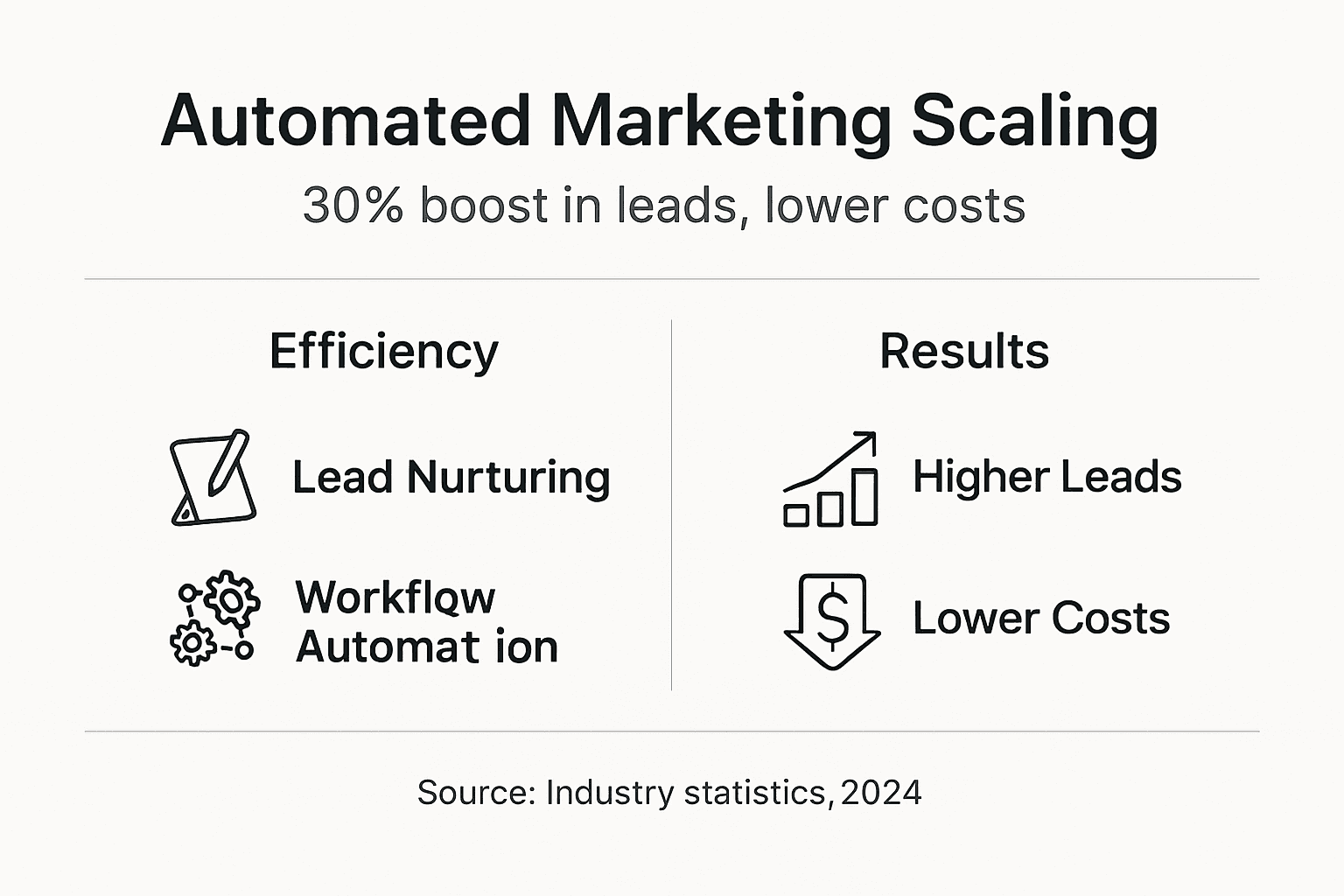
Implementing a high-converting digital marketing workflow creates predictable lead flow. You’ll know exactly how many website visitors convert to leads, how many leads become customers, and which marketing channels deliver the best ROI. This predictability is essential for confident scaling decisions.
For eCommerce businesses specifically, growth marketing strategies leverage automation to recover abandoned carts, cross-sell products, and create loyal repeat customers without manual intervention.
Branding’s Impact on Scalable Growth
While automation handles the mechanics of growth, branding ensures that growth sticks. Your brand creates the trust and emotional connection that converts first-time buyers into loyal customers who return repeatedly and refer others.
Customer retention matters exponentially more than acquisition as you scale. Acquiring new customers costs five to seven times more than retaining existing ones. A strong brand keeps customers coming back, building predictable recurring revenue that supports sustainable scaling.
Brand equity acts as a growth multiplier. When customers recognize and trust your brand, they buy faster with less convincing. Your sales cycle shortens. Price sensitivity decreases. Word-of-mouth referrals increase organically.
Consider two companies selling identical products at identical prices. The one with stronger brand recognition consistently outsells its competitor because buyers trust the known entity. This trust advantage becomes crucial when entering new markets or launching new products during scale.
Key branding elements that support scaling:
- Consistent visual identity across all customer touchpoints
- Clear brand voice that resonates with your target audience
- Defined brand values that guide business decisions
- Memorable brand story that differentiates you from competitors
Many business owners view branding as secondary to operations, but this perspective limits growth potential. Your brand is the emotional foundation that makes all other scaling efforts more effective. It’s the reason customers choose you over cheaper alternatives.
When you understand branding’s role in scaling business growth, you see it’s not about logos and colors. It’s about building recognition that reduces friction throughout your entire customer journey. Strong brands scale faster because they’ve invested in trust before expansion.
Common Misconceptions About Business Scaling
Several persistent myths about scaling lead small businesses into expensive mistakes. Understanding what scaling is not helps you avoid costly missteps.
Misconception 1: Scaling Means Rapid Hiring
Many owners believe growth requires proportional staff expansion. They hire aggressively, assuming more people automatically create more revenue. This approach increases fixed costs dramatically while systems remain inefficient. You end up with a bigger team executing broken processes faster.
Misconception 2: Any Growth Is Good Growth
Revenue increases look impressive on paper, but premature scaling causes 70% of small business failures. Growing before your systems can handle volume strains operations, damages customer experience, and burns cash reserves. Sustainable scaling happens only after operational foundations are solid.
Misconception 3: Technology Alone Solves Scaling Challenges
Buying expensive software doesn’t automatically create scalable systems. Without proper implementation, training, and process integration, technology becomes shelfware. Successful scaling pairs smart technology with clear workflows and team adoption.
Misconception 4: Branding Can Wait Until Later
Some owners focus purely on operational efficiency, planning to
Recommended
- Role of Branding in Scaling Business Growth – Lind Creative
- Growth Marketing for eCommerce – Driving Scalable ROI – Lind Creative
- Build a High-Converting Digital Marketing Workflow – Lind Creative
- What Is Performance Marketing? 70% Boost Budget in 2024 – Lind Creative