
Most American businesses find that branding shapes far more than their logo. In fast-moving markets where competition is fierce, strong branding serves as the foundation for long-term growth and customer loyalty. Research shows that companies with consistent brands are three times more likely to enjoy strong brand visibility. Discover how clear brand strategy transforms American businesses into trusted names that customers remember and recommend.
Table of Contents
- Branding Defined: Foundation For Scaling Up
- How Branding Drives Business Expansion
- Building Differentiation In Competitive Markets
- Integrating Branding With Growth Marketing
- Common Branding Pitfalls When Scaling
Key Takeaways
| Point | Details |
|---|---|
| Importance of Branding | Branding is a strategic core that goes beyond visuals, creating a unique narrative that resonates with customers. |
| Value of Differentiation | Effective differentiation involves meaningful distinctions that address customer needs and build lasting connections. |
| Integration of Branding and Marketing | Successful growth marketing merges branding with data-driven strategies to enhance customer acquisition and retention. |
| Avoiding Common Pitfalls | Companies must maintain consistent messaging and core values during scaling to prevent dilution of their brand identity. |
Branding Defined: Foundation for Scaling Up
Branding represents more than a logo or visual identity – it is the strategic core that distinguishes businesses in competitive markets. At its essence, branding is the comprehensive narrative that communicates a company’s unique value, personality, and promise to customers. Strategic brand development transforms businesses from generic service providers into memorable, trusted entities that resonate deeply with their target audience.
The EPIC Brand Map™ highlights that branding encompasses far more than surface-level design elements. It strategically integrates people, products, operations, and organizational vision into a cohesive experience. Marketing techniques like market research and targeted advertising play crucial roles in building brand awareness and establishing meaningful connections with potential customers. Successful branding creates an emotional blueprint that guides customer perceptions and differentiates a business in crowded marketplaces.
Building a powerful brand requires intentional strategy across multiple dimensions. Businesses must develop a clear value proposition, consistent visual and verbal communication, and an authentic narrative that reflects their core mission. This involves understanding target audience preferences, crafting a unique positioning statement, and maintaining unwavering commitment to brand principles across all customer touchpoints. Effective branding transforms businesses from commodity providers to preferred partners customers actively seek out and recommend.
Here’s a comparison of key branding strategy components and their impact on business growth:
| Branding Component | Purpose | Business Impact |
|---|---|---|
| Value Proposition | Clarifies unique market offer | Drives customer preference |
| Brand Storytelling | Engages emotions and builds loyalty | Increases trust and differentiation |
| Visual Identity | Creates memorable impressions | Boosts recognition and recall |
| Customer Experience | Delivers consistent brand interactions | Enhances retention and positive word-of-mouth |
| Internal Culture | Aligns team with brand mission | Sustains long-term brand consistency |
Pro Tip: Brand Alignment Strategy: Conduct a comprehensive brand audit every 12-18 months to ensure your visual identity, messaging, and customer experience remain tightly synchronized with your evolving business goals and market dynamics.
How Branding Drives Business Expansion
Business expansion requires more than traditional growth strategies. It demands a sophisticated approach where branding becomes the fundamental driver of competitive differentiation and market penetration. Innovation and brand awareness play critical roles in enterprise sales growth, transforming how companies position themselves in increasingly complex market landscapes.
Successful brand strategies go beyond surface-level marketing, diving deep into creating compelling narratives that resonate with target audiences. Companies that effectively leverage their brand can increase market valuation, customer loyalty, and overall business performance. Brand equity directly influences business profitability and valuation, making strategic branding an essential investment for businesses seeking sustainable growth.
The mechanics of brand-driven expansion involve multiple interconnected elements. Businesses must develop a consistent brand identity that communicates unique value propositions, builds trust, and differentiates themselves from competitors. This requires a holistic approach integrating visual design, messaging, customer experience, and organizational culture into a unified brand strategy that attracts and retains customers across diverse market segments.

Pro Tip: Brand Performance Tracking: Implement quarterly brand health assessments that measure customer perception, competitive positioning, and alignment between your brand promise and actual customer experience.
Building Differentiation in Competitive Markets
Market differentiation represents the strategic cornerstone for businesses seeking to stand out in crowded industries. Effective brand strategies involve setting clear long-term business goals and targeting the right audience, transforming how companies communicate their unique value proposition beyond traditional competitive tactics. Successful differentiation is not about being different for the sake of uniqueness, but about creating genuine, meaningful distinctions that resonate with target customers.
Companies must develop a comprehensive approach that extends far beyond visual aesthetics or superficial marketing campaigns. Brand storytelling and corporate culture play pivotal roles in creating sustainable competitive advantages, enabling businesses to forge deeper connections with their audience. This involves crafting a narrative that authentically represents the organization’s core values, mission, and unique approach to solving customer challenges.
Differentiation requires a multifaceted strategy that integrates innovation, customer experience, and consistent brand messaging. Businesses need to identify and amplify their unique strengths, whether through specialized expertise, exceptional customer service, innovative product features, or a distinctive organizational philosophy. The most powerful differentiators emerge from a deep understanding of customer needs and the ability to address those needs in ways that competitors cannot or will not.
Pro Tip: Competitive Positioning Audit: Conduct a comprehensive quarterly review of your brand’s market positioning, analyzing customer feedback, competitive landscape, and identifying emerging opportunities for unique value creation.
Integrating Branding With Growth Marketing
Growth marketing represents a sophisticated approach that seamlessly blends strategic branding with data-driven expansion tactics. Marketing techniques like targeted advertising and comprehensive market research enable businesses to create powerful, measurable connections between brand identity and customer acquisition strategies. This integration transforms traditional marketing approaches by focusing on holistic growth that goes beyond surface-level metrics.
The EPIC Brand Map™ demonstrates how brand strategy serves as a strategic compass for intentional business decisions, connecting people, products, operations, and overall organizational strategy. Successful integration requires businesses to view branding not as a standalone aesthetic exercise, but as a fundamental driver of growth. This means aligning brand messaging, visual identity, and customer experience with precise marketing strategies designed to attract, convert, and retain customers.
Effective brand-integrated growth marketing demands a multidimensional approach. Businesses must develop adaptive strategies that leverage data insights, customer feedback, and emerging market trends. This involves creating dynamic marketing channels that communicate brand values while simultaneously driving measurable business outcomes. The most successful approaches use sophisticated targeting, personalization, and continuous optimization to ensure that every marketing effort reinforces the brand’s core narrative and growth objectives.
Pro Tip: Brand Performance Integration: Develop a quarterly cross-functional workshop that brings together marketing, branding, and sales teams to align growth strategies, share insights, and create integrated campaigns that drive both brand awareness and customer acquisition.
Common Branding Pitfalls When Scaling
Branding challenges can derail business growth when companies fail to adapt their strategic approach during expansion. Successful brand strategies require setting clear long-term business goals and targeting the right audience, a nuanced process that many organizations overlook during rapid scaling. The most common pitfalls emerge when businesses prioritize short-term growth over consistent brand identity and strategic positioning.
Brand storytelling and corporate culture represent critical components beyond visual aesthetics, yet many companies neglect these fundamental elements during expansion. Scaling businesses often make critical mistakes such as diluting their core brand message, inconsistent messaging across different channels, and losing the authentic connection that originally distinguished them in the marketplace. These missteps can quickly erode customer trust and diminish the distinctive value proposition that drove initial success.
Navigating brand scaling requires a delicate balance between maintaining core identity and adapting to new market dynamics. Businesses must remain vigilant about preserving their unique voice while simultaneously evolving to meet changing customer expectations. This involves developing robust brand guidelines, investing in consistent training for new team members, and creating flexible frameworks that allow for strategic innovation without compromising the fundamental brand essence that customers have come to trust and appreciate.
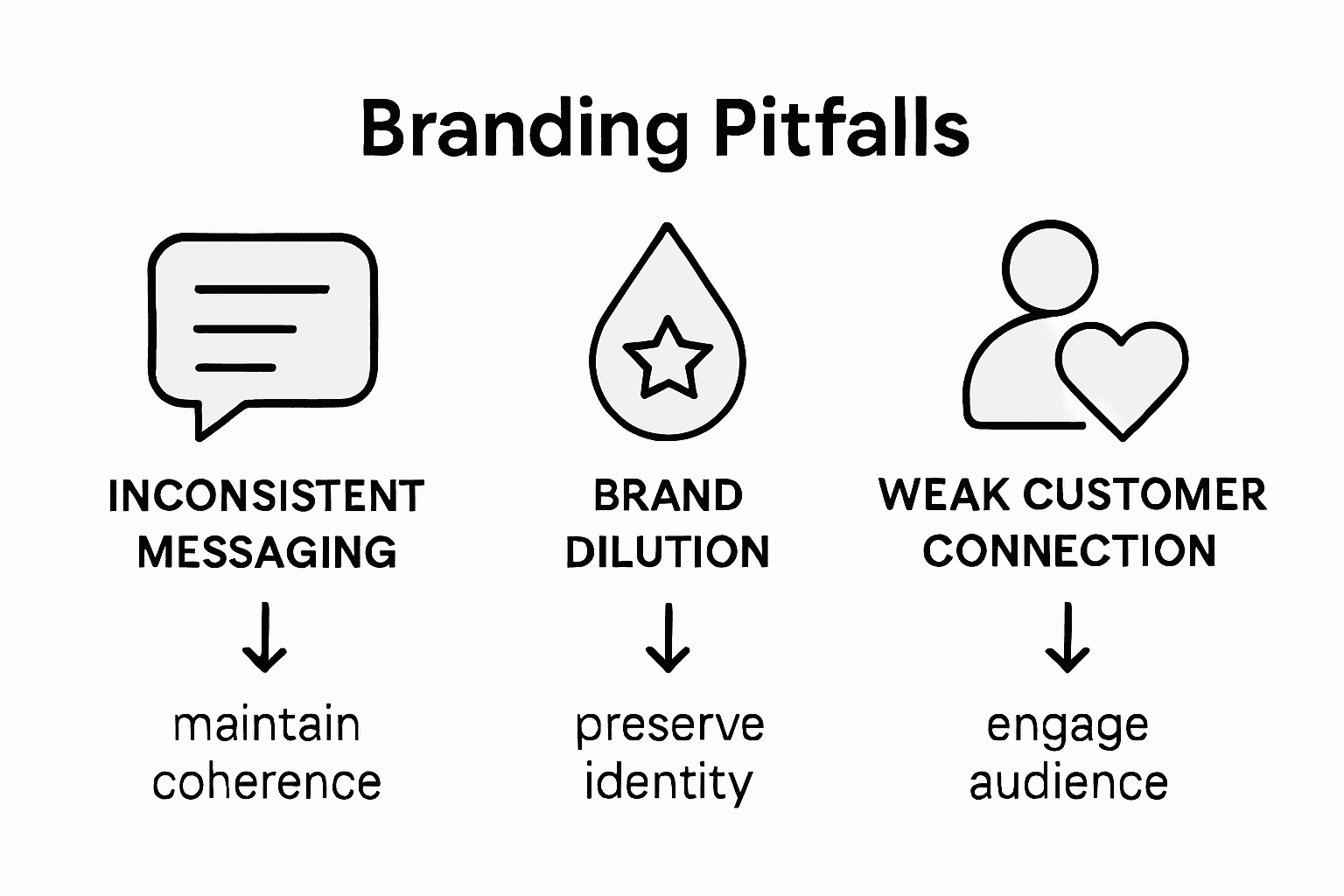
Below is a summary of common branding pitfalls faced during business scaling and best practices to avoid them:
| Pitfall | Why It Happens | Prevention Strategy |
|---|---|---|
| Inconsistent Messaging | Rapid growth, more channels | Centralized brand guidelines |
| Brand Dilution | Entering new markets quickly | Regular brand audits and reviews |
| Neglecting Core Values | Focus shifts to short-term gains | Continuous training and leadership alignment |
| Losing Customer Connection | Over-automation, less personalization | Invest in authentic communication |
Pro Tip: Brand Consistency Check: Develop a quarterly brand alignment audit that reviews all marketing materials, customer touchpoints, and communication channels to ensure messaging, visual identity, and core brand values remain cohesive and true to the original brand promise.
Elevate Your Business Growth Through Strategic Branding
Scaling your business demands more than just incremental growth. The article highlights key challenges such as maintaining brand consistency, creating meaningful differentiation, and integrating branding with growth marketing to drive sustainable expansion. If you are struggling with inconsistent messaging or want to transform your brand into a powerful asset that resonates deeply with your audience, strategic branding is your answer. Lind Creative understands these critical pain points and combines creativity, innovation, and data-driven strategies to help you build a brand that drives measurable results.
Explore our Branding & Identity – Lind Creative services designed to create authentic narratives and cohesive visual identities that reflect your core mission. Whether you are launching a new brand or scaling an existing one, our integrated approach uses our signature Growth Engine to automate lead capture and optimize your marketing funnel. Start turning your brand into a preferred partner customers actively seek by partnering with Lind Creative today at https://lindcreative.com.
Frequently Asked Questions
What is the role of branding in business growth?
Branding plays a crucial role in business growth by establishing a unique identity that differentiates a company from its competitors. It helps build customer loyalty, increases market recognition, and fosters emotional connections with target audiences, which ultimately drives sales and expansion.
How can a business develop an effective branding strategy?
An effective branding strategy involves developing a clear value proposition, consistent visual and verbal communication, and an authentic narrative that reflects the core mission of the company. It’s important to understand target audience preferences and maintain commitment to brand principles across all customer touchpoints.
What are common pitfalls to avoid in branding during expansion?
Common pitfalls include inconsistent messaging across channels, brand dilution when entering new markets rapidly, neglecting core values, and losing customer connection due to over-automation. To avoid these, businesses should implement centralized brand guidelines and regularly conduct brand audits.
How does branding influence customer perception?
Branding shapes customer perception by providing a cohesive narrative and experience that communicates a company’s unique value. Effective branding creates an emotional connection, builds trust, and differentiates a business in crowded marketplaces, leading to increased customer loyalty and preference.
Recommended
- Why Branding Matters: Complete Guide for Businesses – Lind Creative
- The Essential Guide to Investing in Branding – Lind Creative
- Role of Branding in Business Success Today – Lind Creative
- 7 Essential Types of Branding Strategies for Business Growth – Lind Creative