
Luxury hospitality brands across the United States often face the challenge of keeping high-value guests engaged in a crowded digital world. Effective email marketing stands apart as a direct, permission-based channel that places your brand in your guests’ inboxes, not just their feeds. By focusing on personalized, well-structured communications, you create moments that reflect your brand’s unique promise and drive measurable loyalty, ensuring every interaction feels both exclusive and relevant.
Table of Contents
- Defining Email Marketing for Hospitality
- Types and Functions of Hospitality Emails
- Personalization and Data-Driven Engagement
- List Building, Automation, and Compliance Essentials
- Common Pitfalls and How to Avoid Them
Key Takeaways
| Point | Details |
|---|---|
| Email Marketing is Strategic | It serves as a direct line to guests, focusing on building relationships through personalized communication. |
| Different Types of Emails | Utilize various types of emails to target guests at different stages and enhance engagement effectively. |
| Importance of Personalization | Customize emails using data to significantly improve open rates and guest interactions. |
| Maintain Compliance and List Integrity | Ensure subscribers opt in and provide clear options for opting out to build trust and adhere to legal requirements. |
Defining Email Marketing for Hospitality
Email marketing in hospitality is a digital communication strategy that goes beyond simple promotional messages. It’s about building sustained relationships with guests through targeted, personalized messages delivered directly to their inboxes.
At its core, email marketing involves sending targeted messages to potential and existing customers to promote your services, share valuable information, and strengthen brand loyalty. For your luxury property, this means every email serves a specific purpose aligned with guest preferences and behaviors.
Unlike traditional advertising, email marketing puts the guest in control. They choose to receive your communications, which creates a permission-based relationship built on trust and relevance.
Why Email Stands Apart in Hospitality
Email differs from other marketing channels in several critical ways:
- Direct access: You reach guests in a personal space they check multiple times daily
- Measurable results: Track opens, clicks, and conversions with precision
- Cost-effective: Lower per-contact cost compared to traditional advertising
- Flexible messaging: Adapt tone and content from promotional to educational to personalized
- Long-term engagement: Build relationships that extend beyond the initial booking
Your guests expect professional, well-structured communications. Mastering effective email communication means understanding formal email styles, clear greetings, and professional closings that maintain the luxury experience your brand promises.
The Three Core Functions
Email marketing in luxury hospitality serves three main purposes:
- Drive bookings: Promote special offers, packages, and availability to past guests and prospects
- Enhance guest experience: Send pre-arrival information, personalized recommendations, and post-stay follow-ups
- Build loyalty: Create exclusive member programs, reward repeat visits, and strengthen emotional connections
Think of email as your direct line to guests. It’s permission-based, measurable, and entirely within your control—unlike social media algorithms or search rankings that shift constantly.
Email marketing succeeds in luxury hospitality when every message feels personally relevant to the recipient, not generic or interruptive.
For marketing directors at luxury properties, email isn’t just another channel. It’s a strategic asset that complements your broader marketing efforts and drives demonstrable ROI.

Pro tip: Segment your email list from day one by guest type (first-time visitors, repeat customers, corporate groups) so you can send relevant messages that resonate with each audience rather than broadcasting the same message to everyone.
Types and Functions of Hospitality Emails
Hospitality emails aren’t one-size-fits-all. Each type serves a distinct purpose in your guest relationship strategy, and understanding the differences matters for your marketing success.
Your email program should include various types of hospitality emails that perform different functions throughout the guest lifecycle. Some drive immediate action, others build relationships over time, and some provide essential service information.
The Five Essential Email Types
- Promotional emails: Showcase special offers, seasonal packages, and limited-time deals to drive bookings
- Transactional emails: Send booking confirmations, reservation details, and payment receipts automatically
- Welcome and pre-arrival emails: Greet new guests and share preparation information before their stay
- Newsletters: Share company updates, local recommendations, and relevant hospitality news on a regular schedule
- Personalized offers: Target repeat guests with tailored recommendations based on their previous preferences
Each email type targets guests at different stages. Promotional emails work best for prospects considering a stay, while transactional emails serve guests who’ve already booked.
Below is a summary of essential hospitality email types and their primary business impact:
| Email Type | Purpose | Business Impact |
|---|---|---|
| Promotional | Inspire bookings and upsells | Increases revenue |
| Transactional | Confirm bookings and payments | Builds trust, reduces errors |
| Welcome/Pre-Arrival | Begin guest relationship | Enhances guest satisfaction |
| Newsletter | Share updates and recommendations | Maintains brand awareness |
| Personalized Offer | Encourage repeat stays | Boosts loyalty and retention |
Understanding Email Functions
Effective hospitality email marketing employs different strategies to accomplish specific goals. Your emails should attract new customers, nurture existing relationships, provide service information, and drive repeat business through regular engagement.
Transactional emails like confirmations are mandatory communications that guests expect. These aren’t marketing messages—they’re operational necessities that build trust and reduce guest anxiety.
Promotional emails, by contrast, should feel optional. When guests choose to receive them, you’ve earned permission to share relevant offers aligned with their interests and past behaviors.
The strongest hospitality email programs balance marketing goals with guest value, ensuring every message serves the recipient’s needs, not just your revenue targets.
Feedback emails ask guests to rate their experience and suggest improvements. These provide invaluable data while showing guests you care about their opinions. A follow-up survey sent 48 hours after checkout typically captures honest, detailed responses.
Newsletters keep your property top-of-mind between stays. Share local restaurant recommendations, upcoming events, or seasonal highlights to maintain engagement when guests aren’t actively booking.
Subscription-based emails reward loyalty. VIP members might receive exclusive early access to promotions, special discounts, or invitations to members-only events.
Pro tip: Use email automation to trigger transactional emails immediately (confirmations, receipts) and schedule promotional emails strategically—avoiding weekends and holidays when guests are less likely to engage with travel plans.
Personalization and Data-Driven Engagement
Generic emails get deleted. Personalized emails get opened, read, and acted upon. This is the difference between email marketing that performs and email marketing that wastes budget.
Personalization in hospitality email marketing leverages first-party data to tailor guest communications based on individual preferences and behaviors. You’re not just using a guest’s name in the subject line—you’re crafting entire experiences around what they actually value.
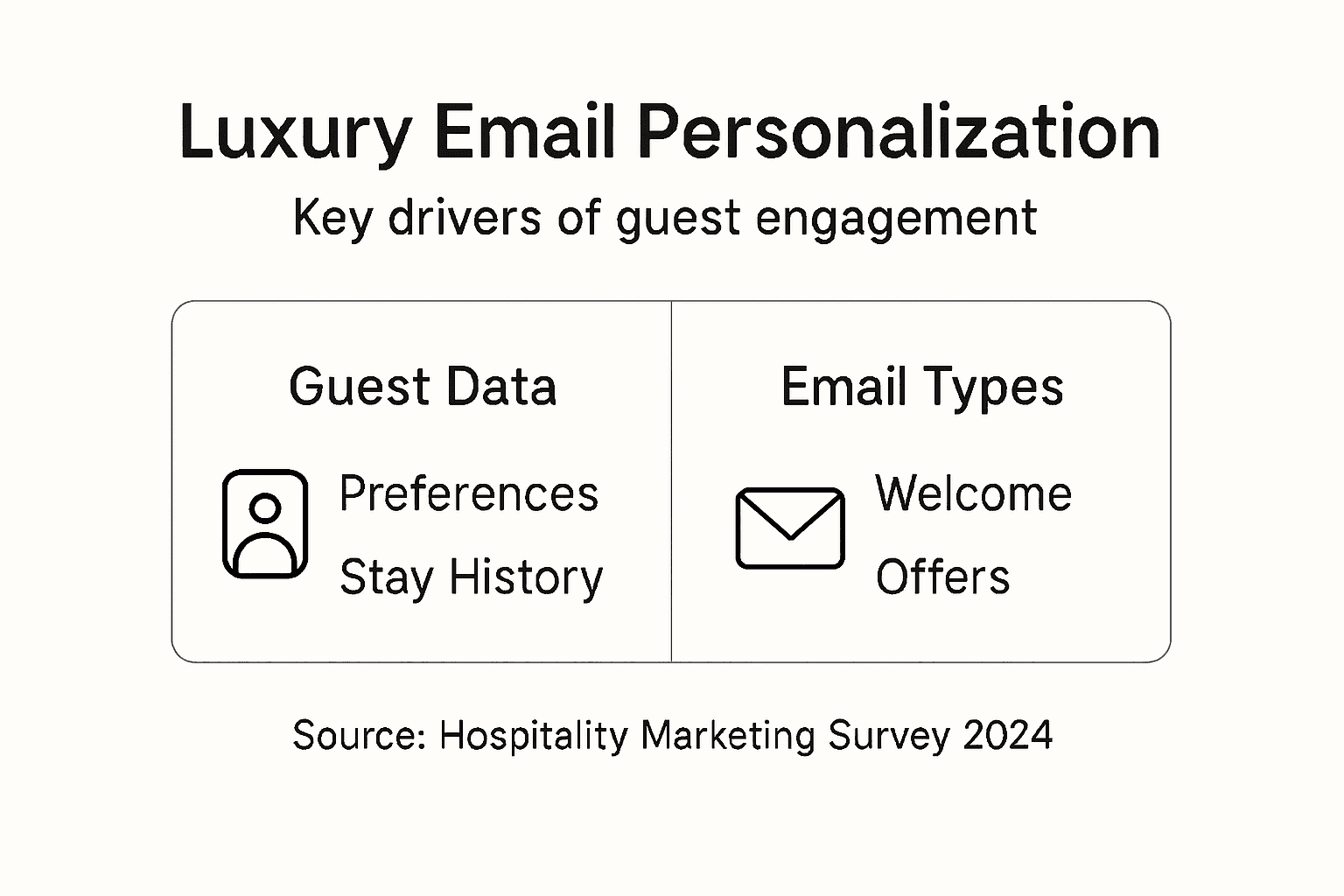
This approach transforms your email program from a broadcast channel into a one-to-one conversation at scale. Each guest receives content relevant to their specific interests, history, and needs.
The Data Behind Personalization
Data-driven engagement starts with collecting the right information:
- Booking history: Previous room types, dates visited, price sensitivity
- Guest preferences: Bed configuration, floor level, smoking/non-smoking, special requests
- Engagement patterns: Which emails they open, what links they click, when they typically browse
- Service interactions: Complaints filed, requests made, loyalty program tier
- Demographic details: Location, travel purpose, group size, interests
Once you have this data, customized marketing emails become genuinely useful instead of interruptive. A guest who stayed in your oceanfront suite receives offers for oceanfront upgrades. A business traveler gets early check-in options. A honeymooner sees romantic experiences.
Hyper-Personalization in Action
This goes beyond simple segmentation. Real personalization means each email reflects individual behaviors and preferences, not just broad audience groups.
Send a guest who loved your spa an email featuring new wellness packages. Recommend restaurants based on their previous dining preferences. Suggest activities that match their interests from their profile. Timing matters too—send pre-arrival information when they’re most likely to engage.
Personalized emails generate significantly higher open rates, click-through rates, and conversions than generic broadcasts because they address the recipient’s actual needs.
Your booking system already captures valuable data. Your property management system tracks preferences. Your website shows you what guests browse. Combine these signals to create email experiences that feel thoughtfully crafted, not mass-produced.
Feedback emails asking for surveys yield better response rates when timed strategically. A guest who mentioned dissatisfaction receives a follow-up offer, not a generic survey.
Pro tip: Start with two or three data points for personalization—previous room type, guest name, and one preference—rather than attempting complex segmentation immediately; test what resonates, then expand your personalization strategy gradually.
Here’s a comparison of personalization levels in email marketing and their effects:
| Personalization Level | Guest Experience | Likelihood of Engagement |
|---|---|---|
| None (Generic) | Feels impersonal | Low open and response rates |
| Basic (Name Only) | Somewhat personal | Slightly higher interaction |
| Segmentation | Relevant to segment/group | Moderate engagement |
| Hyper-Personalized | Tailored to individual | Highest open and conversion rates |
List Building, Automation, and Compliance Essentials
Your email list is your most valuable marketing asset. Unlike social media followers or paid ad audiences, your email subscribers own direct access to guest inboxes. But this power comes with serious legal responsibility.
Building a quality list requires permission and consent. Every subscriber should have actively opted in, understanding exactly what they’ll receive. This isn’t just good practice—it’s the law.
List Building Best Practices
Start capturing emails strategically across your property and digital channels:
- At booking: Include opt-in checkboxes during the reservation process
- On your website: Use signup forms offering value (exclusive offers, local guides)
- Post-stay: Send a follow-up survey with an option to join your newsletter
- Mobile check-in: Collect emails through your property’s app or kiosk
- Events and dining: Capture emails from restaurant reservations and event attendees
Each touchpoint should clearly explain what guests will receive. “Subscribe to our monthly newsletter” works better than vague promises. Guests appreciate transparency about frequency and content type.
Automation That Works
Marketing automation platforms streamline your email operations while maintaining compliance. Set triggers that send emails based on guest actions, not manual effort.
Automation handles routine communications efficiently. A guest books a room—an automated confirmation arrives immediately. They check out—a follow-up survey triggers 48 hours later. They abandon a cart—a reminder email goes out in 24 hours.
This saves time while ensuring consistent, timely outreach. Your team focuses on strategy while automation executes flawlessly.
Compliance Is Non-Negotiable
CAN-SPAM Act compliance requires accurate sender information, truthful subject lines, clear opt-out options, and your physical business address in every email. Violations result in hefty fines and damage to your reputation.
Inclusion of a working unsubscribe link isn’t optional. Guests who wish to stop receiving emails must be able to do so with a single click. Honor opt-out requests within 10 business days.
Legal compliance and guest trust go hand-in-hand; when you respect opt-outs and honor preferences, you build a list of genuinely interested subscribers.
Keep accurate records of when and how guests consented. Document their preferences clearly. If audited, you need proof that subscribers actually agreed to receive your emails.
Pro tip: Implement a double opt-in process where guests confirm their email address after initial signup; this reduces undeliverable addresses, improves sender reputation, and provides clear documentation of consent.
Common Pitfalls and How to Avoid Them
Email marketing failures rarely happen overnight. They’re the result of small mistakes repeated consistently, slowly degrading your sender reputation and guest engagement.
Understanding these pitfalls helps you avoid them. Most hospitality marketers face the same obstacles—the difference is knowing which ones to prioritize.
The Biggest Mistakes
Common email marketing mistakes include weak opt-in offers, skipped welcome emails, irrelevant content, and poor personalization. Each one damages your program’s effectiveness in different ways.
Weak opt-in incentives mean your list grows slowly with unmotivated subscribers. A generic discount code attracts deal-seekers who never book at full price. A compelling incentive—“Local Insider’s Guide” or “Exclusive Early Access”—attracts genuinely interested guests.
Skipping welcome emails leaves money on the table. A new subscriber is most engaged in that first moment. Send them something valuable immediately to set expectations and build momentum.
Irrelevant content causes unsubscribes. Sending every guest every promotion means many emails miss their mark. A guest interested in spa packages doesn’t care about golf packages.
Communication Mistakes That Hurt
Beyond strategy, basic communication errors damage your brand reputation. Poor email etiquette such as incorrect recipient addressing, overly long messages, and typos creates a negative impression.
Proofread everything before sending. A single typo in a luxury hospitality email looks careless, damaging trust immediately. Use spell-check, read aloud, and have someone else review before hitting send.
Address recipients by name when possible. “Dear Guest” feels impersonal; “Dear Sarah” feels intentional. Get names right—misspelled names are worse than generic greetings.
Keep emails concise. Luxury guests are busy. They want clear, polished communication, not paragraphs of text. Use short sentences and white space generously.
Email fatigue kills engagement faster than irrelevant content; respect your guests’ inboxes by sending only when you have something genuinely valuable to share.
Don’t send too frequently. Many luxury properties email weekly without proper segmentation. Some guests see seven irrelevant emails in one week and unsubscribe. Others would welcome daily updates. Let preferences guide frequency.
Failure to segment means one-size-fits-all messaging that resonates with nobody. Business travelers need different information than leisure guests. Weekend visitors need different offers than weekday corporate groups.
Pro tip: Audit your last 10 sent emails and identify which ones had low open rates or high unsubscribe numbers; analyze what made them underperform, then implement one specific change and test it against your baseline before rolling out additional improvements.
Elevate Your Luxury Hospitality Email Marketing with Strategic Digital Solutions
Mastering the art of personalized, data-driven email marketing is essential for luxury hospitality brands aiming to build trust and boost guest engagement. This article highlights the need to deliver targeted, relevant communications that enhance guest experiences while driving bookings and loyalty. Common challenges include segmentation, automation, and compliance—areas that require a blend of creativity and technology to overcome effectively.
Discover how Lind Creative, a full-service digital agency, empowers luxury hospitality marketers by combining strategic Industry Trends insights with innovative Web Design and Web Development solutions. Our signature Growth Engine automates lead capture, email personalization, and campaign management so you can connect authentically with your guests and maximize ROI. Don’t wait to transform your email marketing into a powerful driver of growth. Visit Lind Creative now and start crafting email experiences your guests will value and remember.
Frequently Asked Questions
What is email marketing in luxury hospitality?
Email marketing in luxury hospitality is a digital communication strategy that focuses on building strong relationships with guests through targeted and personalized messages, promoting services, and enhancing brand loyalty.
Why is email marketing important for hotels and resorts?
Email marketing is crucial for hotels and resorts because it allows for direct access to guests, measurable results, cost-effectiveness, flexible messaging, and the capability to build long-term engagement with customers, all aligned with their preferences and behaviors.
What types of emails should luxury hotels send to their guests?
Luxury hotels should send various types of emails, including promotional emails for special offers, transactional emails for booking confirmations, welcome and pre-arrival emails, newsletters with updates, and personalized offers based on guest preferences.
How can personalization enhance email marketing effectiveness for luxury hospitality?
Personalization enhances email marketing effectiveness by using first-party data to tailor communications based on individual guest preferences and behaviors, resulting in higher open rates, improved engagement, and ultimately driving more bookings.
Recommended
- Multi Channel Strategy: Boosting Luxury Hotel Bookings – Lind Creative
- Why Content Marketing Matters for Luxury Hospitality – Lind Creative
- Key Digital Marketing Terms Driving Hotel Growth – Lind Creative
- Why Market Research Matters for Luxury Hospitality – Lind Creative