
Every luxury hospitality brand in the United States faces the pressure of meeting rising guest expectations while navigating a rapidly evolving market. Making the right moves requires insights backed by more than just instinct. Market research delivers the strategic intelligence that reveals shifting traveler preferences, competitive moves, and growth opportunities, enabling brands to design remarkable guest experiences that drive real loyalty. Discover how market research transforms customer understanding into a true business advantage for luxury hotels.
Table of Contents
- What Market Research Means in Hospitality
- Key Types of Market Research for Hotels
- How Market Research Drives Guest Experience
- Data-Driven Competitive Positioning Strategies
- Avoiding Costly Mistakes and Missed Trends
- Transforming Market Insights Into Lasting Growth
Key Takeaways
| Point | Details |
|---|---|
| Data-Driven Insights | Luxury hospitality brands must leverage data analytics to understand consumer behaviors and market trends for effective decision-making. |
| Personalization Focus | Understanding and anticipating high-end customer preferences is essential for crafting exceptional personalized experiences. |
| Continuous Market Research | Implementing an ongoing market research framework is crucial for adapting to evolving traveler expectations and avoiding costly mistakes. |
| Strategic Intelligence | Transforming market insights into actionable growth strategies enables luxury hotels to stay competitive and innovative in a dynamic landscape. |
What Market Research Means in Hospitality
Market research in the luxury hospitality sector represents a strategic intelligence gathering process designed to decode complex consumer behaviors, industry dynamics, and competitive landscapes. At its core, this research provides critical insights that enable hospitality brands to make data-driven decisions that directly impact growth, positioning, and customer satisfaction.
In the United States, hospitality market research encompasses several key dimensions of strategic investigation:
- Consumer Behavior Analysis: Understanding traveler preferences, booking patterns, and experiential expectations
- Industry Trend Tracking: Monitoring shifts in travel demand, technological innovations, and service expectations
- Competitive Landscape Assessment: Evaluating market positioning, pricing strategies, and service differentiation
- Economic Impact Evaluation: Analyzing market size and growth potential across different hospitality segments
The scope of hospitality market research extends far beyond traditional data collection. It involves sophisticated methodologies that synthesize quantitative metrics like revenue per available room (RevPAR) with qualitative insights about customer experience. By tracking indicators such as occupancy rates, average daily rates, and emerging travel trends, researchers provide a comprehensive view of the market’s current state and future trajectory.
Luxury hospitality brands specifically rely on market research to understand nuanced consumer expectations. This means going beyond generic traveler demographics to uncover the intricate preferences of high-end customers who seek personalized, exceptional experiences.
Market research transforms raw data into strategic intelligence that enables luxury hospitality brands to anticipate and exceed customer expectations.
Pro Tip: Invest in continuous market research that goes beyond annual reports, utilizing real-time data collection methods to stay ahead of rapidly evolving traveler preferences.
Key Types of Market Research for Hotels
Market research for hotels encompasses a diverse range of strategic approaches designed to gather comprehensive insights into the complex hospitality landscape. Segmentation analysis plays a critical role in understanding the nuanced dynamics of different hotel market segments, from luxury to economy class establishments.
The primary types of market research in the hospitality sector include:
- Consumer Preference Studies: Capturing traveler expectations, preferences, and booking behaviors
- Competitive Benchmarking: Analyzing positioning, pricing, and service offerings of competing hotels
- Demand Forecasting: Predicting future travel trends and occupancy potential
- Online Reputation Management: Tracking and analyzing guest feedback across digital platforms
- Feasibility Studies: Evaluating potential new locations and investment opportunities
Each research type serves a unique strategic purpose. Consumer preference studies, for instance, dive deep into understanding traveler motivations, technological expectations, and personalization demands. These insights help luxury hotels craft targeted marketing strategies and design experiences that resonate with high-end clientele.

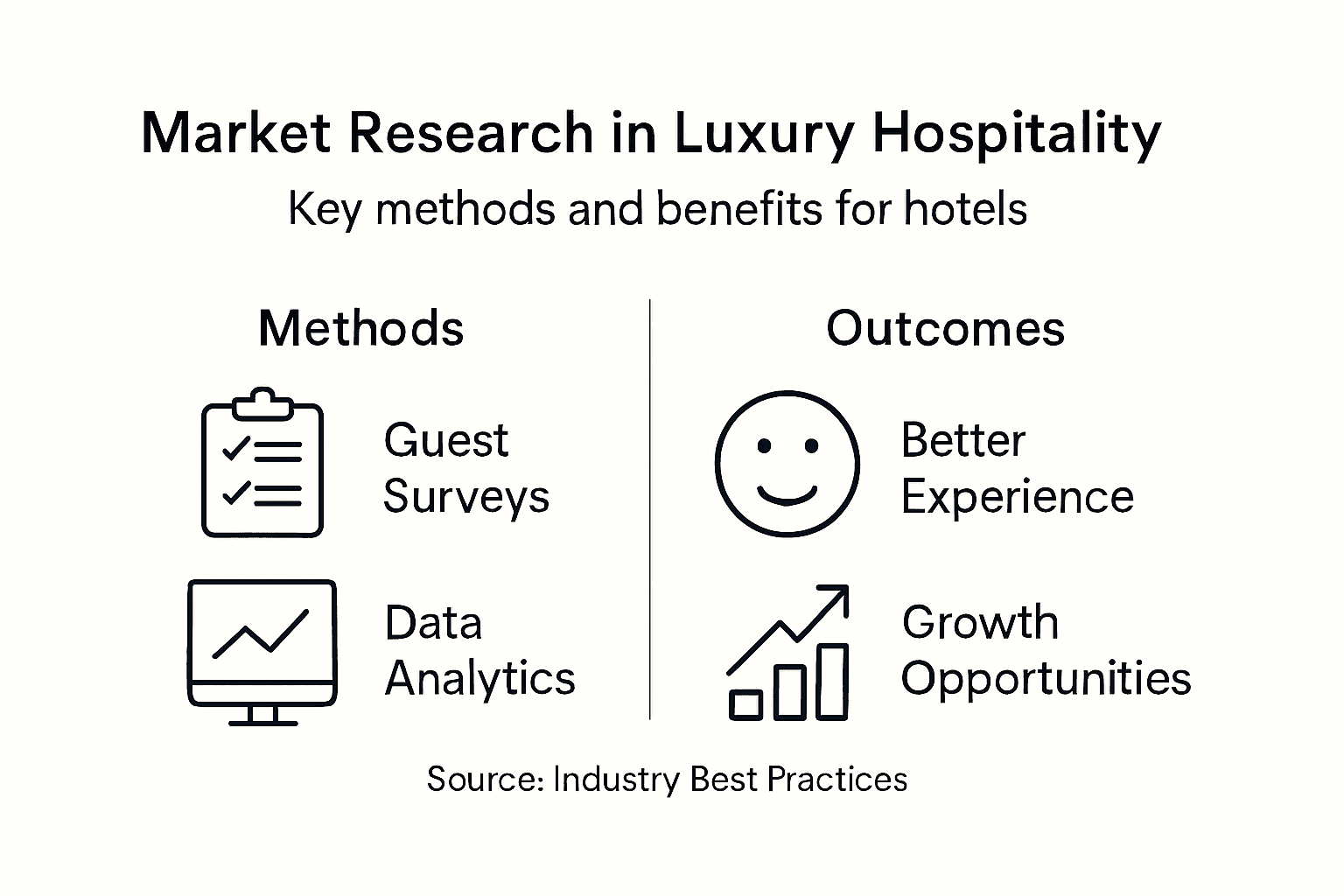
Quantitative and qualitative methodologies combine to provide a holistic view of the market. Digital analytics, guest surveys, and advanced data collection techniques enable hotels to transform raw data into actionable intelligence that drives operational improvements and enhances guest satisfaction.
Here’s a summary of common research methodologies used in luxury hospitality and their business benefits:
| Methodology | Data Type | Primary Benefit |
|---|---|---|
| Digital Analytics | Quantitative | Reveals booking patterns |
| Guest Surveys | Quantitative | Measures satisfaction rates |
| Focus Groups | Qualitative | Uncovers emotional triggers |
| Social Media Monitoring | Qualitative | Tracks reputation trends |
| Predictive Modeling | Quantitative | Forecasts future demand |
Market research is not just about collecting data, but about uncovering the stories behind the numbers that can transform hotel experiences.
Pro Tip: Implement a continuous market research framework that integrates multiple research types, ensuring a dynamic and adaptive approach to understanding evolving guest expectations.
How Market Research Drives Guest Experience
Market research has transformed from a passive data collection exercise to a dynamic strategy for creating exceptional guest experiences in luxury hospitality. Multidimensional customer experience frameworks now help hotels understand the intricate layers of guest expectations, moving beyond traditional service metrics to capture the nuanced emotional and psychological dimensions of luxury travel.
Key ways market research drives guest experience include:
- Personalization Insights: Mapping individual guest preferences and anticipating needs
- Service Quality Optimization: Identifying gaps between expected and delivered experiences
- Emotional Connection Mapping: Understanding the psychological triggers that create memorable stays
- Technological Integration: Evaluating how digital innovations can enhance guest interactions
- Predictive Experience Design: Using data to proactively shape guest journey touchpoints
Luxury hotels leverage advanced analytics to transform raw data into meaningful guest experiences. By analyzing behavioral patterns, feedback loops, and emerging travel trends, hospitality brands can craft highly tailored services that resonate with their target clientele. This approach goes beyond traditional demographic segmentation, focusing instead on creating deeply personalized and emotionally engaging interactions.
Cognitive technologies play a critical role in this transformation. Hotels now use sophisticated data integration techniques that combine guest history, real-time preferences, and predictive modeling to create seamless, anticipatory service experiences that feel both high-tech and high-touch.
Market research in luxury hospitality is about understanding the unspoken desires and creating experiences that exceed explicit expectations.
Pro Tip: Develop a continuous feedback mechanism that captures both quantitative metrics and qualitative emotional insights to refine your guest experience strategy in real-time.
Data-Driven Competitive Positioning Strategies
In the luxury hospitality sector, competitive positioning has evolved from intuitive decision-making to a sophisticated, data-driven approach that demands precision and strategic insight. Hotel competitor profiling techniques now provide unprecedented granularity in understanding market dynamics, enabling hotels to differentiate themselves with unprecedented accuracy.
Key data-driven competitive positioning strategies include:
- Granular Market Segmentation: Breaking down target audiences into highly specific personas
- Pricing Intelligence: Real-time tracking of competitive rate structures and market positioning
- Service Differentiation: Identifying unique value propositions based on comprehensive data analysis
- Performance Benchmarking: Comparing operational metrics against industry standards
- Predictive Competitive Modeling: Anticipating market shifts and competitor movements
Advanced big data analytics transform raw information into strategic advantages. By integrating multiple data sources—including online travel agency metrics, customer feedback, and operational performance indicators—luxury hotels can develop nuanced positioning strategies that go beyond surface-level comparisons. This approach allows for precise targeting, dynamic pricing, and service innovations that resonate with specific market segments.
Organizational data readiness becomes a critical competitive differentiator. Hotels that invest in sophisticated analytics infrastructure and develop a data-driven culture can rapidly adapt to market changes, creating more agile and responsive positioning strategies that outperform traditional competitors.
Here’s a comparison of data-driven competitive positioning strategies and their impact on luxury hotels:
| Strategy | Description | Impact on Business |
|---|---|---|
| Pricing Intelligence | Monitors competitor rates in real time | Improves revenue margins |
| Performance Benchmarking | Measures results vs. industry averages | Identifies areas for improvement |
| Service Differentiation | Finds unique service opportunities | Strengthens brand appeal |
| Predictive Modeling | Anticipates market changes | Informs agile business decisions |
Competitive positioning in luxury hospitality is no longer about being the best, but about being the most precisely targeted and intelligently differentiated.
Pro Tip: Develop a cross-functional data analytics team that bridges marketing, operations, and strategic planning to ensure comprehensive and actionable competitive insights.
Avoiding Costly Mistakes and Missed Trends
Luxury hospitality businesses frequently encounter systemic financial challenges that can significantly erode profitability and competitive positioning. Repeated financial mistakes represent critical vulnerabilities that demand strategic intervention and proactive management.
Common costly mistakes in luxury hospitality include:
- Pricing Strategy Failures: Neglecting dynamic pricing models
- Demand Forecasting Gaps: Inadequate predictive analytics
- Labor Management Inefficiencies: Misaligning staffing with actual demand
- Inventory Control Weaknesses: Poor tracking of resource utilization
- Technology Investment Hesitation: Resisting critical digital transformation
Successful hotels mitigate risks by implementing comprehensive monitoring systems that provide real-time insights into operational performance. This approach requires sophisticated data integration, continuous staff training, and a willingness to adapt quickly to changing market conditions. Advanced analytics platforms can help identify potential inefficiencies before they translate into substantial financial losses.
Operational intelligence becomes the key differentiator for luxury hospitality brands seeking to minimize costly mistakes. By developing robust risk management frameworks that leverage predictive technologies and comprehensive data analysis, hotels can create more resilient and adaptive business models.
Strategic foresight in luxury hospitality means anticipating challenges before they become critical failures.
Pro Tip: Implement a quarterly operational audit that combines financial metrics, guest feedback, and predictive analytics to proactively identify and address potential performance gaps.
Transforming Market Insights Into Lasting Growth
Transforming market research into sustainable growth requires a strategic approach that goes beyond traditional data collection. AI-powered personalization strategies are revolutionizing how luxury hospitality brands convert insights into competitive advantages, creating more nuanced and targeted guest experiences.
Key strategies for transforming market insights into lasting growth include:
- Predictive Experience Design: Anticipating guest needs before they arise
- Cross-Sector Collaboration: Leveraging partnerships to expand brand capabilities
- Talent Management Innovation: Aligning workforce strategies with market insights
- Technology Integration: Deploying advanced analytics for continuous improvement
- Personalization at Scale: Creating individualized experiences through data intelligence
Successful luxury hospitality brands recognize that market insights are dynamic living systems, not static reports. By developing adaptive frameworks that continuously integrate emerging trends, customer feedback, and technological innovations, hotels can create responsive business models that evolve in real-time. This approach transforms raw data into a strategic asset that drives innovation, differentiates the brand, and creates memorable guest experiences.
Strategic intelligence becomes the cornerstone of sustainable growth, enabling luxury hospitality brands to move beyond reactive management toward proactive value creation. The most successful organizations view market research not as a cost center, but as a powerful engine for organizational transformation and competitive differentiation.
Market insights are the compass that guides luxury hospitality brands toward unprecedented growth and innovation.
Pro Tip: Establish a dedicated insights team that bridges market research, customer experience, and strategic planning to ensure a holistic approach to transforming data into actionable growth strategies.
Unlock Growth in Luxury Hospitality with Data-Driven Digital Strategies
The article highlights how luxury hospitality brands must master the art of market research to understand guest preferences, optimize guest experiences, and stay ahead of competitors. The challenges of turning complex data into actionable insights demand precision and agility. Lind Creative is your partner in bridging this gap by transforming sophisticated market insights into compelling digital experiences that attract and convert the luxury traveler.
Elevate your hospitality brand with strategy-driven design and marketing crafted to reflect your unique positioning. Lind Creative’s signature Growth Engine automates lead capture, funnels, and targeted ads that help you capitalize on market intelligence effectively. Don’t wait to turn your data into engaging websites and branding that resonate with high-end clientele. Visit Lind Creative now to start building the digital foundation needed to scale sustainably and connect deeply with your audience.
Frequently Asked Questions
What is the role of market research in luxury hospitality?
Market research in luxury hospitality serves as a strategic tool to understand consumer behaviors, industry trends, and competitive landscapes, enabling brands to make informed, data-driven decisions that enhance growth and customer satisfaction.
How does market research improve guest experiences in hotels?
Market research improves guest experiences by providing insights into individual preferences and expectations, allowing luxury hotels to personalize services, optimize service quality, and create memorable stays through tailored interactions.
What types of methodologies are used in hospitality market research?
Hospitality market research utilizes both quantitative and qualitative methodologies, including digital analytics, guest surveys, focus groups, social media monitoring, and predictive modeling to gather comprehensive insights about guest preferences and market conditions.
How can luxury hotels avoid costly mistakes through market research?
Luxury hotels can avoid costly mistakes by implementing robust market research frameworks that provide real-time insights into pricing strategies, demand forecasting, and operational efficiencies, allowing them to proactively address potential issues and adapt to market changes.
Recommended
- Why Customer Experience Matters for Luxury Hotels – Lind Creative
- 7 Key Benefits of Branding for Luxury Hospitality Success – Lind Creative
- Why Rebrand: Elevating Luxury Hospitality Success – Lind Creative
- Role of Content Marketing in Luxury Hospitality – Lind Creative
- Understanding Luxury Fragrance Defined: A Deep Dive