
Every guest brings a unique story to your property, shaping each moment from the first spark of curiosity to the final farewell. For luxury hospitality brands in the United States, understanding these stories is not just a strategy but a necessity for lasting customer loyalty. By embracing customer journey mapping, you gain actionable insight into every emotional and rational touchpoint, empowering smarter engagement and stronger returns on investment.
Table of Contents
- Defining Customer Journey Mapping For Hospitality
- Types Of Customer Journey Maps And Key Differences
- Mapping Stages: From Awareness To Post-Stay
- Personalization And Emotional Engagement Strategies
- Common Pitfalls In Journey Mapping Implementation
Key Takeaways
| Point | Details |
|---|---|
| Importance of Customer Journey Mapping | It allows luxury hospitality brands to visualize and analyze every guest interaction, optimizing experiences from awareness to post-stay engagement. |
| Types of Journey Maps | Different map types, such as Current State and Emotional Journey Maps, help diagnose service gaps and enhance personalization strategies. |
| Emotional and Rational Factors | Understanding guests’ emotional states is crucial for creating memorable experiences that foster loyalty and satisfaction. |
| Common Implementation Pitfalls | Key challenges include neglecting holistic engagement and failing to integrate data across departments, hindering effective journey mapping. |
Defining Customer Journey Mapping for Hospitality
Customer journey mapping represents a strategic framework for understanding and optimizing the complex interactions between luxury hospitality brands and their guests. At its core, this methodology provides a comprehensive visualization of every touchpoint a customer experiences, from initial awareness through post-stay engagement. Customer journey mapping transforms customer interactions into actionable metrics that drive meaningful business insights.
The process involves meticulously documenting each stage of a guest’s experience, which typically includes several critical phases:
- Pre-Booking Interaction: Marketing materials, website exploration, initial research
- Booking Experience: Reservation process, communication channels, payment interactions
- Pre-Arrival Engagement: Confirmation communications, anticipation building
- On-Property Experience: Check-in, service interactions, amenity usage
- Post-Stay Engagement: Follow-up communications, feedback collection, loyalty program integration
Emotional and Rational Factors play a crucial role in this mapping process. Comprehensive journey analysis reveals that successful hospitality brands don’t just track transactional moments, but deeply understand the emotional landscape of their guests’ experiences.
Pro tip: Invest in detailed customer personas and journey maps that capture both quantitative interactions and qualitative emotional states to create truly personalized luxury experiences.
Types of Customer Journey Maps and Key Differences
Customer journey maps are not a one-size-fits-all tool, but rather a sophisticated approach with multiple variations tailored to specific business objectives and customer experiences. Systematic research frameworks reveal distinct types of journey maps that serve unique strategic purposes in luxury hospitality.
The primary types of customer journey maps include:
- Current State Maps: Visualize existing customer interactions and emotions
- Future State Maps: Project ideal customer experiences and potential improvements
- Emotional Journey Maps: Focus on tracking customer feelings and psychological responses
- Service Blueprint Maps: Highlight internal processes supporting customer interactions
- Persona-Based Maps: Customize journey experiences for specific customer segments
Each map type offers distinct insights. Consumer segmentation research demonstrates that luxury hospitality brands can uncover nuanced understanding of guest behaviors by strategically employing different mapping approaches.
Key differentiators between journey map types include their focus on quantitative metrics, qualitative emotions, current performance, or future potential. By selecting the appropriate map type, hospitality brands can diagnose service gaps, predict customer needs, and design more personalized guest experiences.
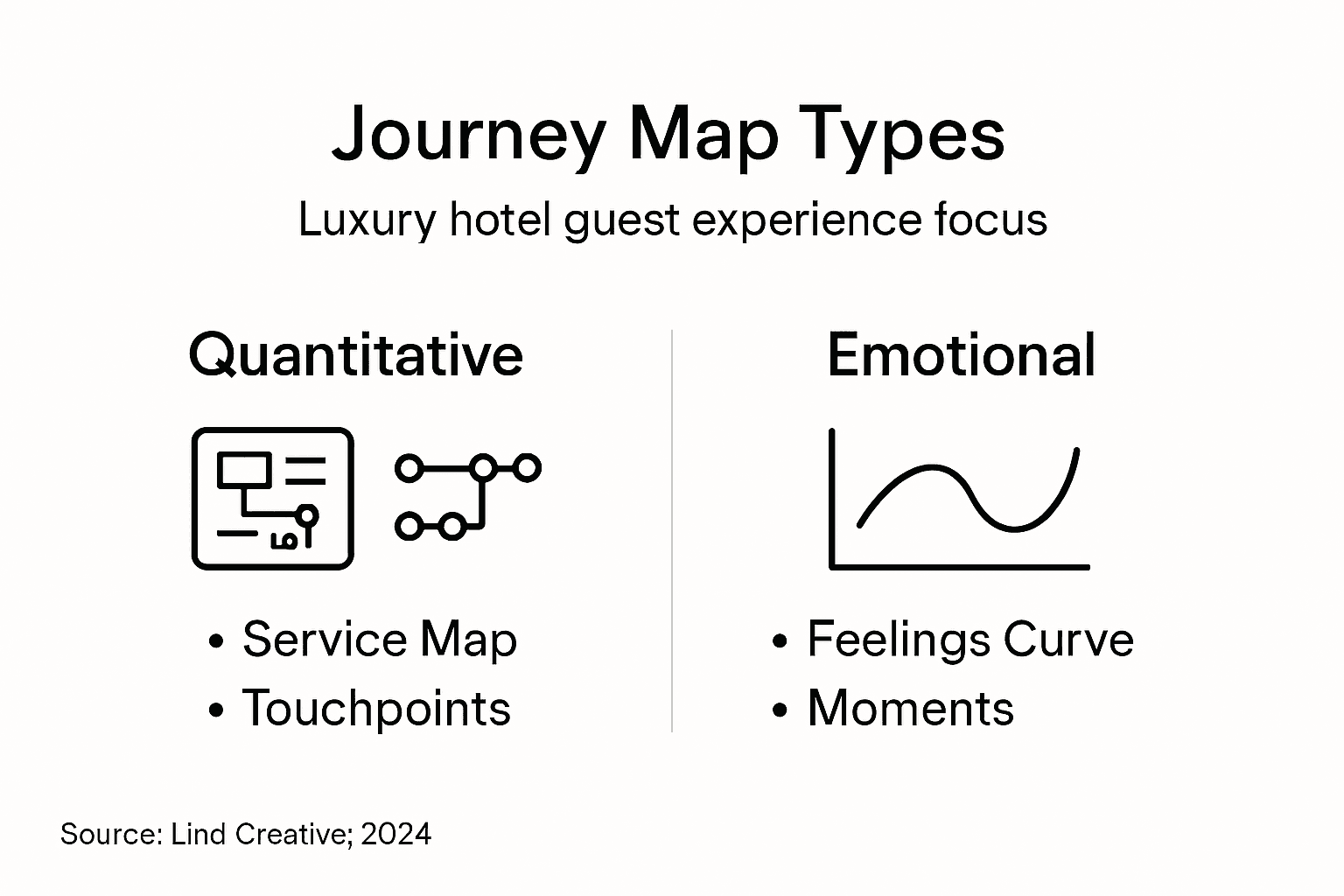
Here’s a summary comparing the main types of customer journey maps and their core applications:
| Map Type | Main Focus | Typical Use Case | Key Benefit |
|---|---|---|---|
| Current State | Existing interactions | Diagnose service gaps | Optimizes ongoing operations |
| Future State | Ideal experiences | Design new guest touchpoints | Drives innovation and improvement |
| Emotional Journey | Guest emotions | Uncover delight drivers | Enhances guest loyalty |
| Service Blueprint | Internal processes | Align staff and workflows | Improves operational efficiency |
| Persona-Based | Guest segmentation | Tailor experiences by persona | Increases personalization outcomes |
Pro tip: Select your customer journey map type based on your specific strategic goal, whether it’s improving current service, predicting future experiences, or understanding emotional triggers.
Mapping Stages: From Awareness to Post-Stay
Customer journey mapping is a comprehensive process that tracks a guest’s entire experience through multiple interconnected stages. Luxury hotel guest journeys reveal complex emotional and transactional interactions that extend far beyond traditional service boundaries.
The typical customer journey in luxury hospitality encompasses several critical stages:
- Awareness Stage: Initial brand discovery through marketing channels
- Research Stage: Exploring options, comparing amenities, reading reviews
- Booking Stage: Reservation process, communication, and initial expectations
- Pre-Arrival Stage: Anticipation building, confirmation communications
- Arrival Stage: Check-in experience, first impressions, welcome interactions
- Stay Stage: On-property service delivery, amenity usage, real-time experiences
- Departure Stage: Check-out process, final service interactions
- Post-Stay Stage: Follow-up communications, feedback collection, loyalty engagement
Hotel guest journey mapping demonstrates that each stage presents unique opportunities to create memorable experiences, diagnose potential service gaps, and build long-term customer relationships. Understanding these nuanced interactions allows luxury brands to design holistic, emotionally resonant guest experiences.
This table outlines how each hospitality journey stage can directly influence guest satisfaction and business outcomes:
| Journey Stage | Guest Experience Impact | Business Outcome |
|---|---|---|
| Awareness | Sets initial expectations | Drives brand recognition |
| Research | Builds trust and confidence | Increases conversion rates |
| Booking | Establishes first impression | Reduces booking abandonment |
| Pre-Arrival | Heightens anticipation | Boosts upsell opportunities |
| Arrival | Shapes emotional connection | Affects guest reviews |
| Stay | Delivers promised value | Generates positive feedback |
| Departure | Leaves lasting impression | Influences guest retention |
| Post-Stay | Encourages ongoing loyalty | Stimulates repeat bookings |
Pro tip: Create detailed personas for each journey stage to anticipate guest needs and design personalized touchpoint strategies that exceed expectations.
Personalization and Emotional Engagement Strategies
Personalization in luxury hospitality transcends mere data collection, representing a sophisticated approach to creating deeply meaningful guest experiences. Digital marketing personalization metrics demonstrate that tailored interactions can dramatically enhance revenue, loyalty, and overall guest satisfaction.
Key strategies for emotional engagement include:
- Data-Driven Personalization
- Collect granular guest preference data
- Develop comprehensive guest profiles
- Anticipate individual needs before they arise
- Emotional Touchpoint Design
- Create memorable, unexpected moments
- Match service style to guest personality
- Use empathetic communication techniques
- Predictive Experience Customization
- Leverage artificial intelligence for personalized recommendations
- Design adaptive service protocols
- Implement real-time personalization technologies
Emotional engagement research reveals that luxury hospitality brands must move beyond transactional interactions to create deeply resonant emotional connections. By understanding unique customer segments and their specific delight drivers, hotels can transform standard services into extraordinary experiences.
Successful personalization requires a holistic approach that integrates technological capabilities with genuine human empathy, creating seamless, intuitive interactions that make guests feel uniquely understood and valued.
Pro tip: Develop a comprehensive emotional intelligence training program for staff that teaches them to recognize and respond to subtle guest emotional cues across different journey stages.
Common Pitfalls in Journey Mapping Implementation
Customer journey mapping in luxury hospitality requires meticulous attention to detail and strategic planning. Hotel journey mapping challenges reveal numerous potential pitfalls that can undermine the effectiveness of customer experience strategies.
Key implementation challenges include:
- Scope Limitations
- Focusing only on check-in and check-out moments
- Neglecting pre-booking and post-stay interactions
- Overlooking subtle emotional touchpoints
- Data and Insight Gaps
- Insufficient data collection methods
- Failing to integrate cross-departmental insights
- Lack of comprehensive customer segmentation
- Technological and Process Barriers
- Inadequate technology infrastructure
- Poor communication across departments
- Inability to translate insights into actionable strategies
Comprehensive journey mapping research emphasizes the critical importance of holistic approach that goes beyond surface-level interactions. Successful implementation requires breaking down organizational silos, investing in advanced analytics, and creating a culture of continuous improvement.
Luxury hospitality brands must recognize that journey mapping is not a one-time exercise, but an ongoing process of understanding and anticipating guest needs. This demands a dynamic, adaptive approach that combines technological capabilities with genuine human insights.
Pro tip: Establish a cross-functional team dedicated to continuously reviewing and updating customer journey maps, ensuring real-time insights and rapid adaptation to changing guest expectations.
Unlock the Full Potential of Your Luxury Hospitality Brand with Strategic Customer Journey Mapping
Customer journey mapping exposes the emotional and operational gaps that can hold your luxury hospitality business back from delivering outstanding guest experiences and maximizing ROI. If you are struggling with fragmented touchpoints or missing deeper emotional triggers, it is time to embrace a data-driven, personalized approach to guest engagement using proven digital strategies. Lind Creative understands these challenges and specializes in translating complex journey insights into high-impact designs and marketing systems that not only captivate but also convert.
By choosing Lind Creative, you get:
- Strategy-driven design tailored to each critical guest journey stage
- Powerful brand identity development that resonates emotionally
- Our signature Growth Engine that automates lead capture, funnels, email, and ad campaigns to increase bookings and guest loyalty
Don’t let service gaps or lack of personalization hold your brand back. Visit Lind Creative to discover how we blend creativity, technology, and strategy to elevate your customer journey. Experience a collaborative process that ensures your hospitality brand not only looks outstanding but performs at the highest level.
Ready to transform your guest experience and ROI with smart, personalized digital solutions? Contact us today at Lind Creative to start mapping your success.
Frequently Asked Questions
What is customer journey mapping in luxury hospitality?
Customer journey mapping is a strategic framework that visualizes the complex interactions between luxury hospitality brands and their guests, covering every touchpoint from awareness to post-stay engagement.
Why is emotional engagement important in customer journey mapping?
Emotional engagement is crucial because it helps hospitality brands understand the feelings and psychological responses of their guests, leading to more personalized and memorable experiences that enhance loyalty and satisfaction.
What are the key stages in the customer journey for luxury hotels?
The key stages in the customer journey typically include awareness, research, booking, pre-arrival, arrival, stay, departure, and post-stay engagement, each influencing guest satisfaction and business outcomes.
What common pitfalls should be avoided when implementing journey mapping?
Common pitfalls include limiting the scope to only certain interactions, insufficient data collection, and failing to integrate insights across departments, which can undermine the effectiveness of customer experience strategies.
Recommended
- Customer Journey Mapping: Driving Loyalty in Hospitality – Lind Creative
- Why Customer Experience Matters for Luxury Hotels – Lind Creative
- What Is User Journey and Why It Matters – Lind Creative
- What Is User Experience and Its Impact on Luxury Hospitality – Lind Creative
- You Should Try This Around-the-world Vineyard-hopping Trip by Private Jet – SeekStudy Business School |