
Most businesses waste up to 70% of paid traffic budgets because visitors land on their site but never convert. Conversion rate optimization (CRO) fixes this by turning more of your existing traffic into customers, leads, or subscribers. This guide shows you how to implement CRO strategies that can boost conversions by 30 to 40% without spending more on ads or traffic generation.
Table of Contents
- Introduction To Conversion Rate Optimization
- How CRO Works: Mechanisms And Methods
- The Impact And Importance Of Conversion Rate Optimization
- Common Misconceptions About Conversion Rate Optimization
- CRO Frameworks And Models For Systematic Improvement
- Case Studies Illustrating CRO Success For Small Businesses
- Top CRO Tools And Techniques For Effective Implementation
- Tradeoffs And Decision Points In CRO Strategy
- Boost Your Website’s Conversion With Expert Help
- Frequently Asked Questions
Key takeaways
| Point | Details |
|---|---|
| CRO is data-driven | Systematic process using analytics, A/B testing, and user behavior analysis to increase website conversion rates. |
| Results are measurable | Effective CRO typically boosts conversions by 30 to 40% within months of implementation. |
| Works with existing traffic | Maximizes value from visitors you already have rather than requiring more traffic investment. |
| Prevents budget waste | Neglecting CRO wastes up to 70% of paid advertising budgets due to poor conversion rates. |
| Requires balance | Must align short-term conversion gains with long-term user experience and brand trust. |
Introduction to conversion rate optimization
Conversion rate optimization is a systematic, data-driven approach to increase the percentage of website visitors who take desired actions like making purchases, signing up for newsletters, or requesting quotes. Instead of pouring more money into driving additional traffic, CRO focuses on converting the visitors you already attract.
Typical CRO improvements range from 10% to 50%+ in conversion rates, focusing on converting existing traffic effectively. This means if your site currently converts 2% of visitors, effective CRO could push that to 3% or even higher, essentially doubling your results from the same traffic volume.
Conversion actions vary by business type but commonly include:
- Completing a purchase on an ecommerce site
- Filling out a lead generation form
- Signing up for a free trial or demo
- Downloading a resource like an ebook or guide
- Clicking through to a product page or contact form
Understanding defining high-converting websites helps frame CRO as complementary to traffic acquisition. While SEO, paid ads, and content marketing bring visitors to your site, CRO ensures those visitors actually take action once they arrive. Think of traffic generation as filling a bucket and CRO as plugging the holes so more water stays in.
How CRO works: mechanisms and methods
CRO relies on analyzing detailed visitor behavior data to identify friction points and opportunities. Tools like heatmaps show where users click, scroll, and hover. Session recordings reveal exactly how real visitors navigate your pages, exposing confusing elements or broken flows.
The core methodology includes these steps:
- Collect baseline data on current conversion rates and user behavior
- Identify problem areas causing visitors to leave without converting
- Form hypotheses about what changes might improve conversions
- Design and launch A/B tests comparing original versus modified versions
- Analyze test results to determine which version performs better
- Implement winning variations and repeat the cycle
Techniques include A/B testing, heatmaps, visitor behavior analysis, and continuous iterative testing. A/B testing compares two versions of a page by showing each to different visitor segments simultaneously. Multivariate testing takes this further by testing multiple elements at once to understand how they interact.

The iterative nature of CRO is crucial. User preferences shift, competitors change tactics, and what works today may underperform next quarter. Continuous testing keeps your site optimized as conditions evolve.
Pro Tip: Start with high-traffic pages that have clear conversion goals. Testing your homepage or primary landing pages yields faster, more statistically significant results than optimizing low-traffic pages first.
Effective optimize website conversions ecommerce strategies demonstrate how systematic testing uncovers hidden opportunities. A simple button color change might seem trivial but could lift conversions by 5% or more when tested properly.
The impact and importance of conversion rate optimization
Average CRO implementations can increase conversion rates 30 to 40% within months, significantly boosting revenue without requiring additional traffic investment. For a business generating $100,000 monthly from 10,000 visitors at a 2% conversion rate, improving to 2.8% adds $40,000 in monthly revenue from the exact same traffic.
Neglecting CRO can waste up to 70% of paid traffic budgets due to low conversion rates. Every dollar spent on Google Ads or Facebook campaigns becomes less effective when your landing pages fail to convert. This waste compounds month after month, representing massive opportunity cost.
CRO enhances overall digital marketing ROI by converting more existing visitors into customers or leads. Rather than competing solely on ad spend to outbid competitors for traffic, you win by converting better. Two businesses spending identical ad budgets can see vastly different results based purely on conversion optimization.
“Improving conversion rates is often 10 times more cost effective than increasing traffic volume, yet most businesses obsess over traffic numbers while ignoring conversion potential.”
Understanding how to analyze website traffic provides the foundation for identifying where conversion optimization will deliver maximum impact. The opportunity cost of delayed CRO efforts grows exponentially as you continue driving traffic to underperforming pages month after month.
CRO complements traffic acquisition rather than replacing it. The ideal strategy combines both: attract quality visitors through strong marketing, then convert them efficiently through optimized user experiences. For deeper exploration of strategic considerations, review conversion rate optimization importance.
Common misconceptions about conversion rate optimization
Many businesses mistakenly believe that driving more traffic alone will solve their sales problems. Reality check: doubling traffic to a page converting at 1% just gives you twice as many lost opportunities. Without conversion-focused strategies, more traffic often means more wasted ad spend.
CRO is not a replacement for traffic generation. Both work together. Optimizing conversions on 100 monthly visitors has limited impact compared to optimizing for 10,000 visitors. You need both sufficient traffic volume and strong conversion rates to maximize results.
Mobile optimization is non-negotiable for successful CRO in 2026. Over 60% of web traffic comes from mobile devices, yet many businesses still design primarily for desktop. A site that converts well on desktop but poorly on mobile leaves massive revenue on the table.
Key misconceptions to avoid:
- CRO is a one-time project rather than an ongoing process
- Only major redesigns move the needle (small iterative changes often deliver better results)
- Copying competitor tactics guarantees success (your audience and context differ)
- More aggressive sales tactics always improve conversions (they often damage trust)
- CRO only applies to ecommerce (every business with a website needs conversion optimization)
Overly aggressive tactics like intrusive popups, fake urgency timers, or misleading headlines might boost short-term conversions but harm brand reputation and customer lifetime value. The goal is sustainable conversion improvement aligned with positive user experience, not manipulative tricks that erode trust.
CRO frameworks and models for systematic improvement
The LIFT Model provides a structured way to analyze conversion factors across five key dimensions: Value Proposition clarity, Relevance to visitor intent, Clarity of messaging, Anxiety or concern reduction, and Distraction minimization. This framework helps identify specific roadblocks preventing conversions rather than making random changes.
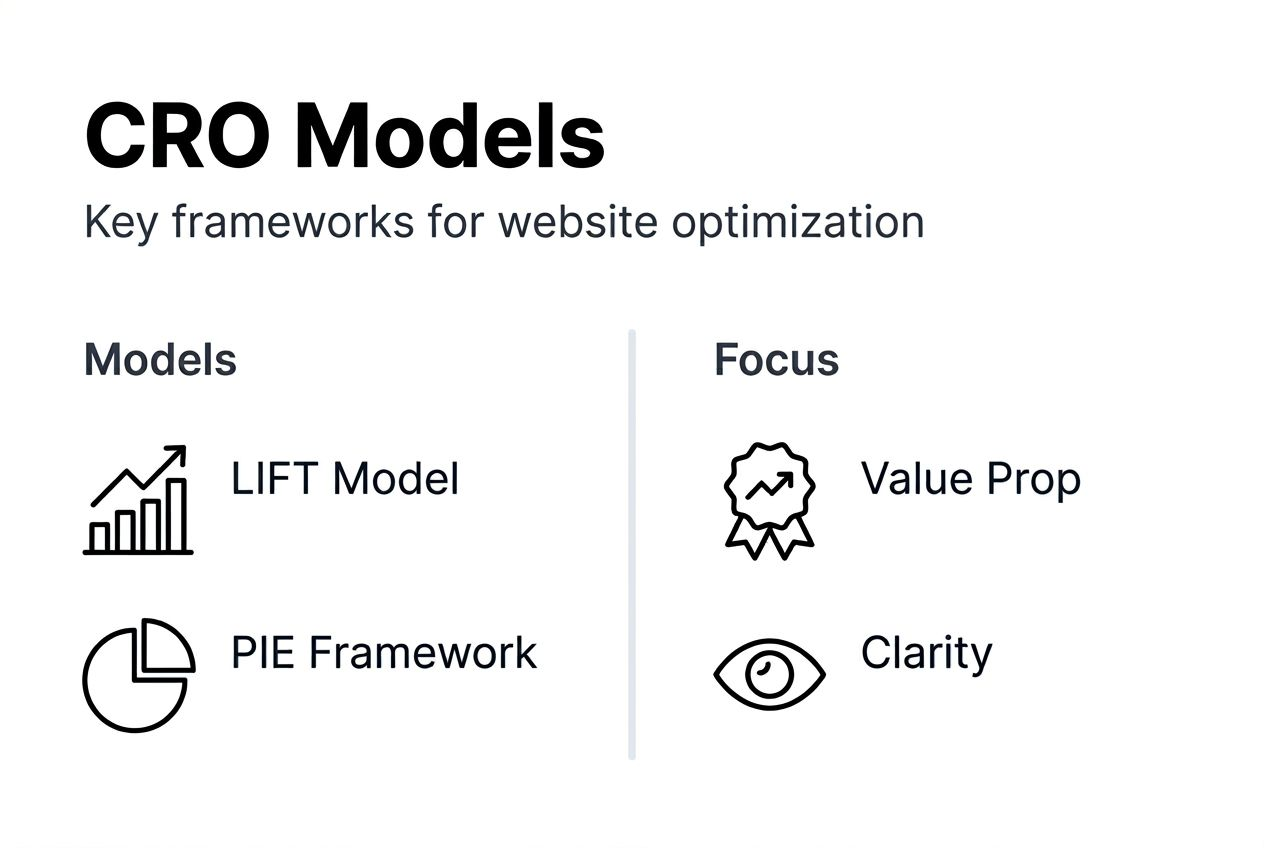
Using proven frameworks improves decision making and testing focus. Instead of guessing which elements to test, you systematically evaluate each LIFT component to find the weakest links. For example, if your value proposition is strong but anxiety is high due to unclear security badges, you know exactly what to test next.
| Framework | Primary Focus | Best Used For |
|---|---|---|
| LIFT Model | Five conversion factors: value, relevance, clarity, anxiety, distraction | Comprehensive page analysis |
| Hierarchy of Effects | Awareness to action progression | Funnel optimization |
| Fogg Behavior Model | Motivation, ability, and triggers | Understanding user psychology |
| ResolutionMedia 4W Framework | Who, what, when, where of conversions | Audience segmentation |
Applying these models to optimize landing pages conversions transforms guesswork into strategic analysis. You can pinpoint whether messaging clarity, trust signals, or friction points most need improvement.
Pro Tip: Map your current conversion funnel against the LIFT Model dimensions. Score each dimension from 1 to 10 to identify your biggest opportunities. The lowest scoring areas typically offer the highest ROI when improved.
The conversion optimization guide Shopify shows how these frameworks apply to specific platforms and business types, helping you adapt general principles to your unique situation.
Case studies illustrating CRO success for small businesses
Real-world results validate CRO’s strategic value. A regional home services company doubled qualified leads within four months by optimizing their contact form and adding trust signals like customer reviews and certifications. They didn’t increase their ad spend or traffic volume, just converted existing visitors more effectively.
Iterative testing and funnel optimization drove these successes. The home services company didn’t achieve results from a single change but through testing 12 variations over four months. Each small improvement compounded: simplified form fields, clearer headlines, better mobile layout, and prominent phone numbers.
Key strategies from successful small business CRO implementations:
- Simplified multi-step forms into single-page designs with progress indicators
- Added prominent trust signals like industry certifications and customer testimonials
- Optimized mobile experiences with larger buttons and reduced form fields
- Implemented exit-intent offers to capture abandoning visitors
- A/B tested headline variations focusing on specific customer pain points
- Improved page load speed, especially on mobile devices
A local ecommerce retailer increased average order value by 35% through strategic product bundling and improved checkout flow. They removed unnecessary steps, added clearer shipping cost information upfront, and tested different product recommendation placements. Total revenue jumped 40% without increasing marketing spend.
These examples demonstrate CRO scalability without requiring large budgets or massive traffic increases. Small businesses with limited resources can achieve meaningful growth by systematically optimizing what they already have rather than constantly chasing more traffic.
Top CRO tools and techniques for effective implementation
Selecting the right tools accelerates evidence-based CRO work. Popular A/B testing platforms include Optimizely, VWO (Visual Website Optimizer), and Google Optimize. Each provides visual editors for creating test variations, experiment reporting, and statistical significance calculations.
These tools offer features like heatmaps showing where visitors click, scroll maps revealing how far down pages users read, and session recordings capturing real user interactions. Advanced platforms integrate with analytics tools to segment audiences and personalize experiences based on visitor characteristics.
| Tool | Starting Price | Best For | Key Features |
|---|---|---|---|
| Google Optimize | Free | Small budgets, basic testing | A/B testing, Google Analytics integration |
| VWO | $186/month | Mid-sized businesses | Heatmaps, recordings, surveys, testing |
| Optimizely | Custom pricing | Enterprise, complex testing | Advanced targeting, multivariate testing |
| Hotjar | $39/month | Behavior analysis | Heatmaps, recordings, feedback polls |
Free tools work well for businesses just starting CRO or operating on tight budgets. Google Optimize integrates seamlessly with Google Analytics, making it easy to set up tests without technical expertise. As your testing program matures and traffic grows, upgrading to paid platforms provides more sophisticated capabilities.
Advanced options suit larger companies needing features like multivariate testing, advanced audience segmentation, or integration with marketing automation platforms. Optimizely and VWO offer enterprise-grade capabilities for running multiple simultaneous tests across different page types and user segments.
Technology accelerates CRO by automating data collection, statistical analysis, and result reporting. What once required weeks of manual analysis now happens in real time, letting you iterate faster and compound improvements more quickly.
Tradeoffs and decision points in CRO strategy
Balancing short-term conversion boosts with long-term brand equity requires careful strategy. Aggressive CRO tactics can improve conversions 15% short term but reduce repeat visitors by 10% over six months. Intrusive popups might capture more emails initially but annoy loyal customers who return regularly.
Friction reduction must maintain brand trust. Removing all form fields boosts completion rates but may attract lower-quality leads. Simplifying checkout increases purchases but might reduce average order value if you eliminate upsell opportunities. Every CRO decision involves tradeoffs between competing goals.
Consider long-term brand perception alongside immediate conversion numbers. A misleading headline that inflates click-through rates damages credibility when visitors discover the content doesn’t match. Trust, once lost, takes months or years to rebuild and costs far more than short-term conversion gains are worth.
“The best CRO strategies increase conversions today while strengthening customer relationships for tomorrow. Manipulation might spike metrics temporarily, but authentic value creation builds sustainable growth.”
Use data to monitor effects on both conversion and loyalty post-implementation. Track not just conversion rates but also repeat purchase rates, customer lifetime value, and satisfaction scores. A change boosting conversions 20% while reducing repeat purchases 15% may hurt overall profitability.
Strategic CRO requires nuanced decisions aligned with overall business goals. A premium brand might accept lower conversion rates to maintain exclusivity and brand positioning. A volume-focused business might optimize aggressively for maximum conversions. Neither approach is universally right, context determines optimal strategy.
For comprehensive perspective on strategic considerations, explore CRO tradeoffs and strategy to understand how leading businesses balance competing priorities.
Boost your website’s conversion with expert help
Stuck between knowing CRO matters and actually implementing it effectively? You’ve seen the data, understand the frameworks, and recognize the opportunity cost of underperforming pages.
Lind Creative specializes in building websites that don’t just look great but convert visitors into customers. Our team combines conversion optimization expertise with strategic design to maximize your marketing ROI. Whether you need a complete high-converting digital marketing workflow or want to optimize your existing site, we provide the strategy and execution to drive measurable growth.
Explore our best website builders for agencies comparison to choose the right platform for your needs. Ready to transform your online presence? Our website redesign step by step guide shows how we help businesses scale through strategic optimization and data-driven design.
Frequently asked questions
What is conversion rate optimization (CRO)?
CRO is the systematic process of increasing the percentage of website visitors who complete desired actions like purchases, signups, or form submissions. It uses data analysis, user behavior research, and testing to improve conversion rates. The focus is maximizing value from existing traffic rather than simply driving more visitors to your site.
How does A/B testing improve conversion rates?
A/B testing compares two or more versions of a webpage by showing each to different visitor segments simultaneously, measuring which performs better. It removes guesswork by using actual user behavior data to determine which design, copy, or layout converts more effectively. Winners get implemented while losers get discarded, creating continuous improvement through evidence-based decisions.
What are common mistakes to avoid in CRO?
Focusing only on traffic growth while ignoring conversion optimization wastes marketing budgets and leaves revenue on the table. Running too few tests or stopping tests before reaching statistical significance leads to false conclusions. Neglecting mobile experience, using overly aggressive tactics that damage trust, and treating CRO as a one-time project rather than ongoing process all reduce effectiveness and can harm long-term business performance.
Which CRO tools are best for small businesses?
Google Optimize offers a free, easy-to-use option perfect for small budgets and businesses just starting with conversion optimization. VWO provides affordable plans starting around $186 monthly with features like heatmaps, visitor recordings, and A/B testing capabilities. Hotjar works well for behavior analysis at $39 monthly, while Optimizely suits growing businesses needing advanced testing and integration capabilities despite higher custom pricing.
Recommended
- Website Conversion Optimization Guide for Shopify Success – Lind Creative
- How to Optimize Website Conversions for eCommerce Success – Lind Creative
- How to Optimize Landing Pages for Maximum Conversions – Lind Creative
- Defining High-Converting Websites for Results-Driven Growth – Lind Creative