
Running a luxury hospitality brand in the United States means every missed connection can feel like a missed opportunity. Standing out takes more than classic marketing and manual lead management when discerning guests expect seamless, personalized experiences online. SaaS marketing offers a specialized approach focused on building long-term relationships and measurable value through targeted digital strategies. This article explains how adopting these core principles can automate your lead generation and sharpen your brand visibility in a competitive, ever-evolving marketplace.
Table of Contents
- Defining SaaS Marketing and Its Core Principles
- Key SaaS Marketing Strategies for Hospitality
- Types of SaaS Marketing Automation Tools
- Benefits and Limitations for Hospitality Brands
- Common Mistakes and How to Avoid Them
Key Takeaways
| Point | Details |
|---|---|
| Emphasize Customer Retention | SaaS marketing focuses on building long-term relationships and demonstrating ongoing value to retain customers. |
| Implement Targeted Strategies | Tailoring marketing campaigns to specific customer segments enhances effectiveness and addresses niche needs. |
| Leverage Marketing Automation | Utilize automation tools to streamline engagement, measure performance, and enhance personalization in marketing efforts. |
| Continuous Improvement | Regularly analyze market data and customer feedback to refine marketing strategies and ensure alignment with customer expectations. |
Defining SaaS Marketing and Its Core Principles
SaaS marketing represents a specialized approach to promoting subscription-based software solutions, distinctively different from traditional product marketing strategies. Unlike conventional sales models, SaaS marketing focuses on building long-term customer relationships and demonstrating ongoing value through targeted digital strategies.
At its core, SaaS marketing involves several critical principles that set it apart from other marketing disciplines:
- Subscription-based model: Prioritizing recurring revenue over one-time purchases
- Niche audience targeting: Developing hyper-specific marketing campaigns
- Measurable performance metrics: Tracking key performance indicators like Customer Acquisition Cost (CAC) and Customer Lifetime Value (CLV)
- Continuous value demonstration: Emphasizing product utility and ongoing improvements
The fundamental goal of SaaS marketing is not just selling a product, but creating a compelling value proposition that encourages customers to maintain their subscription. This requires a nuanced approach that combines precise customer targeting, transparent pricing models, and consistent product evolution.
Strategic elements that distinguish SaaS marketing include:
- Offering free trial periods
- Implementing transparent pricing structures
- Developing robust onboarding experiences
- Creating educational content that showcases product capabilities
Pro tip: Invest in analytics tools that help you understand customer behavior and optimize your marketing funnel in real-time.
Key SaaS Marketing Strategies for Hospitality
In the competitive landscape of hospitality technology, SaaS marketing strategies must be tailored to address the unique challenges of hotel and travel businesses. Advanced digital marketing techniques have become essential for distinguishing software solutions in this dynamic marketplace.
Key strategies for successful SaaS marketing in hospitality include:
- Product demonstration: Creating immersive free trials that showcase real-world application
- Targeted content marketing: Developing educational resources specific to hospitality challenges
- Personalization: Crafting marketing messages that address specific pain points for different hospitality segments
- Performance tracking: Implementing robust analytics to measure customer acquisition and retention
Successful SaaS marketing in hospitality requires a multifaceted approach that goes beyond traditional sales techniques. Businesses must focus on building trust, demonstrating tangible value, and providing continuous support throughout the customer journey.

Strategic implementation for SaaS marketing in hospitality involves:
Here’s a comparison of SaaS marketing challenges and strategies for hospitality brands:
| Challenge | Impact on Hospitality | Effective Strategy |
|---|---|---|
| Complex buyer segments | Needs tailored approach | Develop detailed customer personas |
| High competition | Hard to differentiate | Create industry-specific content |
| Long decision cycles | Slower conversions | Offer case studies and free trials |
| Security requirements | Data privacy concerns | Demonstrate compliance standards |
| Integration needs | Must fit with legacy systems | Highlight integration capabilities |
- Developing comprehensive onboarding experiences
- Creating industry-specific case studies
- Offering scalable pricing models
- Implementing responsive customer support systems
Hospitality SaaS solutions must prove their ability to solve specific operational challenges, not just sell a generic software product.
Pro tip: Invest in creating detailed, segment-specific content that demonstrates your software’s unique value proposition for different hospitality business types.
Types of SaaS Marketing Automation Tools
Marketing automation tools have revolutionized how hospitality businesses approach customer engagement and streamline their digital marketing efforts. Key digital marketing technologies enable businesses to create more personalized, efficient marketing strategies that adapt to rapidly changing customer expectations.
The primary types of SaaS marketing automation tools for hospitality include:
- Customer Relationship Management (CRM) Tools: Tracking and managing customer interactions and data
- Email Marketing Platforms: Designing targeted communication campaigns
- Lead Generation Software: Identifying and nurturing potential customer prospects
- Analytics and Reporting Tools: Measuring marketing performance and customer behavior
- Social Media Management Platforms: Coordinating and scheduling cross-channel marketing content
Each category of marketing automation tool serves a unique purpose in the hospitality technology ecosystem. These sophisticated solutions help businesses optimize their marketing efforts, reduce manual workload, and create more personalized customer experiences.
Below is a summary of SaaS marketing automation tools, their main use, and typical value for hospitality:
| Tool Type | Main Use | Value for Hospitality Brands |
|---|---|---|
| CRM Tools | Manage guest relationships | Boost retention and upsell rates |
| Email Marketing Platforms | Automate client communication | Increase direct booking engagement |
| Lead Generation Software | Identify new prospects | Fill pipeline with quality leads |
| Analytics Tools | Track campaign results | Optimize marketing investment |
| Social Media Management | Schedule platform content | Elevate brand engagement online |
Strategic implementation of marketing automation tools requires careful consideration of:
- Integration capabilities with existing systems
- Scalability for business growth
- User-friendly interface and training requirements
- Data security and compliance standards
Successful marketing automation is not about replacing human interaction, but enhancing and personalizing customer engagement through intelligent technology.
Pro tip: Select marketing automation tools that offer comprehensive integration capabilities and provide detailed analytics to continuously refine your marketing strategy.
Benefits and Limitations for Hospitality Brands
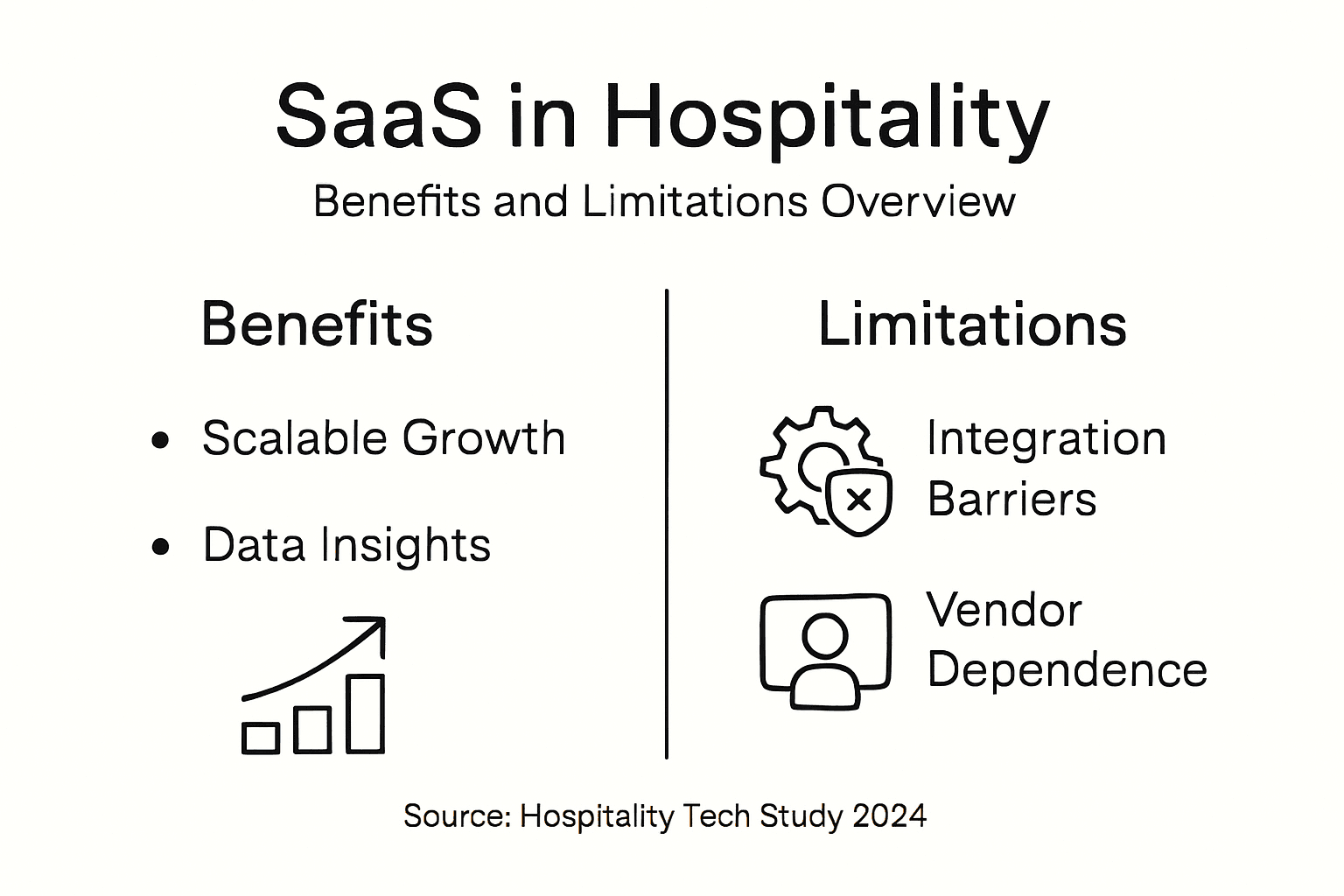
SaaS solutions in hospitality represent a transformative technology that offers significant advantages while presenting unique challenges. Custom hospitality technology platforms enable businesses to reimagine their operational and marketing strategies with unprecedented flexibility.
Key benefits for hospitality brands include:
- Cost Efficiency: Reducing upfront technology investments
- Operational Scalability: Adapting quickly to changing business needs
- Enhanced Customer Experience: Personalizing interactions and services
- Real-time Data Analytics: Making informed strategic decisions
- Automated Marketing Processes: Streamlining customer engagement
However, SaaS solutions are not without potential limitations. Hospitality brands must carefully evaluate potential drawbacks such as internet dependency, data security concerns, and complex system integrations.
Critical considerations for hospitality brands adopting SaaS include:
- Assessing technological infrastructure compatibility
- Evaluating data migration challenges
- Understanding security and compliance requirements
- Training staff on new technological platforms
Technology should enhance human connection, not replace the personalized touch that defines exceptional hospitality.
Pro tip: Conduct thorough vendor assessments and request comprehensive demonstrations before committing to any SaaS marketing automation platform.
Common Mistakes and How to Avoid Them
Navigating the complex landscape of SaaS marketing requires strategic awareness and proactive planning. Top SaaS marketing traps often emerge from fundamental misunderstandings about customer needs and market dynamics.
Common mistakes hospitality brands frequently encounter include:
- Inadequate Market Research: Failing to understand specific customer segments
- Unclear Value Proposition: Not articulating unique software benefits
- Overlooking Customer Segmentation: Creating generic marketing approaches
- Ignoring Data Analytics: Neglecting performance measurement
- Poor Onboarding Experiences: Complicated user introduction processes
Successful SaaS marketing demands a nuanced approach that goes beyond traditional selling techniques. Hospitality brands must develop a deep understanding of their target audience’s specific technological and operational challenges.
Strategic solutions to mitigate these risks involve:
- Conducting comprehensive market analysis
- Developing targeted customer personas
- Creating clear, measurable value propositions
- Implementing robust analytics tracking
- Designing intuitive user onboarding experiences
Effective SaaS marketing is about solving problems, not just selling software.
Pro tip: Invest in continuous customer feedback loops and regularly update your marketing strategies based on real-world insights.
Elevate Your Hospitality SaaS Marketing with Lind Creative
Succeeding in SaaS marketing for hospitality requires not only understanding complex buyer segments and navigating long decision cycles but also crafting personalized experiences that demonstrate ongoing value. If you are challenged by high competition and the need for clear, measurable growth strategies, our expertise aligns perfectly with your goals. At Lind Creative, we specialize in blending creativity, technology, and strategic insights to build marketing systems that automate lead capture and nurture prospects effectively.
Discover how our full-service digital agency can empower your hospitality brand to overcome common SaaS marketing pitfalls through targeted content, advanced onboarding strategies, and scalable automation. Visit our Industry Trends – Lind Creative to stay informed and learn more. Ready to unlock your growth potential with a proven marketing system? Connect with us today at Lind Creative and start transforming your SaaS marketing challenges into measurable success.
Frequently Asked Questions
What is SaaS marketing?
SaaS marketing refers to the unique strategies and techniques used to promote subscription-based software solutions, focusing on building long-term customer relationships and delivering ongoing value.
How does SaaS marketing differ from traditional marketing?
Unlike traditional marketing, SaaS marketing prioritizes recurring revenue, niche audience targeting, measurable performance metrics, and continuous product improvements instead of one-time sales.
What are the key strategies for SaaS marketing in the hospitality industry?
Key strategies include creating immersive product demonstrations, targeted content marketing addressing hospitality challenges, personalization of marketing messages, and tracking performance metrics to optimize customer acquisition.
What are some common mistakes to avoid in SaaS marketing?
Some common mistakes include inadequate market research, unclear value propositions, overlooking customer segmentation, ignoring data analytics, and providing poor onboarding experiences.
Recommended
- Key Digital Marketing Terms Driving Hotel Growth – Lind Creative
- 7 Steps for an Effective Marketing Strategy Checklist – Lind Creative
- What Is Retargeting: Boosting Conversions for Hospitality – Lind Creative
- Why Market Research Matters for Luxury Hospitality – Lind Creative