
Managing high-value clients across multiple channels can quickly overload even the most skilled marketing team. For luxury eCommerce brands, consistently delivering personalized experiences is what separates lasting loyalty from fleeting interest. A CRM system serves as the foundation for achieving seamless customer engagement, enabling you to centralize data and automate relevant interactions that exceed modern expectations. This article clarifies exactly how CRM automation can transform your marketing efforts, from targeted communications to operational efficiency.
Table of Contents
- Defining CRM’s Role In Modern Marketing
- Core CRM Types And Key Features
- Key Features That Drive Luxury Engagement
- Personalization And Customer Journey Automation
- Omnichannel Integration For Seamless Engagement
- Measuring Success And Avoiding Common Pitfalls
Key Takeaways
| Point | Details |
|---|---|
| CRM as a Central Hub | A CRM system centralizes customer data, allowing for personalized marketing and improved communication with high-value clients. |
| Automation Drives Efficiency | Automation features within CRM systems reduce manual tasks, enabling teams to focus on building customer relationships and generating revenue. |
| Personalization Enhances Loyalty | Tailoring marketing efforts to distinct customer segments drives loyalty and engagement, creating a more meaningful connection with each client. |
| Measuring Success is Essential | Clear metrics aligned with business objectives are crucial for assessing the impact of CRM initiatives on sales and customer retention. |
Defining CRM’s Role in Modern Marketing
At its core, a CRM system functions as the backbone of modern marketing strategy for luxury brands. It’s the central hub where customer data converges, relationships are nurtured, and marketing effectiveness multiplies. For luxury eCommerce businesses, this means having a unified view of every customer touchpoint, from the first website visit to post-purchase engagement. Rather than managing customer information scattered across spreadsheets, email platforms, and sales tools, your entire team accesses the same comprehensive customer profiles. This unified approach transforms how you communicate with high-value clients who expect personalized, seamless experiences across every channel.
When you implement a CRM effectively, you’re essentially automating the parts of customer relationship management that drain your team’s time while amplifying the parts that drive revenue. CRM enables marketing automation, allowing you to trigger timely, relevant messages based on customer behavior rather than manually sending campaigns. Think about your luxury customer journey: A visitor browses your premium collection, abandons their cart, and suddenly receives a personalized message acknowledging their interest with exclusive access to new arrivals. That’s CRM automation at work. Beyond automation, the system provides detailed analytics for tracking campaign performance, showing exactly which messages resonate with which customer segments. You can see conversion rates, engagement metrics, and revenue attribution tied directly to specific campaigns, giving you the data needed to refine your strategy continuously.
For luxury brands, the competitive advantage lies in customer segmentation and personalization. Your high-net-worth clients have different expectations than casual browsers, and a CRM lets you treat them accordingly. You can segment your audience by purchase history, engagement level, product preferences, and even lifecycle stage, then deliver campaigns tailored to each group. A VIP customer who spent six figures with you receives different messaging than someone exploring your brand for the first time. This level of customization drives loyalty because customers feel understood rather than sold to. Additionally, CRM systems support customer retention through proactive engagement strategies. Rather than waiting for customers to return, you can implement loyalty programs, send anniversary offers, recommend complementary products, and create exclusive experiences that reinforce their decision to invest in your brand.
The operational impact extends beyond marketing into your entire customer-facing operation. By centralizing customer data across multiple channels, your sales team knows what marketing communicated, your customer service team understands purchase history, and your product team gains insights into what customers actually want. This transparency eliminates the frustration luxury clients experience when they repeat information or receive contradictory messages. Your team works more efficiently because they’re not duplicating efforts or searching for customer information buried in different systems. The result is faster response times, fewer errors, and the kind of coordinated service luxury clientele expects as standard.
Pro tip: Start by mapping your current customer data sources and identifying which information matters most for personalization, then gradually migrate that data into your CRM with clean, standardized formats to ensure your automation and segmentation efforts produce accurate results from day one.
Core CRM Types and Key Features
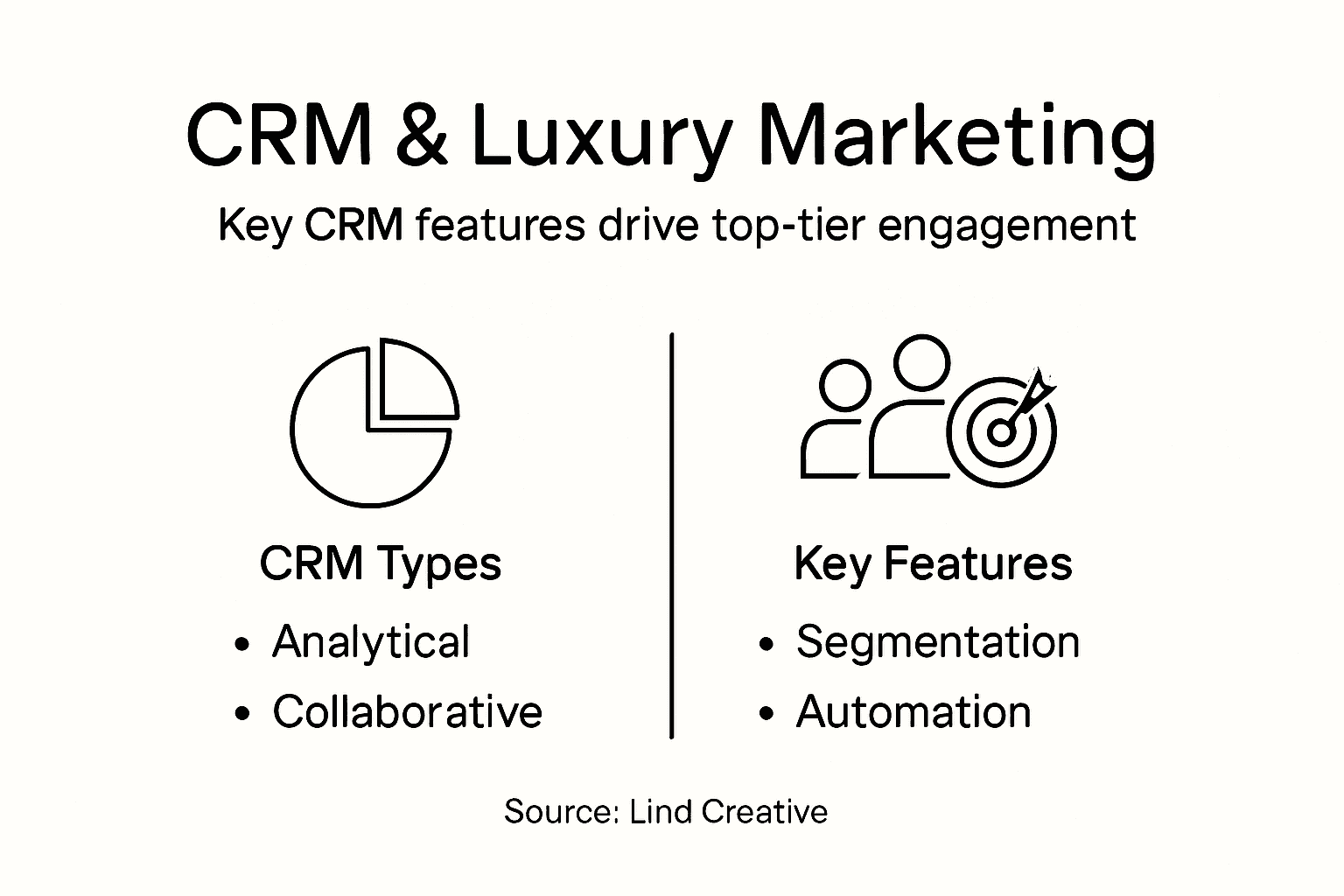
Not all CRM systems work the same way, and understanding the different types helps you choose what actually solves your luxury eCommerce challenges. The three main categories each serve distinct purposes, though many modern platforms blend elements of all three. Operational CRM handles the day-to-day customer interactions that move prospects through your sales funnel and keep existing customers engaged. This includes automating sales tasks like lead tracking, email follow-ups, and customer service requests. When a potential client reaches out about a premium product, operational CRM captures that interaction, assigns it to the right team member, and ensures nothing falls through the cracks. For luxury brands, this means your sales team spends less time on administrative work and more time building relationships with high-value prospects.
Analytical CRM takes a completely different approach by focusing on what your data reveals about customer behavior and market trends. Rather than managing individual interactions, this type aggregates customer information and runs sophisticated analysis to uncover patterns. You might discover that customers who purchased your flagship collection during spring typically upgrade their purchases in fall, or that customers acquired through Instagram spend 40 percent more than those from other channels. These insights inform your broader marketing strategy, helping you allocate budget more effectively and predict which customers are most likely to make repeat purchases. For luxury brands competing on exclusivity and personalization, analytical CRM reveals which segments deserve VIP treatment and which messaging resonates with your most profitable customers.
Collaborative CRM bridges the gap between departments by making customer information universally accessible. Your marketing team documents why a customer engaged with a specific campaign, your sales team notes their preferences and purchase timeline, and your customer service team tracks their support history. When this customer contacts you with a question, they don’t need to repeat information because everyone on your team sees the same customer story. Collaborative systems unify communications and interactions across business units, eliminating silos that damage the luxury customer experience. A high-value client expects seamless service whether they’re emailing, calling, or visiting your site, and collaborative CRM makes that consistency possible.
Here’s a side-by-side summary of CRM types and their business impacts for luxury eCommerce:
| CRM Type | Primary Focus | Typical Business Impact | Example Use Case |
|---|---|---|---|
| Operational CRM | Daily customer interactions | Enhances workflow efficiency | Automated lead assignment |
| Analytical CRM | Customer data analysis | Informs targeted marketing | Predicting repeat purchases |
| Collaborative CRM | Cross-team coordination | Improves service consistency | Shared customer conversation log |
Key Features That Drive Luxury Engagement
Beyond these three types, specific features distinguish a CRM that works for luxury eCommerce from one that doesn’t. Contact and account management forms the foundation, storing detailed customer profiles that go beyond basic email addresses. You’re tracking purchase history, preferred communication channels, VIP status, and personal preferences that signal what matters to each customer. Lead scoring automatically identifies which prospects show the strongest buying signals, allowing your sales team to prioritize conversations with customers most likely to convert. Segmentation and personalization tools let you divide your customer base into meaningful groups and deliver tailored messaging at scale. For luxury brands, this might mean segmenting by purchase value, product category interest, or engagement level, then sending highly customized campaigns that speak directly to each segment’s needs.

Marketing automation represents perhaps the most time-saving feature for busy marketing teams. You can create workflows that trigger specific actions based on customer behavior without manual intervention. A customer abandons their cart? Automatic reminder email. A repeat customer hasn’t engaged in six months? Automated win-back campaign launches. A new customer completes their first purchase? Automated welcome series begins. These workflows run around the clock, delivering timely messages that feel personal but require minimal ongoing effort. Analytics and reporting close the loop by showing you exactly what’s working. You see open rates, click-through rates, conversion rates, and revenue attribution tied to specific campaigns and segments. This data-driven approach eliminates guesswork and lets you invest confidently in strategies proven to generate results.
Integration capabilities matter more than many teams realize. Your CRM should connect seamlessly with your eCommerce platform, email marketing tools, social media channels, and customer service systems. Without proper integration, you’re manually moving data between platforms, which introduces errors and wastes hours. Luxury eCommerce operations run smoothly when information flows automatically between systems, keeping everyone synchronized and preventing duplicate efforts.
Below is a quick reference for CRM features that drive luxury brand engagement:
| Feature | What It Does | Impact on Customer Experience | Business Benefit |
|---|---|---|---|
| Segmentation Tools | Groups customers by criteria | Enables tailored communication | Boosts loyalty and sales |
| Marketing Automation | Triggers messages by behavior | Delivers timely, relevant outreach | Saves team time |
| Analytics & Reporting | Tracks campaign performance | Reveals effective engagement | Informs strategy refinement |
| Integration Support | Connects to other platforms | Allows consistent omnichannel view | Prevents data errors |
Pro tip: Audit your current marketing tools and identify which ones already contain valuable customer data, then prioritize integration with those platforms first when implementing your CRM to minimize manual data entry and ensure accuracy from launch.
Personalization and Customer Journey Automation
Personalization isn’t about knowing a customer’s first name anymore. It’s about understanding their preferences, purchase patterns, and aspirations well enough to feel like you’re reading their mind. For luxury eCommerce brands, this level of customization separates you from competitors and turns casual browsers into loyal advocates. When a customer visits your site, your CRM should instantly recognize them, recall their previous interactions, and present exactly what matters to them. If they previously showed interest in limited-edition handbags, your homepage highlights new arrivals in that category. If they abandoned a cart three months ago, you remind them with exclusive early access to the next collection. This isn’t random messaging; it’s orchestrated personalization powered by the data your CRM collects and analyzes continuously.
AI-driven personalization technologies amplify what your CRM can accomplish at scale. These systems use machine learning to identify patterns in customer behavior that human analysts might miss. Chatbots, recommendation systems, and virtual assistants deliver personalized content in real-time, answering questions about products while subtly steering customers toward items aligned with their preferences. A recommendation engine might suggest complementary products based on what similar high-value customers purchased, increasing average order value without aggressive upselling. These AI tools work around the clock, personalizing experiences for hundreds or thousands of customers simultaneously while maintaining the feel of one-on-one service. The result is what marketers call hyper-targeted marketing, where each customer receives messaging and recommendations tailored specifically to their behavior and interests.
Beyond individual messages, true automation requires mapping the entire customer journey and automating responses at each stage. Customer journey mapping enhanced by real-time data analytics lets you see exactly where customers interact with your brand, where they hesitate, and where they need support. You might discover that customers who read your blog post about luxury fabric care are 60 percent more likely to purchase your premium line. With this insight, you can automatically place that blog post in front of prospects showing similar behaviors, accelerating their path to purchase. Journey automation means that when a customer reaches a specific milestone, your CRM triggers the next logical step without anyone manually intervening. A new customer completes their first purchase and automatically enters a welcome series designed to reinforce their decision and introduce them to your brand story. A VIP customer hasn’t engaged in eight weeks and receives a personalized win-back email offering exclusive access to an upcoming release.
Building Seamless Experiences Across Touchpoints
The magic happens when personalization works consistently whether customers interact with you via email, Instagram, your website, or customer service. Your CRM becomes the central nervous system ensuring every touchpoint reflects the same customer understanding. When someone replies to your email asking about size availability, your customer service team sees the conversation history and knows this customer prefers detailed product information over generic responses. When they browse your Instagram stories, retargeting ads show products matching their demonstrated interests. When they visit your website, their experience reflects their VIP status and previous purchases. This consistency builds trust because customers recognize you understand them across every interaction.
The operational benefit extends to your entire team. Sales representatives spend less time on research because the CRM already knows each prospect’s interests and timeline. Marketing teams stop wasting budget on irrelevant messaging because segmentation ensures campaigns reach the right people with the right message at the right moment. Customer service teams handle inquiries faster because context is instant. Your inventory team gains visibility into which products resonate with which customer segments, informing purchasing decisions. What looks like magic from the customer perspective is actually the result of systematic, data-driven automation that eliminates friction throughout your entire organization.
Pro tip: Start your automation journey by mapping just three to five critical moments in your customer journey, such as post-purchase onboarding or cart abandonment, then build triggered automation workflows for those moments before expanding to more complex journeys.
Omnichannel Integration for Seamless Engagement
Your luxury customers don’t think about your business as separate channels. They think about you as a brand. When they start researching on Instagram, browse your website, text customer service with questions, and eventually visit a physical showroom (if you have one), they expect continuity throughout. They shouldn’t need to repeat themselves or explain their context. They shouldn’t discover that the VIP discount they received via email isn’t valid on your website. Yet this is exactly what happens when your CRM doesn’t integrate across channels. Omnichannel integration means your entire organization operates as one unified system, regardless of where customers interact with you. Your CRM becomes the central hub connecting email, social media, your website, mobile app, customer service, and any other touchpoint where customers engage with your brand.
When omnichannel integration works properly, customer data flows seamlessly between channels in real-time. A customer adds items to their cart on your mobile app, then later accesses your desktop site and finds those same items still in their cart. They see personalized product recommendations on both devices reflecting the same browsing history. If they contact customer service via chat, the representative immediately sees their purchase history and recent website activity, enabling context-aware support. Integrated management of retail technologies and channels enhances customer engagement by creating fluency and flow across all interactions. Your CRM tracks every touchpoint, every conversation, and every transaction, building a 360-degree view of each customer. This unified perspective allows your team to deliver consistent, personalized service whether the customer interacts with you through email, Instagram direct messages, your website, or phone support.
The competitive advantage for luxury eCommerce brands is profound. When a high-value customer browses your premium collection at midnight on a Friday, your CRM captures that interest and ensures your marketing team knows about it Monday morning. When they receive a personalized email featuring those exact products with styling suggestions from your brand, it feels like your team was listening. When they click through and make a purchase, that transaction is instantly visible to customer service, so if they have questions, your team already knows what they bought and can provide expert guidance without generic responses. Omnichannel strategies optimize channel coordination and network efficiency while meeting consumer preferences for consistency and convenience across platforms. The operational efficiency gains matter equally to your team. Instead of managing disparate systems where information gets lost between departments, your CRM consolidates everything in one place. Sales, marketing, and customer service work from the same playbook, eliminating conflicting messages and duplicate efforts.
Strategic Channel Coordination
Successful omnichannel integration requires more than just connecting systems. It demands intentional strategy about how channels work together. Consider a luxury handbag customer who discovers your brand through a carefully placed Instagram ad, visits your website to explore, abandons their cart due to decision paralysis, receives a targeted email offering personalized styling advice, and eventually makes a purchase. Without omnichannel coordination, each of these touchpoints operates independently, and you lose the narrative thread. With proper CRM integration, you orchestrate this journey deliberately. Your social team knows their role is brand discovery. Your website team knows their role is education and inspiration. Your email team knows their role is removing barriers to purchase. Each channel amplifies the others because they’re all connected through your CRM, which tracks progress and coordinates timing.
Inventory synchronization exemplifies why omnichannel matters for luxury brands. If a customer sees an exclusive item on your Instagram story, visits your website, finds it available, but discovers it’s actually sold out (because your inventory system wasn’t integrated), you’ve destroyed trust. With proper CRM and inventory integration, channels reflect real-time availability. If an item is limited edition with only two remaining, all channels show that scarcity, reinforcing exclusivity and urgency. If a customer expresses strong interest in a product currently out of stock, your CRM can automatically notify them when it’s back in inventory through their preferred channel. This proactive communication builds loyalty and captures sales that competitors miss.
Implementation requires auditing your current technology stack and identifying integration gaps. Which systems currently operate in isolation? Where does customer data get trapped? Where do customers experience friction because departments don’t share information? Your CRM should integrate with your eCommerce platform, email marketing tool, social media management system, customer service platform, inventory system, and analytics tools. Modern platforms offer API connections that enable real-time data synchronization. Some integration requires custom development, but the investment pays for itself through improved conversion rates, higher customer lifetime value, and reduced operational redundancy.
Pro tip: Start with your three highest-value customer touchpoints and focus on integrating those channels first, ensuring data flows bidirectionally between your CRM and those systems, then gradually expand integration to lower-priority channels once you’ve proven the value.
Measuring Success and Avoiding Common Pitfalls
Investing in a CRM system is only half the battle. The real challenge is measuring whether your investment actually drives business results. Many luxury eCommerce brands implement CRM platforms, load them with customer data, and then wonder why their marketing performance hasn’t improved. The gap between implementation and success often comes down to measurement. You need clear metrics that show whether your CRM is actually increasing sales, improving customer retention, and delivering the return you expected. Without purposeful measurement tied to business objectives, your CRM becomes an expensive data warehouse that teams use sporadically rather than a strategic tool that transforms how you market.
Start by identifying metrics that matter to your business. This sounds obvious, but many organizations focus on activity metrics rather than performance metrics. Your team might measure how many emails were sent, how many leads were captured, or how many customers were added to the database. These numbers feel productive but don’t prove that your CRM is driving revenue. Instead, focus on outcomes. Track conversion rates from CRM campaigns compared to non-CRM marketing efforts. Measure customer lifetime value for segments nurtured through automated workflows versus those who received generic messaging. Calculate customer retention rates and compare them before and after implementing your CRM. Monitor average order value changes when customers receive personalized recommendations. These outcome metrics directly connect CRM usage to business growth. Effective measurement requires selecting meaningful key performance indicators aligned with stakeholder needs, ensuring you’re tracking what actually matters rather than vanity metrics that look impressive but don’t influence decisions.
Data quality directly impacts whether your metrics are trustworthy. If your customer data contains duplicates, incomplete information, or outdated details, your CRM metrics become unreliable. A campaign might appear to perform poorly because the segmentation was based on bad data, not because the messaging was ineffective. Implement data governance practices from day one. Establish clear rules for how customer information is entered, stored, and updated. Regular audits should identify and fix data quality issues before they compromise your analysis. Train your team on proper data entry because garbage data leads to garbage insights. Your CRM is only as valuable as the information it contains. When data quality is high, your metrics become trustworthy guides for strategic decisions.
Common Pitfalls That Derail CRM Success
One critical mistake is implementing a CRM without aligning it to your broader business strategy. You select a platform with impressive features, implement it across your organization, but never clearly define what business problems you’re solving. Is the goal to increase customer retention? Accelerate sales cycles? Improve customer service responsiveness? Increase marketing efficiency? Without clear alignment, different departments pursue different objectives and CRM adoption suffers because users don’t see how it serves their specific needs. Sales teams resist using it because they don’t understand how it helps them close deals. Marketing teams find workarounds because it doesn’t integrate with their existing workflows. Customer service teams treat it as an additional burden rather than a tool that makes their job easier. Success requires starting with explicit business objectives, then configuring your CRM to support those goals, not the other way around.
Another widespread pitfall is collecting data for its own sake rather than using it to improve business processes. Teams become obsessed with capturing every possible data point, creating overly complex forms that customers abandon during checkout. Your CRM becomes a data collection machine that gathers information but doesn’t inform action. The real value emerges when you act on what the data reveals. If your analytics show that customers who receive style consultation emails have 35 percent higher conversion rates, that insight should shape your marketing strategy. If data reveals that abandoned carts recover faster with phone calls than emails, your team should prioritize outbound calls. If segmentation shows that VIP customers need different communication frequency than casual browsers, your automation should reflect that. Data means nothing without decisions and actions flowing from it.
User adoption represents perhaps the most underestimated success factor. You can have the perfect CRM with flawless data and brilliant strategies, but if your team doesn’t actually use the system, none of it matters. This often fails because implementation emphasizes the technology rather than how it changes daily work. Sales professionals might resist because the CRM requires data entry they see as stealing time from selling. Managers might lack training on how to interpret CRM reports. Teams might continue using outdated spreadsheets because nobody explained why the CRM is better. Success requires fostering genuine adoption through clear communication about benefits, comprehensive training tailored to different roles, ongoing support when problems arise, and leadership modeling that demonstrates the system’s value. When adoption is strong, your metrics become meaningful because you’re measuring actual usage patterns, not theoretical capabilities.
Finally, avoid the trap of setting metrics too ambitiously or expecting overnight results. CRM success unfolds gradually as your team becomes proficient with the system, data quality improves, and automation sophistication increases. Set realistic expectations with stakeholders about the timeline for seeing meaningful improvements. First quarter might show improved data quality and basic automation working. Second quarter might show improved team adoption and early efficiency gains. Third and fourth quarters reveal the real revenue impact as sophisticated segmentation and personalization drive customer engagement. This phased approach keeps stakeholders aligned and prevents the common scenario where leadership loses confidence because quarter-one metrics don’t show transformational improvement.
Pro tip: Establish a baseline measurement of your key metrics before fully launching your CRM, then review performance monthly during the first year, adjusting your strategy based on data rather than assumptions about what will work.
Unlock the Full Potential of CRM to Elevate Your Luxury Brand Engagement
Managing fragmented customer data and automating personalized marketing can feel overwhelming. This article highlights how a centralized CRM system drives tailored experiences, seamless omnichannel integration, and precise analytics to captivate high-value luxury customers. If your challenge lies in transforming scattered data into actionable insights and delivering consistent, exclusive customer journeys, it is time to partner with experts who understand these nuances.
Discover how Lind Creative’s blend of strategy-driven design and marketing technology powers luxury brands to build strong relationships and grow revenue. Through our full-service digital agency, we develop high-converting websites and deploy our signature Growth Engine — an all-in-one marketing system that automates lead capture, funnels, email campaigns, and ads for measurable ROI. Get started by exploring our Resources – Lind Creative to stay ahead with proven CRM and marketing strategies or learn how our expert Web Development – Lind Creative team integrates seamless systems tailored to your needs. Ready to scale your brand with creativity and precision Visit Lind Creative now and turn your CRM into your most powerful marketing asset.
Frequently Asked Questions
What is the role of CRM in luxury eCommerce marketing?
A CRM system serves as the backbone of modern marketing for luxury brands by centralizing customer data, allowing personalized communication, and automating marketing campaigns to enhance engagement.
How does CRM help in customer segmentation for luxury brands?
CRM enables luxury brands to segment their audience based on factors such as purchase history, engagement level, and preferences, allowing for tailored marketing strategies that resonate with different customer groups.
What are the key features of an effective CRM system for luxury marketing?
Key features include contact and account management, segmentation tools, marketing automation, analytics and reporting, and integration capabilities with other platforms to enhance customer engagement.
How can automation in CRM improve customer retention?
Automation in CRM supports proactive engagement by sending targeted offers, reminders, and personalized communications, helping to maintain customer interest and encourage repeat purchases.
Recommended
- 7 User Experience Improvement Ideas for Luxury Brands – Lind Creative
- Multi Channel Strategy: Boosting Luxury Hotel Bookings – Lind Creative
- Why Customer Experience Matters for Luxury Hotels – Lind Creative
- Role of Content Marketing in Luxury Hospitality – Lind Creative
- Complete Guide to Social Media Engagement – Jarrod Harman