
More than 80 percent of consumers visit a company’s website before making a purchase decision. For businesses competing in a fast-paced market, your website is now the engine that drives growth, brand reputation, and customer trust. How you design and position your site can make the difference between steady success and missed opportunities, and this guide reveals what separates high-performing business websites from the rest.
Table of Contents
- Defining A Website’s Role In Modern Business
- Types Of Business Websites And Their Purposes
- Key Website Features Driving Business Growth
- Integrating Automation And Marketing Systems
- Common Mistakes Limiting Website ROI
Key Takeaways
| Point | Details |
|---|---|
| Website as a Strategic Asset | Modern websites go beyond aesthetics; they serve as dynamic platforms for lead generation, brand storytelling, and sales conversion. |
| Critical Features for Growth | Effective websites must include responsive design, intuitive navigation, fast loading speed, and compelling CTAs to enhance user experience and drive engagement. |
| Integration of Automation | Incorporating automation and marketing systems streamlines operations, personalizes user experiences, and enhances customer engagement, ultimately improving ROI. |
| Avoid Common Design Mistakes | Addressing pitfalls like slow loading speeds, complex navigation, and weak CTAs is essential to ensure websites effectively convert visitors into customers. |
Defining a Website’s Role in Modern Business
In today’s digital ecosystem, a website is far more than a digital business card — it’s the central nervous system of your brand’s online presence and growth strategy. Business websites have transformed from static information repositories to dynamic, interactive platforms that drive customer engagement, generate leads, and directly contribute to revenue generation.
Modern businesses recognize that websites are powerful conversion engines. They’re not just about looking good — they’re strategic assets designed to solve specific business challenges. 7 Essential Types of Business Websites and How to Use Them highlights how different website architectures can align with unique business objectives. Whether you’re a service provider, e-commerce brand, or local business, your website serves multiple critical functions:
- Lead Generation: Capturing potential customer information
- Brand Storytelling: Communicating your unique value proposition
- Customer Education: Providing valuable insights about your products/services
- Sales Conversion: Turning website visitors into paying customers
The most effective websites go beyond aesthetics — they’re engineered for performance. They integrate seamlessly with marketing technologies, leverage data-driven design principles, and create intuitive user experiences that guide visitors toward taking desired actions. Why Update Your Website: Complete Guide for Growth emphasizes that websites are living digital assets requiring continuous optimization and strategic refinement to remain competitive in rapidly evolving markets.
Understanding a website’s multifaceted role means recognizing it as a 24/7 digital storefront, marketing platform, sales representative, and customer service channel. It’s not just about being online — it’s about being strategically positioned to attract, engage, and convert your ideal customers with precision and purpose.
Types of Business Websites and Their Purposes
According to research from DIVA Portal, business websites can be strategically categorized into four primary domains: Business-to-Consumer (B2C), Business-to-Business (B2B), Consumer-to-Consumer (C2C), and Consumer-to-Business (C2B). Each of these website types serves distinct purposes and plays a unique role in digital business strategies.
B2C Websites are designed to sell products or services directly to consumers, featuring intuitive navigation, compelling product descriptions, and seamless purchasing experiences. B2B Websites focus on building professional relationships, showcasing expertise, and facilitating complex sales processes through detailed service offerings, case studies, and thought leadership content. Business Website Must-Haves for Strong Growth highlights that regardless of category, successful websites share fundamental design principles that drive engagement and conversions.
The International Journal of Modeling and Optimization further elaborates on website functionality, identifying key types that businesses leverage:
- Informational Websites: Providing valuable content and educational resources
- Commercial Websites: Enabling direct online transactions and e-commerce
- Service-Based Websites: Offering online services and interactive customer support
Each website type requires a tailored approach that aligns with specific business goals. Whether you’re a startup, established enterprise, or service provider, understanding these categories helps create a digital presence that not only looks professional but strategically drives business growth and customer engagement.
Key Website Features Driving Business Growth
According to research from Candamo Technology Consulting, user satisfaction is the cornerstone of effective website design, directly influencing business growth through enhanced customer engagement. Modern websites must go beyond mere aesthetics, delivering strategic functionality that meets user expectations and drives meaningful interactions.
The University of Florida’s College of Journalism and Communications emphasizes that effective web design reinforces brand identity and improves content presentation. Website Design Checklist Steps for Business Growth highlights the critical features that transform websites from static pages to dynamic business assets:
- Responsive Design: Seamless experience across all devices
- Intuitive Navigation: Clear user pathways and easy information access
- Fast Loading Speed: Minimal wait times to prevent user drop-off
- Compelling Call-to-Action (CTA): Strategic prompts that guide user decisions
- Mobile Optimization: Fully functional experience on smartphones and tablets
These features work synergistically to create a powerful online presence.
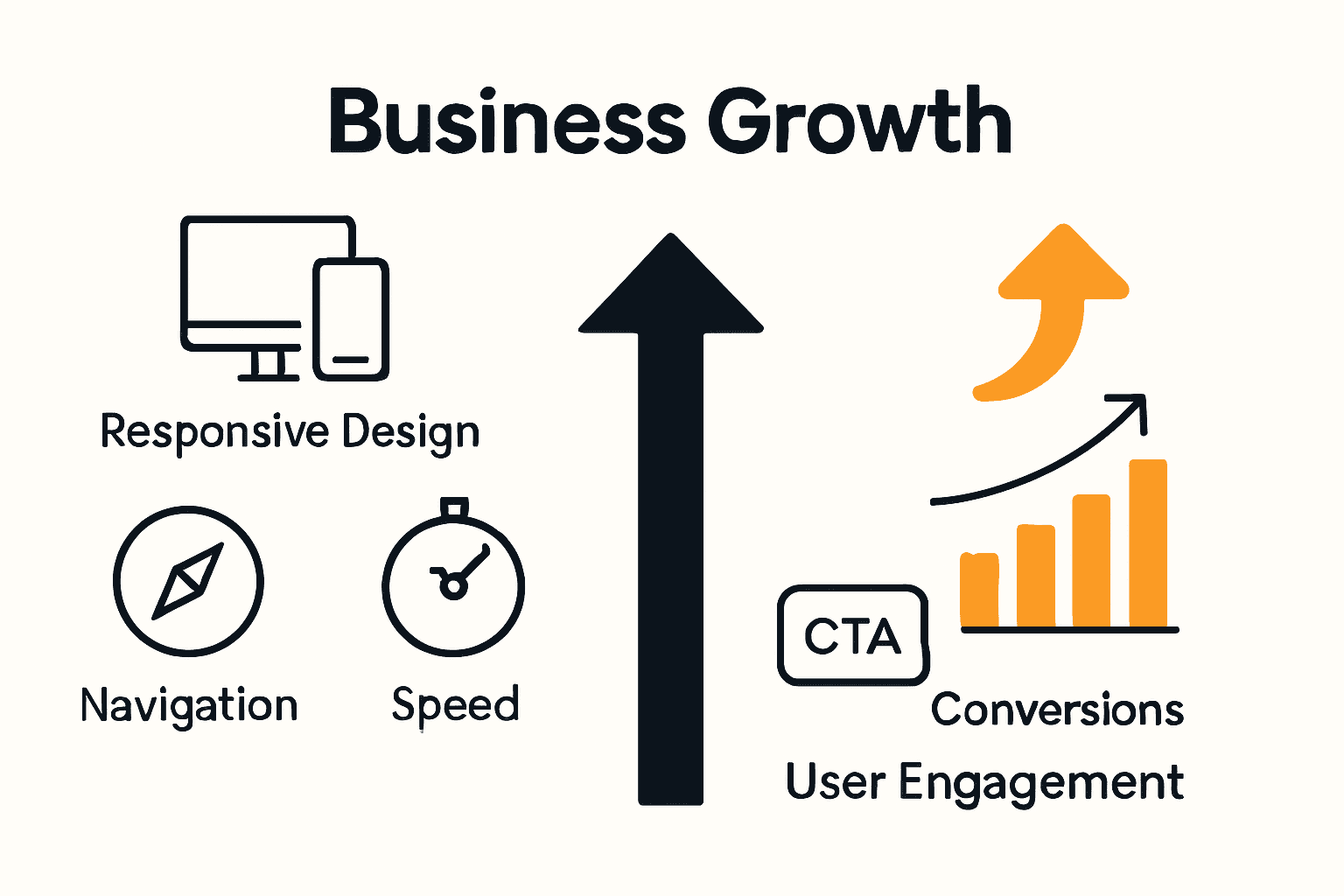 A well-designed website doesn’t just look good — it strategically guides potential customers through a journey of discovery, engagement, and conversion, ultimately driving tangible business growth by transforming website visitors into loyal customers.

Integrating Automation and Marketing Systems
According to Stanmore School of Business, web development has become a critical pathway for improving operational efficiency through strategic marketing system integration. Modern websites are no longer passive digital brochures, but dynamic platforms that actively streamline business processes, automate critical tasks, and create seamless communication channels between businesses and their customers.
The integration of automation and marketing systems transforms how businesses interact with their audience. University of Florida’s College of Journalism and Communications emphasizes the importance of interactive elements that facilitate direct user engagement. These sophisticated systems enable businesses to:
- Capture Lead Information: Automatically collect and segment potential customer data
- Personalize User Experiences: Deliver targeted content based on user behavior
- Streamline Communication: Implement chatbots and automated response systems
- Track Customer Journey: Monitor and analyze user interactions in real-time
- Automate Marketing Workflows: Create intelligent, responsive marketing campaigns
By strategically combining website functionality with advanced automation tools, businesses can create a powerful digital ecosystem that works continuously to attract, engage, and convert potential customers.
Website Optimization Guide and Strategies demonstrates that successful integration is not just about technology, but about creating intelligent systems that adapt and respond to your unique business needs.
Common Mistakes Limiting Website ROI
According to Candamo Technology Consulting, poor user experience is a critical factor that dramatically limits a website’s return on investment. Non-intuitive interfaces and complex navigation create significant barriers that prevent potential customers from engaging with your brand, effectively turning away valuable business opportunities.
The University of Florida’s College of Journalism and Communications emphasizes that neglecting key web design aspects can severely impact a website’s effectiveness. Website Design Tips for Business Growth reveals the most common mistakes businesses make that restrict their online potential:
- Slow Loading Speeds: Losing potential customers due to technical inefficiencies
- Non-Responsive Design: Failing to provide seamless experiences across devices
- Complicated Navigation: Creating user frustration and high bounce rates
- Weak Call-to-Action: Missing opportunities to guide user interactions
- Inconsistent Brand Messaging: Diluting brand identity and user trust
These pitfalls transform websites from potential revenue generators into digital roadblocks. Successful businesses understand that a website is more than a digital placeholder — it’s a sophisticated marketing tool that requires continuous optimization, strategic design, and a laser focus on delivering exceptional user experiences that convert visitors into loyal customers.
Unlock Your Website’s True Potential for Business Growth
Many businesses struggle with creating a website that truly drives growth instead of just existing online. This article highlights key challenges such as poor user experience, ineffective lead generation, and the lack of automation that can stunt your website’s ability to convert visitors into loyal customers. Recognizing that a website must be more than just visually appealing but a strategic tool is critical to attracting and engaging your ideal audience.
At Lind Creative, we specialize in building high-converting websites that blend creativity, technology, and strategy to solve those exact pain points. By integrating your site with powerful marketing systems and implementing features like responsive design and intuitive navigation, we help you transform your online presence into a true growth engine. Learn more about cutting-edge approaches in our Web Development – Lind Creative category.
Explore the latest industry insights that shape digital success in our Industry Trends – Lind Creative section to stay ahead in a competitive market. Whether you are launching a new brand or ready to scale, our signature Growth Engine automates lead capture, funnels, emails, and ads to deliver measurable results and real ROI.
Eager to turn your website into a powerful asset that consistently attracts, engages, and converts?
Visit Lind Creative today to start your journey. Connect with us now to create a strategic, performance-driven website that works for your business around the clock.
Frequently Asked Questions
What is the role of a website in business growth?
A website acts as a central platform for brand presence, driving customer engagement, lead generation, sales conversion, and effective communication, ultimately contributing to overall business growth.
Why is it important to optimize a website continuously?
Continuous optimization ensures that your website remains competitive, engaging, and user-friendly. This includes updating content, enhancing functionality, and improving user experience according to evolving market trends and customer needs.
What are the key features that make a website effective for businesses?
Key features include responsive design, intuitive navigation, fast loading speed, compelling calls-to-action, and mobile optimization, all of which create a seamless user experience that supports business goals.
How can automation enhance the effectiveness of a business website?
Automation improves communication and operational efficiency by capturing lead information, personalizing user experiences, streamlining workflows, and tracking customer interactions, allowing businesses to engage with their audience more effectively.
Recommended
- 7 Essential Website Design Checklist Steps for Business Growth – Lind Creative
- 7 Essential Business Website Must-Haves for Strong Growth – Lind Creative
- 7 Essential Types of Business Websites and How to Use Them – Lind Creative
- 7 Essential Website Design Tips for Business Growth Success – Lind Creative