
Many marketing managers face pushback about remarketing, often hearing concerns that it feels repetitive or only benefits the largest brands. For established American eCommerce businesses, these myths can stall smart strategies that drive real growth. This guide cuts through common misconceptions, highlights data-driven remarketing techniques, and clarifies how ethical, compliant approaches convert missed opportunities into measurable sales gains.
Table of Contents
- Defining Remarketing And Common Misconceptions
- Types Of Remarketing For eCommerce Brands
- How Remarketing Campaigns Actually Work
- Legal Considerations And Data Compliance
- Avoiding Common Remarketing Mistakes
Key Takeaways
| Point | Details |
|---|---|
| Understanding Remarketing | Remarketing is a strategic way to re-engage potential customers by delivering targeted ads based on their previous interactions with a brand. |
| Common Misconceptions | Many believe remarketing is simply annoying advertising, but it leverages data-driven strategies to understand and address customer behaviors. |
| Types of Remarketing | eCommerce brands can use various remarketing strategies, such as standard retargeting, dynamic retargeting, email remarketing, and search remarketing, to recover sales opportunities. |
| Legal Compliance | Brands must ensure robust legal frameworks regarding data privacy and consent to avoid risks and enhance customer trust in their remarketing efforts. |
Defining Remarketing And Common Misconceptions
Remarketing represents a strategic approach for recovering lost sales opportunities in eCommerce by re-engaging potential customers who have previously interacted with a brand’s website or digital platforms. At its core, remarketing is about delivering targeted advertisements to individuals who have already demonstrated interest in a product or service, but did not complete a purchase.
Understanding remarketing requires dispelling several prevalent misconceptions. Many business owners incorrectly assume remarketing is simply repetitive advertising, when in reality, it involves sophisticated, data-driven strategies that strategically target consumer behaviors. Key misconceptions include:
- Believing remarketing is intrusive or annoying
- Thinking remarketing only works for large enterprises
- Assuming all remarketing campaigns produce identical results
- Expecting immediate conversions from every campaign
Remarketing actually leverages advanced tracking technologies and consumer psychology to create personalized re-engagement experiences. The fundamental goal is not just to remind customers about abandoned products, but to understand and address the underlying reasons why they did not complete their original transaction.
Consumer behavior research reveals that remarketing campaigns can significantly increase conversion rates when executed strategically. Successful approaches involve:
- Segmenting audience groups based on specific interaction patterns
- Creating personalized messaging that addresses potential purchase barriers
- Utilizing dynamic product recommendations
- Implementing time-sensitive incentives
Pro tip: Develop a remarketing strategy that focuses on providing value rather than pure sales pressure, using data-driven insights to craft compelling, customer-centric messaging.
Types Of Remarketing For eCommerce Brands
Ecommerce brands have multiple remarketing strategies at their disposal, each designed to re-engage potential customers through targeted approaches. Remarketing techniques vary in complexity and targeted consumer engagement, providing brands with flexible options to recover lost sales opportunities.
The primary types of remarketing for eCommerce brands include:
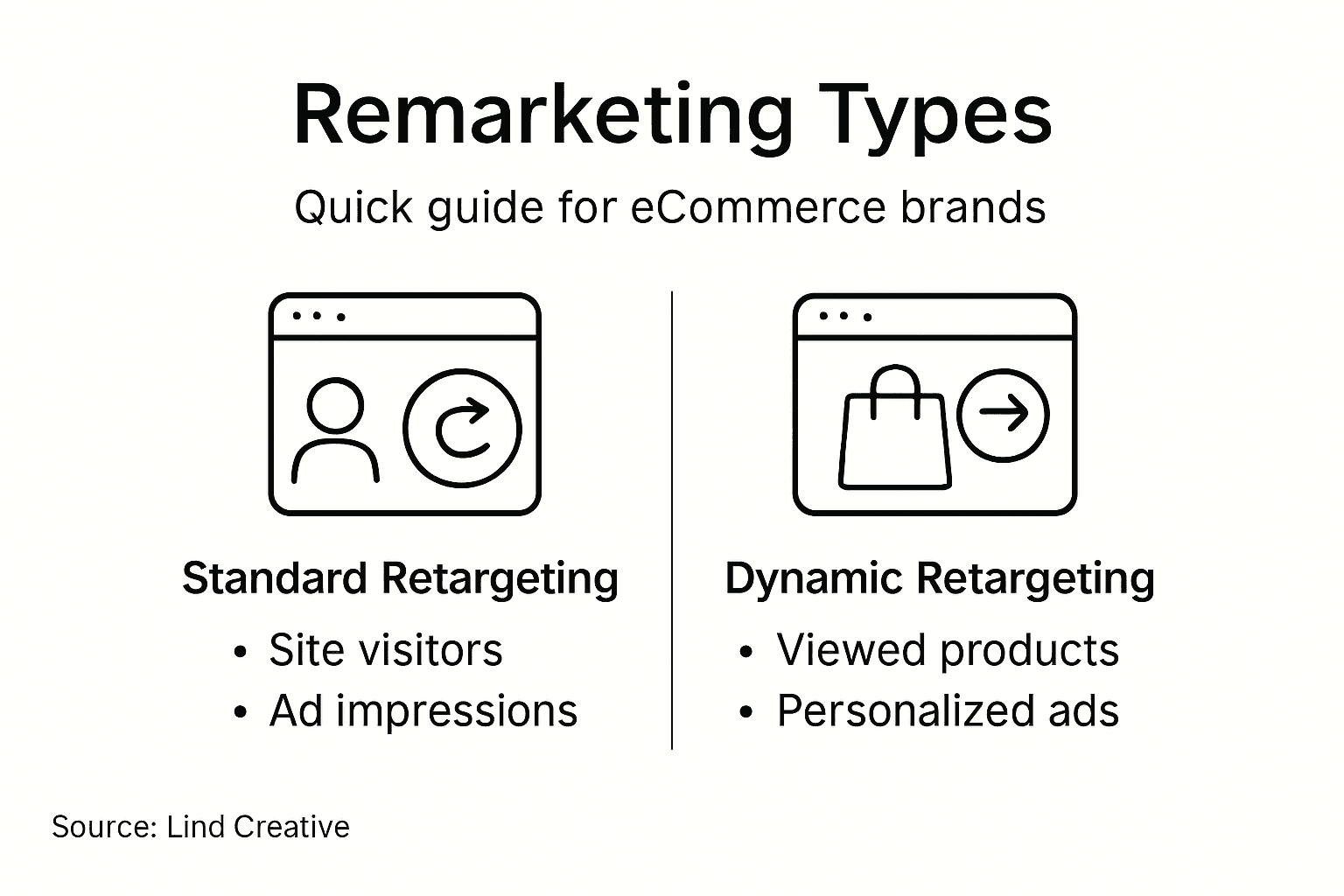
- Standard Retargeting: Displaying ads to users who previously visited your website but did not complete a purchase
- Dynamic Retargeting: Showing personalized product ads based on specific items a user viewed during their website session
- Email Remarketing: Targeting customers through email campaigns featuring abandoned cart items or personalized product recommendations
- Search Remarketing: Displaying targeted ads to users who have previously searched for specific products related to your brand
Each remarketing approach offers unique advantages in reconnecting with potential customers. Dynamic retargeting, for instance, allows brands to create highly personalized advertisement experiences that directly showcase products a user has already demonstrated interest in purchasing.
Remarketing Channel Strategies involve understanding the nuanced differences between these approaches:
Here’s a summary of remarketing strategies and their ideal use cases:
| Strategy Type | Typical Application | Business Benefit |
|---|---|---|
| Standard Retargeting | Broad visitor re-engagement | Increases brand recall |
| Dynamic Retargeting | Personalized product recommendations | Boosts conversion rates |
| Email Remarketing | Direct follow-ups for cart abandonments | Strengthens customer relationships |
| Search Remarketing | Targets users with purchase intent | Maximizes ad relevance |
- Standard retargeting works best for broad audience re-engagement
- Dynamic retargeting excels in personalized product recommendations
- Email remarketing provides direct communication with interested customers
- Search remarketing targets users with demonstrated purchase intent
Successful remarketing requires a strategic blend of multiple approaches, tailored to your specific audience and product offerings.
Pro tip: Combine multiple remarketing strategies and continuously test different messaging to optimize your conversion rates and customer re-engagement efforts.
How Remarketing Campaigns Actually Work
Remarketing campaigns operate through sophisticated digital tracking mechanisms that enable brands to re-engage potential customers with precision. Tracking technologies capture anonymous visitor data by placing a small piece of code called a pixel on a website, which monitors user interactions and browsing behaviors.
The technical process of remarketing involves several critical steps:
- Tracking Website Visitors: Identifying users who have interacted with specific pages or products
- Audience Segmentation: Categorizing visitors based on their browsing patterns and engagement levels
- Ad Platform Integration: Connecting visitor data with advertising networks
- Targeted Ad Creation: Developing personalized advertisements matching user interests
When a user visits an eCommerce website, the tracking pixel quietly collects data about their browsing session. This data allows marketers to create highly targeted advertising experiences that re-engage potential customers across multiple digital platforms.
Remarketing Workflow Components include:
- Install tracking pixel on website
- Collect anonymous user interaction data
- Create audience segments
- Design personalized ad creatives
- Deploy ads across multiple digital channels
Effective remarketing transforms casual website visitors into potential customers through strategic, data-driven advertising approaches.
Pro tip: Configure your tracking pixels to capture granular user interaction data, enabling more precise audience segmentation and personalized remarketing strategies.

Legal Considerations And Data Compliance
Navigating the complex landscape of data privacy and digital marketing requires eCommerce brands to carefully understand and implement robust legal frameworks for remarketing campaigns. Comprehensive legal guidelines protect consumer privacy and establish critical boundaries for data collection and advertising practices.
Key legal considerations for remarketing campaigns include:
- Consent Requirements: Obtaining explicit user permission for data tracking
- Transparency Obligations: Clearly communicating data collection practices
- Data Protection Standards: Implementing secure storage and management protocols
- Age-Specific Restrictions: Protecting minors’ data and avoiding inappropriate targeting
The regulatory environment for digital marketing continues to evolve, with increasing scrutiny on how businesses collect, store, and utilize consumer data. Marketers must remain vigilant about potential legal risks associated with remarketing strategies, ensuring full compliance with federal and state regulations.
Critical Compliance Dimensions for remarketing include:
This quick comparison shows how legal compliance impacts remarketing outcomes:
| Compliance Focus | Impact on Campaigns | Long-term Business Value |
|---|---|---|
| Consent Management | Builds user trust | Reduces regulatory risk |
| Transparent Practices | Improves customer confidence | Enhances reputation |
| Secure Data Storage | Prevents data breaches | Protects brand integrity |
| Age-specific Protections | Safeguards minors | Ensures responsible marketing |
- Implementing clear opt-out mechanisms
- Maintaining detailed records of user consent
- Protecting personally identifiable information
- Avoiding deceptive advertising practices
- Regularly auditing data collection processes
Digital marketing success requires a delicate balance between effective targeting and respecting consumer privacy rights.
Pro tip: Consult with a legal professional specializing in digital privacy to develop a comprehensive compliance strategy that protects both your business and your customers.
Avoiding Common Remarketing Mistakes
Remarketing strategies can quickly become ineffective or counterproductive when brands fail to understand nuanced consumer behaviors and technical limitations. Maintaining ethical marketing practices is crucial for creating successful remarketing campaigns that respect user experience and build long-term customer trust.
Common remarketing mistakes that can derail your advertising efforts include:
- Excessive Frequency: Bombarding users with repetitive advertisements
- Poor Audience Segmentation: Targeting irrelevant or uninterested customer groups
- Neglecting Ad Creative: Using generic, unengaging marketing materials
- Ignoring Performance Metrics: Failing to analyze and adjust campaign strategies
- Privacy Violations: Disregarding data protection and consent requirements
Successful remarketing demands a sophisticated approach that balances technological capabilities with consumer privacy expectations. Brands must carefully craft strategies that feel personalized and helpful rather than intrusive or aggressive.
Key Strategies to Prevent Remarketing Failures:
- Implement strict frequency capping
- Develop highly specific audience segments
- Create dynamic, personalized ad content
- Regularly audit campaign performance
- Maintain transparent data collection practices
Effective remarketing is about building relationships, not just generating immediate sales.
Pro tip: Develop a comprehensive remarketing strategy that prioritizes user experience, respects privacy boundaries, and provides genuine value to potential customers.
Unlock Your eCommerce Potential with Strategic Remarketing Solutions
The article highlights how remarketing is essential for recovering lost sales and building meaningful connections with your website visitors. If you are facing challenges like low conversion rates, ineffective audience segmentation, or lack of personalized messaging, these pain points call for a smarter, data-driven approach. Remarketing is not just about repetitive ads but about strategically re-engaging customers by leveraging dynamic retargeting, email marketing, and precise audience insights to boost conversions and customer loyalty.
At Lind Creative, we understand the critical need to blend creativity with technology and strategy to deliver remarketing campaigns that work. Through our signature Growth Engine and custom digital marketing solutions, we help businesses capture leads, automate relevant ads, and build customer relationships that drive real growth. Our collaborative process ensures your brand not only stands out visually but also performs at the highest level.
Ready to elevate your remarketing game and grow your eCommerce business now?

Explore how our full-service digital agency approach can transform your marketing. Visit Lind Creative to discover how we build high-converting websites and powerful brand identities designed for results. Learn more about our strategy-driven marketing and start reclaiming lost sales with purpose today.
Frequently Asked Questions
What is remarketing in eCommerce?
Remarketing in eCommerce is a strategy designed to re-engage potential customers who have previously interacted with a brand’s website but did not complete a purchase. It involves displaying targeted ads to these individuals to remind them of the products or services they showed interest in.
How does dynamic retargeting differ from standard retargeting?
Dynamic retargeting shows personalized product ads to users based on specific items they viewed on your website, while standard retargeting displays general ads to users who visited your site but didn’t convert. Dynamic retargeting creates a more tailored experience by featuring products that users have already shown interest in.
What are some common mistakes to avoid in remarketing campaigns?
Common mistakes include bombarding users with excessive ads, poor audience segmentation, using unengaging ad creatives, ignoring performance metrics, and violating privacy regulations. Avoiding these pitfalls is essential for creating effective and respectful remarketing efforts.
How can I ensure compliance with data privacy laws in my remarketing strategies?
To ensure compliance, businesses should obtain explicit user consent for data tracking, maintain transparency regarding data collection practices, implement secure data storage protocols, and adhere to age-specific restrictions to protect minors’ information.
Recommended
- Growth Marketing for eCommerce – Driving Scalable ROI – Lind Creative
- How to Optimize Website Conversions for eCommerce Success – Lind Creative
- Content Creation Workflow for eCommerce ROI Success – Lind Creative
- 7 Essential Ecommerce Website Design Tips for Growth – Lind Creative
- How to Boost Ecommerce Traffic: Proven Strategies for 2025 – Paul Baguley