
Choosing the right approach to value proposition often separates thriving American luxury hospitality brands from those struggling to capture discerning guests. Strong value propositions are more than slogans. They are strategic statements that clarify unique benefits and foster authentic customer engagement. By understanding differentiation, personalized experiences, and meaningful communication, marketing directors can attract and retain high-value clientele. Explore how a bold, customer-centric value proposition becomes the foundation for better loyalty and conversion in the United States hospitality sector.
Table of Contents
- Core Definition And Common Misconceptions
- Major Types Of Value Propositions In Hospitality
- Essential Elements For Strong Customer Appeal
- Crafting And Communicating Your Value Proposition Effectively
- Pitfalls Luxury Brands Should Avoid
Key Takeaways
| Point | Details |
|---|---|
| Importance of Value Proposition | A well-defined value proposition clearly communicates the unique benefits a company offers, differentiating it from competitors. |
| Types in Luxury Hospitality | Key value propositions like personalized service and sustainability commitments create meaningful customer experiences. |
| Customer-Centric Strategy | Successful value propositions focus on customer needs and emotional resonance rather than just product features. |
| Avoiding Common Pitfalls | Luxury brands must avoid superficial personalization and greenwashing to maintain authenticity and trust with consumers. |
Core Definition and Common Misconceptions
A value proposition is a strategic marketing statement that communicates the unique benefits a company offers its customers. Highlighting core economic value, this powerful concept explains precisely why customers should choose one brand over another.
Understanding the core definition requires recognizing several critical components:
- A clear description of the specific value delivered
- Differentiation from competitor offerings
- Tangible and intangible benefits for customers
- A compelling reason to select your product or service
Many organizations misunderstand value propositions, treating them as generic marketing statements rather than strategic positioning tools. Marketing research reveals that effective value propositions evolve from goods-dominant to service-dominant logic, emphasizing customer engagement and collaborative value creation.
Common misconceptions about value propositions include:
- Believing a value proposition is just a slogan
- Focusing solely on product features instead of customer benefits
- Creating propositions from the company’s perspective, not the customer’s
- Failing to communicate unique differentiation
Effective value propositions transcend simple descriptions. They serve as strategic frameworks that articulate why customers should invest their time, attention, and money in a specific offering.
Pro tip: Develop your value proposition by interviewing actual customers and understanding their deepest needs and pain points.
Major Types of Value Propositions in Hospitality
In the competitive luxury hospitality landscape, value propositions have evolved far beyond simple service offerings. Hospitality industry trends reveal sophisticated approaches that transform customer experiences through targeted strategic positioning.
The primary types of value propositions in hospitality include:
- Personalized Service Experience: Creating tailored interactions that make guests feel uniquely valued
- Digital Enhanced Convenience: Integrating technology to streamline booking, check-in, and guest services
- Sustainability Commitment: Demonstrating ethical practices that resonate with environmentally conscious travelers
- Culinary Innovation: Offering unique dining experiences that go beyond traditional meal services
Restaurant industry research highlights several specific value proposition strategies that luxury hospitality brands can leverage:
- Loyalty and rewards programs
- Flexible pricing models
- Tech-enabled convenience platforms
- Themed dining and experience packages
- Off-peak service discounts
Modern hospitality value propositions recognize that customers seek more than transactional interactions. They want meaningful experiences that align with their personal values, technological expectations, and desire for authentic, personalized engagement.

The table below compares major value proposition types in luxury hospitality and their strategic business impacts:
| Value Proposition Type | Key Business Benefit | Example Implementation |
|---|---|---|
| Personalized Service | Builds lasting guest loyalty | Custom welcome amenities |
| Digital Enhanced Convenience | Increases operational efficiency | Mobile check-in and digital keys |
| Sustainability Commitment | Attracts eco-conscious travelers | Green certifications |
| Culinary Innovation | Differentiates brand identity | Chef-driven tasting menus |
Successful value propositions transform service from a commodity into a memorable, distinctive journey that exceeds customer expectations.
Strategic differentiation now demands that hospitality brands move beyond traditional service models. By crafting nuanced, multi-dimensional value propositions, luxury hotels can create compelling narratives that attract and retain discerning guests.
Pro tip: Conduct regular customer interviews to continuously refine and evolve your hospitality value proposition, ensuring it remains relevant and compelling.
Essential Elements for Strong Customer Appeal
Effective value propositions demand a strategic approach that goes beyond simple marketing messaging. The most compelling customer appeals are carefully crafted to address specific customer needs, challenges, and aspirations.
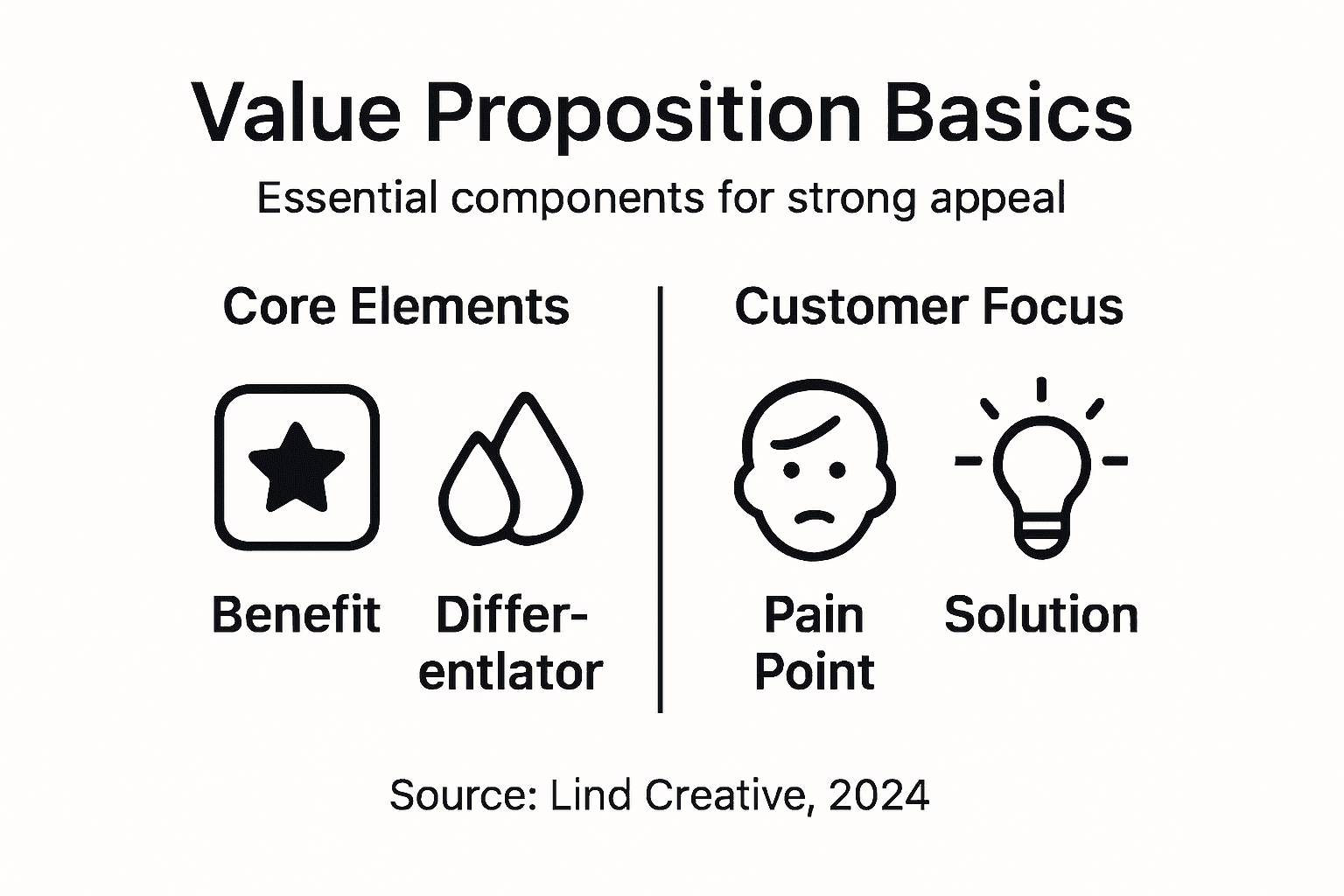
The essential elements for creating strong customer appeal include:
- Clear Communication: Articulating value in straightforward, meaningful language
- Customer-Centric Focus: Demonstrating deep understanding of target audience needs
- Unique Differentiation: Highlighting what sets the offering apart from competitors
- Emotional Resonance: Creating connections that transcend transactional interactions
Customer value research reveals several critical components that transform a basic value proposition into a powerful customer attraction strategy:
- Identify precise target audience characteristics
- Map specific customer pain points
- Develop solutions that directly address those challenges
- Communicate benefits more prominently than features
- Align offering with customer’s deeper values and aspirations
Successful value propositions are not about selling a product, but about solving a customer’s fundamental problem in a uniquely compelling way.
The most sophisticated value propositions go beyond surface-level descriptions. They create a narrative that positions the brand as an essential solution to the customer’s most pressing challenges, transforming traditional marketing approaches into meaningful engagement.
Strategic Alignment requires continuous refinement, understanding that customer needs constantly evolve. Brands must remain agile, regularly reassessing and recalibrating their value propositions to maintain relevance and emotional connection.
Pro tip: Conduct quarterly customer insight sessions to ensure your value proposition remains dynamically aligned with changing market expectations and customer desires.
Crafting and Communicating Your Value Proposition Effectively
Strategic value proposition development requires a systematic approach that transforms customer insights into compelling market positioning. The most successful brands understand that effective communication is not about broadcasting features, but creating meaningful connections that resonate deeply with target audiences.
The key steps for crafting a powerful value proposition include:
- Customer Understanding: Conducting thorough research to map precise customer needs
- Pain Point Identification: Uncovering specific challenges customers experience
- Solution Mapping: Developing targeted solutions that directly address those challenges
- Emotional Alignment: Creating messaging that connects beyond transactional interactions
Marketing communication strategies reveal critical components for effective value proposition communication:
- Leverage data analytics for consumer insights
- Use digital platforms for broader engagement
- Create clear, concise messaging
- Demonstrate unique brand differentiation
- Continuously refine based on customer feedback
Exceptional value propositions transform complex offerings into simple, compelling narratives that customers can immediately understand and appreciate.
Successful communication requires moving beyond generic statements. Brands must craft narratives that not only explain what they offer but why it matters profoundly to their specific audience. This demands a deep understanding of customer motivations, aspirations, and underlying emotional drivers.
Strategic Storytelling becomes the bridge between product features and customer desires. By translating technical capabilities into meaningful personal benefits, brands can create powerful, memorable connections that transcend traditional marketing approaches.
Pro tip: Conduct monthly customer feedback sessions to continuously validate and refine your value proposition, ensuring it remains dynamically aligned with evolving market expectations.
Pitfalls Luxury Brands Should Avoid
Luxury brand positioning requires nuanced understanding of potential strategic missteps that can dramatically undermine brand perception and customer loyalty. The most sophisticated luxury brands recognize that avoiding common pitfalls demands continuous adaptation and deep customer insight.
Key pitfalls luxury brands must carefully navigate include:
- Superficial Personalization: Creating generic experiences that feel inauthentic
- Sustainability Performative Messaging: Making claims without substantive action
- Generational Disconnect: Failing to understand evolving consumer expectations
- Overemphasis on Product: Prioritizing possession over meaningful experiences
Sustainable luxury strategies reveal critical areas where brands frequently stumble:
- Ignore younger consumers’ ethical expectations
- Compromise brand exclusivity through poor sustainability integration
- Utilize superficial greenwashing tactics
- Disconnect brand heritage from contemporary values
- Neglect transparency in environmental practices
Authentic luxury transcends mere product offering; it represents a holistic commitment to values, experiences, and meaningful customer connections.
Successful luxury brands understand that avoiding pitfalls requires more than defensive strategies. They proactively create experiences that anticipate and exceed customer expectations, transforming potential weaknesses into opportunities for deeper engagement.
Here is a summary of common pitfalls in luxury brand value propositions and proactive solutions:
| Pitfall | Negative Outcome | Proactive Solution |
|---|---|---|
| Superficial Personalization | Erodes customer trust | Invest in genuine guest data usage |
| Greenwashing | Damages brand authenticity | Adopt verifiable practices |
| Generational Disconnect | Declining relevance with youth | Launch targeted engagement forums |
| Overemphasizing Product | Reduced emotional engagement | Focus on experiential moments |
Strategic Vulnerability becomes a powerful differentiator. By acknowledging limitations and demonstrating genuine commitment to improvement, luxury brands can build trust that supersedes traditional marketing approaches.
Pro tip: Establish a cross-generational advisory board to continuously challenge internal assumptions and maintain authentic brand relevance.
Elevate Your Value Proposition with Strategy-Driven Branding and Marketing
Many businesses struggle to clearly communicate their unique value and connect emotionally with their customers as highlighted in the article “What Is Value Proposition and Why It Matters.” If you find your value proposition lacks clear differentiation or fails to resonate, you are not alone. Common challenges include superficial personalization, generic messaging, and the inability to transform features into meaningful customer benefits. These pain points can leave your brand overlooked in today’s competitive digital landscape.
Lind Creative specializes in turning complex value propositions into compelling brand stories that attract and engage your ideal audience. Our full-service digital agency blends creativity, technology, and strategy to help you craft a customer-centric value proposition that drives real growth. Whether you want to launch a new brand or refresh your existing presence, our signature Growth Engine combines high-converting websites and automated marketing systems to convert leads into loyal customers.
Don’t let a weak value proposition hold your business back. Discover how to communicate your unique strengths with clarity and confidence. Visit Lind Creative today and take the first step toward building a powerful brand identity that truly matters. Learn more about how our strategy-driven design and marketing can give you the competitive edge and turn your value proposition into your greatest asset.
Frequently Asked Questions
What is a value proposition?
A value proposition is a strategic marketing statement that communicates the unique benefits a company offers its customers, explaining why they should choose one brand over another.
Why is a value proposition important for businesses?
A strong value proposition helps differentiate a brand from its competitors, articulating its unique benefits and value that resonate with target customers, which ultimately drives customer loyalty and sales.
How can businesses create an effective value proposition?
Businesses can create an effective value proposition by conducting customer interviews to understand their needs and pain points, defining clear benefits, and communicating unique differentiators in straightforward language.
What are common misconceptions about value propositions?
Common misconceptions include treating value propositions as mere slogans, focusing on product features instead of customer benefits, and failing to communicate unique differentiation from competitors.
Recommended
- Brand Positioning Explained: Strategies, Types, and Impact – Lind Creative
- The Essential Guide to Investing in Branding – Lind Creative
- Brand Strategy Explained: Key Elements and Impact – Lind Creative
- Role of Branding in Business Success Today – Lind Creative